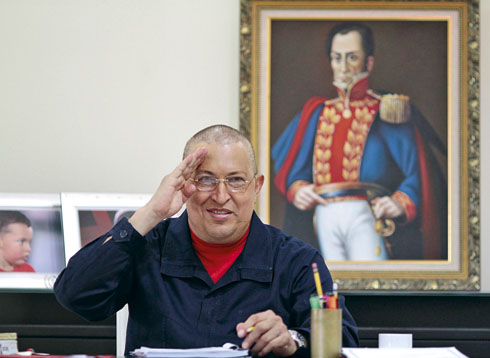
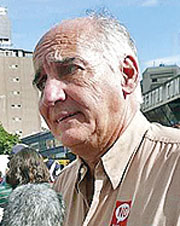
Hugo Chavez announces on national television about the successful passage of the second year of chemotherapy. In the background - a portrait of Simon Bolivar
Red and yellow. The President of Venezuela Hugo Chavez, whose cancer was discovered two months ago, first appeared in public not in the usual red, but in the yellow T -shirt. And then he gave an explanation to the perplexing fellow citizens: “Why do we all must wear red and constantly use the word“ socialism ”? These guys who put on even red panties are extremely suspicious. ” What is happening with the leader, who had just stunned world markets with the intention of nationalizing the gold mining industry, and whether he will re -elect in 2012 - he tried to understand The New Times
After Chavez found out about his deadly disease, he markedly lowered the degree of political impromptu. The president stopped ending his speeches by the slogan “Homeland, Socialism or Death!” Borrowed at Cuba, replacing it at a more suitable moment to “survive and win!” Nevertheless, it is a cube today for Chavez is literally a vital country. Although Vladimir Putin offered Hugo Chavez the help of Russian doctors, he chose Cuba for the treatment, where he had already passed two courses of chemotherapy. Cube Chavez is closer, and not only geographically. Not only is there a high -class elite medicine for foreigners on the island - the Cuban authorities gave the Venezuelan leader a hundred percent guarantee: there will be no leaks on the true state of health of Chavez.
"Second president"
On August 13, in Havana, Chavez was present at the 85th anniversary of his close friend Fidel Castro. He once saw in the Venezuelan president not just a like -minded person who understands him at a glance. For the aging “commandant of the revolution”, Chavez became a kind of political successor who could continue his work - to become at the forefront of the struggle for the ideas of socialism on a planetary scale. Thus, the famous Kubinsky writer and dissident Carlos Alberto Montaner claims that in the middle of the “zero” years Fidel and Chavez came to the conclusion: it is possible to survive in the fight against imperialism only by creating a single state of Cuba and Venezuela.
“Fidel was fully aware that his younger pragmatic brother Raul would not go to such an adventure,” Montuner explains in a conversation with The New Times. - But Chavez will like this idea. Somewhere in the beginning of 2005, it was decided to begin preparations for the merger of the two countries, and in the shortest possible time. The commissions on the development of the “integration plan” Cuba and Venezuela were already approved. And at the end of the same year, two high -ranking officials of the Cuban government, the deputy chairman of the State Council Carlos Lahe and Foreign Minister Felipe Perez Rock, publicly supported this idea. “Hugo Chavez is our second president,” Lahe said then.
However, the “historical” plan was not destined to come true. Fidel is serious
He fell ill and was forced to retire, in the spring of this year already officially transferring the party and state helm of Raul (see The New Times No. 15 of 04/25/2011). And the very bold statement by Lahe about the “second president” caused a storm of indignation on the island, especially among army officers who considered such a plan a betrayal. And very soon both Carlos Lahe and Rock were removed from their posts and unclenched into “ordinary”: Raul Castro, who took power in the country, could not afford to have competitors nearby, even if they were favorites of the Cuban “National Leader”.
Control from the outside
Despite the failure of the association, the leaders of Cuba and Venezuela retained the closest relationship. Venezuela continues to be the main donor of Cuba, supplying it for almost free 60% of the oil to the country, and in general, subsidies to the island are $ 5 billion a year. In turn, Cuba maintains influence on the Presidential Palace of Miraflores in Karakas, using an extensive network of special services agents introduced into each ministry, and above all, the defense and safety of Venezuela. “It was Fidel who persuaded Chavez to be treated in Havana,” Montuner explains. - Thus, the Cuban regime not only holds Chavez’s life in his hands, but also controls the political future of Venezuela. And this control should not be lost, even if Chavez leaves the brave world due to illness. ” The loss of oil -free Venezuela will become a disaster for the brothers.
New image
At the end of July, after the first course of chemotherapy in Cuba, Chavez returned to his homeland lively and confident, as if nothing terrible was happening. On July 28, on the day of his 57th anniversary, he cheerfully danced on the balcony of the Palace of Miraflores along with one of his daughters, periodically wrapping himself in the national flag. “I invite you all to come and celebrate my 77th birthday,” Chavez shouted from the balcony of the thousands of thousands gathered at the palace. “I'm not going to leave my post until 2021, and maybe until 2031.” "Chavez will not go anywhere!" - the enthusiastic people chased in response.
However, a few days later, the president shocked the nation, appearing on the television screenshot on his head. “This is my new image,” Chavez said for some reason in English. And he added already in his own, Spanish: he, they say, warned the audience in advance that his hair would begin to fall out of chemotherapy. And last week, after the second year of chemotherapy, Chavez seemed to put on his head a crab beret on his head - there is no hair left at all. In addition, the weight of Chavez, as journalists in Karakas found out from an unnamed source in the presidential environment, during the disease has already decreased by 20 kg - from 104 to 84 kg. And although the president is still trying to stay vigorously (“All the systems of my body work normally,” Chalshiya assured the Council last week), Venezuens are added to the Venezuens every day: if the president declares that he no longer has cancer cells after the first chemotherapy, then where did such a reduction in weight and the rapid hair loss? “The authorities secretly keep information about what kind of cancer the Chavez is, but he himself makes it clear to everyone that his condition is difficult,” the famous Venezuelan publicist and political scientist Moisyes notes in a conversation with The New Times. - And this has already led to a fierce political conflict in Venezuela. True, not yet between the authorities and the opposition, but between the various fractions of the “Chavists” themselves, which began a fierce battle for who will become the successor of the leader. ”
Who is new
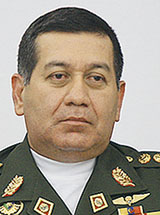
A historically important factor in the struggle for power in Venezuela is the position of the army. But now the country's armed forces are also split. One of the largest army groups, explains to the toe, heads the Favorite of the president, 50-year-old General Henry Ranhel Silva, head of the operational strategic command (OSK). In 2008, the United States included Sylva in the black list of people “financially supporting drug trafficking”. The same general publicly stated that the army would not tolerate the opposition, even if it wins the 2012 elections. Another influential group is represented by senior officers closely related to Cuban intelligence. “There are almost no ideological differences between them, disagreements only in personalities,” explains to the nam. “But this is enough for a military coup.”
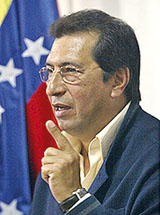
Adan Chavez, 58 years old, Governor of the state Barinas
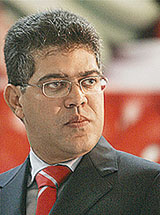
Elias Haua, 42 years old, vice president
Henri Ranhal Silva, 50 years old, head of the operational strategic command (OSK)
Representatives of the so -called Bolivarian bourgeoisie are now trying to level the growing influence of army clans - this is, in fact, the third backbone of the regime. We are talking about entrepreneurs who got rich due to their proximity to power and, in particular, to armed forces. Sources of this wealth can be different - from drug trafficking to “sawing” budget money allocated for the purchase of weapons in Russia and Belarus, tractors in Iran, chickens in Brazil.
In the camp of the closest assistants of Chavez, a 42-year-old Vice President Elias Haua stands out, to whom the leader delegates part of his powers during the course of treatment in Cuba. Haua is extremely loyal to Chavezu and calls himself a representative of the “radical civilian wing” of the ruling Unified Socialist Party (another high -ranking representative of the regime - Foreign Minister Nicholas Maduro adjoins this wing). Haua is one of the likely candidates for the highest post in the country, if Chavez is ahead of schedule from the political arena.
Separately, the family clan of the president himself stands, in which the figure of the elder brother, 58-year-old Adan Chavez, ex-email in Cuba, now the Governor of the state of Barinas, stands out. However, he does not have a part of the leader’s charisma, and his mental abilities can be judged by a publicly spoken phrase: “It will be unforgivably limited only by electoral resources and not resort to other methods that include armed struggle.” According to rumors, it was Adan who told his brother the idea to translate the Venezuela gold and foreign exchange reserve to Russia (the statement of this Hugo Chavez did on August 18. - The New Times), insuring the “family” from possible political upheavals.
And what about the opposition? According to Moses Naima, it is represented primarily by a “energy” student, intellectuals, politicians and entrepreneurs who are not related to the regime. Among the opposition there are also prominent figures, such as the mayor of Karakas Antonio Ledesm, Governor of Miranda, one of the most developed Venezuelan provinces, Enrique Kapriel Radonsky. However, the political influence of the opposition is limited, speaks to the toe. And with irony adds: “She (opposition) does not have weapons, hired killers and sufficient amounts of money for real participation in the struggle for power.”
Change of slogans
“Chavez in Yellow” has recently declared intention to improve relations with the middle class, with representatives of the private sector. “We need middle class, its participation is necessary for the implementation of all political projects of the country,” he says. At the same time, in an interview with local television, Chavez admitted that the disease "changed" him, "expanded his worldview." What happens to the president? “The disease makes Chavez moderate,” writes the Spanish newspaper El Pais. There is no amazing one - fatal ailments change the priorities of politicians and cool their passions. But! In this case, Chavez is forced to take into account the mood of his people. According to recent public opinion polls, 91% of the Venezuelans rejects the Cuban experience as an example to follow, 74% do not welcome the expropriation of large capital property, and 84% believe that it is the private sector that is the basis for the country's development. And although the personal rating of Hugo Chavez remains high, above 50%, the degree of his influence on affairs in the country is already changing. “We are accustomed to the fact that the commandant is everywhere,” one of the supporters of Chavez, private entrepreneur Mario Estrelia shares with The New Times. - Perhaps his disease is caused by the fact that he took a lot of himself, not trusting anyone. And now the ministers and deputies began to work. It is great if Chavez can participate in the 2012 elections. And if not, it doesn’t matter. We have other candidates. Chavez has ceased to be indispensable. "
Venezuela ranks first in the world in explored oil reserves, but at the same time remains the only country of Latin America, which is still experiencing an economic decline. During the first four years after Chavez came to power in 1999, the Venezuela economy quickly grew thanks to the oil boom, but by 2003 the volume of GDP rolled up to the 1997 level. The Achilles fifth government of Chavez remains inflation. According to Forbes, in 1998 it amounted to 35.8%, in 2001 it decreased to 12.05%, in 2003 it rose again to 31.1%. Now inflation in Venezuela is 32%, a record indicator in Latin America.
In attempts to extend his revolution to the entire Latin American continent, Chavez has in recent years have provided financial services, at least 12 neighboring states, where presidential elections were held. According to his plan, this was supposed to deepen the “turn to the left”, which he himself began in 1998. Chavez's efforts justified, and then very conditionally, only three victories in the elections in Latin America: Evo Morales - in Bolivia, Raphael Correa - in Ecuador and Daniel Ortega - in Nicaragua. However, in general, the strategy for the spread of the revolution in Latin America, like other continents, suffers a failure. Even in Cuba, the desire to move away from the orthodox model of Castro is gradually ripening and start moving towards capitalism. The Continent countries, regardless of whether their rulers are considered “left” or “right”, began to move in purely pragmatic considerations to create a single economic space.