
Translated material
"Ulitskaya is for sweet"
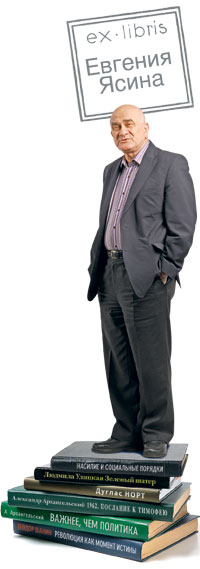 |
"Ulitskaya is for sweets." President of the Liberal Mission Foundation, Scientific Director of the Higher School of Economics, Honorary Professor of the University of China at the PRC and Doctor of Honoris Causa University of Birmingham in the UK, Doctor of Economics Yevgeny Yasin told The New Times that he reads now and why fiction for him is a rare pleasure
Since I write a lot myself and I want to write a lot, the circle of my reading is concentrated in the special literature. The main topic that occupies me now is culture in the broad sense of the word: how much the context contributes or does not contribute to the development of the democratic institutions of Russia. Hence the choice of books.
1. The novelty, which I now carry with me and constantly read, is published by the Gaidar Institute (Institute of Economics of the Transition period. - The New Times) and is called
"Violence and social orders." It belongs to the pen of the Nobel Prize of Douglas North (one of the initiators of neoinstationalism, fashionable and important currents in modern economic science), historian and economist John Wallis and political expert Barry Wyingast. In the West, the book was published back in 2006, and we have only now. It is about the fact that states differ in the level of violence, and violence is that with weak social order allows one to achieve prosperity at the expense of others, condemning these others into poverty and vegetation. In modern Western civilization, culture has largely reduced the level of violence, and the authors are interested in the balance between order and violence. The democratic order leaves only legitimate violence - the police, internal and external troops, which act strictly within the framework of the law, that is, according to previously known rules. In states, “with closed access”, that is, those where citizens' rights are not equal, power is largely based on violence against those who do not belong to the elite. Here are the authors discuss how to make the state “open access”, that is, with equal rights for everyone, with impersonal relationships in the power vertical. This is such an interesting book that I devote all my time to it.
2. "For a sweet" little by little and with great pleasure I read
"Green Tent" Lyudmila Ulitskaya. Her previous novel “Daniel Stein, Translator” I like it just very, very, but the last book evokes strong feelings. Together with her heroes, I am experiencing the time that formed the foundation of my life: when I was young, full of hope, when it seemed that everything would take place, I would ultimately be happy and will die in a good mood. Unfortunately, this does not work out, and now it is obvious that those trials that fall to the share of the heroes of the book will go to our children, and the grandchildren, perhaps, too. It's sad. But the book is alive, written with brilliance characteristic of the author, and I would like to read as many people as possible. Lyudmila Ulitskaya, in principle, love and read all her novels.
3. Favorite author I also have
Dmitry Bykov, his journalism and poems to a greater extent than thick books. I also love
Alexander Arkhangelsky - “1962. Message to Timothy ” and the book that he wrote following the results of meetings in our club“ Liberal Mission ” -
"More important than politics." This is about people who are our cultural property.
4. An important reading for me is history literature. Recently read about Peter Stolypin. It was interesting to figure out why he caused such a rejection that then occurred between liberals and the Bolsheviks. Today in our modern society, I often see parallels with this, meanwhile. At the same time, he met the great-grandson of Peter Arkadyevich-Nikolai Sluchevsky, who is now in Russia and tries to do something for our country. He attracted my attention to the figure of Stolypin. Of all the literature on this topic, the book made the most impression on me
“Revolution as a moment of truth” by Theodore Shanin, dedicated to the reforms of the Stolypin time and peasant studies.