
Translated material
Memory centers
In Russia, the Presidential Center of Boris Yeltsin is being created. The foundation is the Federal Law “On the Historical Heritage Centers of the Presidents of the Russian Federation, who has terminated the execution of their powers.” Place of creation - Yekaterinburg. The intention has already been announced to open a public discussion of ideas and initiatives developing this project. An important part of the discussion seems to be the international experience of presidential centers.
The origins
Presidential centers, as a type of institution that existed today in different countries, originally appeared in the United States as the so -called “presidential libraries” - open archives for storing documents created by the president and its administration. Each administration leaves behind a lot of materials- decrees, speech, letters, audio and video recordings, etc. Before the emergence of libraries, the fate of these documents could vary from complete or partial destruction (in some cases of intentional) to an unsystematic distribution on various meetings.
It began with the fact that in 1939, the 32nd US President Franklin Roosevelt transferred his personal and presidential documents to the federal government, citing the decision that historians need such materials and represent a national property. At the same time, he began to create a fund for the construction of the library in which these documents were to be stored. In 1950, the following president, Harry Truman, did the same. At the next president, Eisenhower, Congress in 1955 adopted a law on presidential libraries, establishing a system of presidential libraries created in private, and then transferred to the jurisdiction of the Federal National Archive . This project was completed, primarily as a help for researchers, but also as a source of information for all those interested. Soon after, in 1962, the library system, which is under the jurisdiction of the national archive, was replenished with the library of the predecessor of Roosevelt - Herbert Goover.
Development
The next step in the formation of the system was the law on presidential documents, the impulse to which was the Watergate scandal, which erupted under President Nixon. When Nixon, according to the results of the scandal and under the threat of impeachment, resigned (1974), he first tried to destroy part of the White House documents. He did not succeed, because the congress, in order to prevent destruction, quickly adopted a decision to preserve presidential documents and materials, according to which, all Nixon’s presidential documents are subject to transfer to the government and should remain within 50 miles from Washington. The trial followed, during which Nixon’s lawyers claimed that the National Archive did not have the right to process these materials without Nixon's consent, but ultimately the Supreme Court decided in favor of the decision.
According to the results of this story in 1978, the Presidential Records ACT law was adopted, according to which all the official documents of the president and its administration do not belong to the president, but are a national property. In other words, all meetings, negotiations, phone calls and correspondence taking place in the White House are recorded and transferred to the archive. Therefore, the law on presidential documents, in particular, stipulates that the president and vice president should take care of sharing his personal documents and official materials. At Obama, from the very beginning of the protruding transparency, a page appeared on the White House website, on which a list of visitors to the White House with a detailed report on the purpose of the visit is regularly updated.
This, however, does not mean that the appearance of unaccounted documents is excluded, by all signs relating to the official and socially important. You can correspond through private e -mail or make meetings outside the White House. In 2007, for example, an investigation was conducted regarding the presidential correspondence, which was partially conducted through non -state services. This is a violation of the law on presidential documents, which requires that all such documents be safe. Critics of Obama now like to talk about secret negotiations between the presidential administration and some mysterious lobbyists.
Federal presidential centers
В настоящий момент в федеральную систему библиотек США, находящуюся в ведении Национального архива (National Archives and Records Administration, NARA), входят 13 президентских библиотек — Г. Гувера, Ф. Рузвельта, Г. Трумэна, Д. Эйзенхауэра, Дж. Кеннеди, Л. Джонсона, Р. Никсона, J. Ford, J. Carter, R. Reagan, J. Bush Sr., W. Clinton and J. Bush Jr. Each of these libraries has its own website, on which, in particular, you can find significant volumes of digitized archival documents. There is already a website of the Barack Obama library, which, however, has not yet been created (they plan to open it in 2016). So far, the site is a collection of references to resources covering the biography and activities of the current president of the United States.
However, the case does not come down to the archives of documents. Each such library has a presidential museum, which, in particular, presents official gifts received by the president, as well as objects reflecting the flavor of the period that the president’s rejection was for. The Kennedy library website even presents an interactive online exposure , in which, among other things, there is an excursion to the virtual museum, as well as the so -called “President’s Workshop” - a multimedia interactive selection of materials related to the rule of Kennedy.
In the Museum of Bush Sr., one can familiarize yourself with the presidential symbols surrounding Bush (including seeing his seal and presidential limousine), things belonging to his family, his biography, official gifts to the president and many other things that became the attributes of his rule. A similar exposition is adjusted for the originality of each particular president can be seen in most other presidential museums.
In addition to the archive and the museum, each such institution is an educational platform that offers its own programs (for schoolchildren, students and just the general public) and public lectures, and also provides space for teachers and lectures for their educational events. The theme of these events is often related to the Presidential board. On the website of each library-museum there is a special section in which the proposed educational measures are listed, as well as links to useful materials available online.
In presidential libraries, seminars, discussions and the like are also regularly held. For example, in the Eisenhower library, a discussion has recently taken place between supporters of oil resources in the United States (in order to reduce the country's oil dependence) and opponents of such programs, which believe that these developments are environmentally friendly.
Thus, the institutions that initially create as library archives overgrown with numerous additional functions, as a result of which they are often called presidential centers (Presidential Centers).
Nefederal Presidential Centers
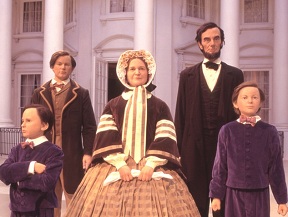
In addition to the 13 centers mentioned, forming the federal system of presidential libraries, there are several centers created by private organizations or state leadership. In particular, outside the competence of the National Archive is the center of Lincoln [1], opened in 2005 by the Illinois leadership, as well as the library of Rutherford Hayz , Woodlon Wilson , Calvin Culidge and William McKinley . In their device, they differ little from federal. There are also meetings of documents, museums and educational programs. Regardless of involvement in the national archive, many of these centers are created in those places where the president is from, that is, often in areas not most popular from a tourist point of view. The presidential center becomes a kind of cultural center in the appropriate place, attracting tourists and researchers.
There are also differences. If federal libraries focus on objectivity and openness of information, then private can attach more importance to promoting the values and principles that the president was guided by. For example, on the website of the Wilson Center there is a section “ Mission ” one of the goals of the project is formulated as follows: “To help the ideas and ideals of Wilson, relating to public service, government responsibility and international interaction, played an important role both in America and in the world stage.” Although here we are talking about trends. The Federal Presidential Center, of course, can also act as a platform to promote certain principles, and the private library in any case also remains an archive and an educational center.
According to the National Archive, the most visited center is the Lincoln Biblioteum Museum in Illinois (400,000 people visited there); The following are the centers of Reagan (California), L. Johnson (Texas) and Clinton (Arkansas). In addition to the mentioned presidential centers created on the model of federal libraries, there are other presidential museums , which can also store the collections of some documents, as well as have educational programs. In a broad sense, they can also be attributed to the number of presidential centers.
Outside the United States
By analogy with the American Institute of the Presidential Center, centers began to be created in other countries, including those where presidents do not exist. In Australia, for example, there are three centers of prime ministers: Alfred Dikin , John Curtin and Robert Hawka . According to their device, they quite accurately reproduce an American model, that is, they are an archive and a museum, offer educational programs and a platform for various events. However, they do not form systems and exist separately from each other on the basis of different universities. Like some American non -state centers, they can be platforms to promote certain ideologies and form the corresponding communities around themselves. This is especially true for the center of Hawk, on the main page of which it indicates: “We strengthen our democracy; We value our diversity; We are building our future. "
In South Korea in 2003, the Kim De Juna Center , also arranged on the principle of American ones, opened. But, again, as the introductory section says on his website, "the library was created ... to contribute to the spread of democracy and the world, as well as a reduction in poverty." She plays the role of the presidential archive, as well as a collection of materials, one way or another concerning Kim De Jun and his reign, and acts as an educational platform and partly the brain trust, while having a distinctly expressed ideological coloring.
In conclusion, we note that institutions named after the President should be distinguished from the presidential centers, for example, the Paris Center (name) Pompidu . Unlike presidential centers, combining the functions of the archive and the memorial, it is just a large cultural center. There is a museum, but it is a museum of contemporary art; There are exhibitions and concerts, but they are not directly related to Georges Pompidu; There is a library, but also general content, and not a repository of decrees and speeches of the president.
[1] The link leads to the unofficial website of the museum; The official website www.alplm.org is currently not available.