
Translated material
Little crabs: romance or fight against overheating?
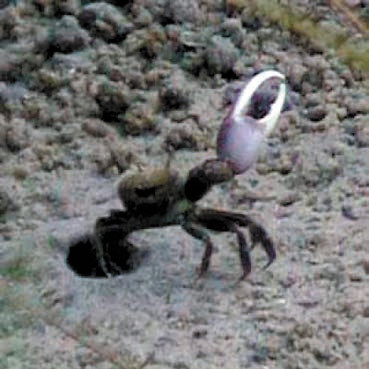
Hypertrophiedly developed claws of crab scripts (alluring crabs) are a considerable riddle for science. The dimensions of one of the claws in males are comparable to the dimensions of all other parts of the body. At the same time, these crabs do not differ any special aggressiveness or belligerence. Actually, they are called violinists or “alluring” because of the habit of waving their hypermed claw in the air (as if luring his friends or playing soundless melodies).
It is believed that animals receive such impractical “jewelry” as a result of sexual selection - in this case, females consider males with the largest claws the most attractive, preferring to mate with them. However, American researchers Zakhary Darnell and Pablo Munguía from the University of Texas now substantiate an alternative assumption: a large claw helps not to overheat the sun. They found that the temperature of the crabs, devoid of large claws, grows much faster and reaches higher values than that of untouched crabs (publication in the fresh September issue of American Naturalist magazine [1]).
A large claw can play the role of a kind of radiator, removing heat from the body due to convection, scattering excess heat in the air. The cooling effect of the claw helps the crab to spend more time outside its hole, feed longer and more often show to females. This property of the claw can partly compensate for the energy costs of growing such a gigantic appendage.
Actually, the role of melting in marriage ceremonies and in the fight against rivals of crabs-scripaces, of course, is also not denied, i.e. The benefits of the claw in thermoregulation are seen only by an additional useful “bonus”.
Maxim Borisov
1. M. Zachary Darnell and Pablo Munguia, “Thermoregulation as an Alternate Function of the Sexually Dimorphic Fidder Crab Claw” - http://dx.doi.org/10.1086/661239
2. Giant Claw Helps Fiddler Crabs Stay Cool in More Ways That ONE-www.eurekalert.org/pub_releases/2011-08/uocp-ses082511.Php