
Translated material
"Price Price: $ 80 per barrel"
President of the CSR Mikhail Dmitriev - The New Times
 |
| Mikhail Dmitriev was born on February 24, 1961. A graduate of the Leningrad Financial and Economic Institute named after Voznesensky (1983). Doctor of Economics. In 1991-1993 - People's Deputy of the Russian Federation. In 1994-1996 - in senior positions at the Institute of Economic Analysis, the Moscow Center of Carnegie. In 1997-1998 - The first deputy minister of labor and social development of the Russian Federation. 2000 - May 2004 - First Deputy Minister of Economic Development and Trade of the Russian Federation. Since June 2004 - Scientific adviser, since October 2005 - President of the Center for Strategic Development Foundation. |
"Price: $ 80 per barrel." The situation in the markets remains extremely unstable. Politics also throws “Drivishki” to the fire: will Medvedev agree with Putin or will not agree? Will the bosses in the regions be preserved in the regions based on the results of the parliamentary campaign or will they not save? Will the budget of the party’s ambitions withstand or pay for that inflation? What all this turns out for the economy and income of fellow citizens - The New Times asked the president of the Center for Strategic Development Mikhail Dmitriev
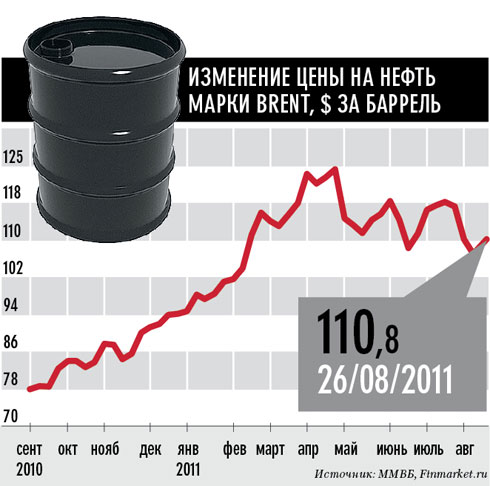
Russia enters the big political season. What is the "election readiness" of our economy? Even before the beginning of August financial upheavals in world markets, economic growth in Russia slowed down. In the middle of the first half of the year there was a fracture in the dynamics of oil prices - they began to decline. And by mid -August, Brent oil had lost about 20% of its peak value: in March, Barrelle cost $ 120, now - just above $ 100. The Russian economy entered the braking phase, which is aggravated by the threat of a new financial crisis. This is the economic background on which the election campaign is deployed.
Alarms and what will happen to investments? Since the beginning of the year, the net outflow of capital amounted to $ 31.2 billion - data for July 1. Most likely, with growing political uncertainty, many portfolio investors will suspend their investments in Russia. In addition, world markets are shaking all over August. Under these conditions, investing in Russia, whose economy is entirely dependent on oil prices, is quite risky. So even with a relatively favorable scenario, the rate of economic growth will slow down in the near future.
And with unfavorable? With a further deterioration in the situation in the global markets and a drop in oil prices, the Russian economy can experience much glossy difficulties. A drop in oil prices by $ 10 is equivalent to a decrease in budget revenues by about one percentage of GDP. It may not sound very scary, but in value terms, this percentage point pulls almost $ 20 billion.
How really is the further drop in prices? Judge for yourself: if in the first four months the price of a barrel fell by 20%, then what prevents him from falling in the same amount in the coming months? Moreover, the rates of economic growth in all main countries - oil consumers - the USA, China, and the European Union - have now significantly decreased. Accordingly, demand is falling. It is quite possible to drop in oil prices from the current $ 100-105 per barrel to $ 80–85 will create stress in many segments of the Russian economy. If only because the draft budget of 2012 is a overpass from the average price of a barrel $ 93.
The risk for the president and how is it fraught with? If oil prices really fall to $ 80 per barrel, it will be a catastrophic scenario. There will be a complete unbalance in the 2012 budget, a sharp slowdown in economic growth. Probably, the growth of the population’s incomes will come to nullify. This may affect the course of the parliamentary elections and will be even more likely to have serious consequences for the presidential election. Perhaps he will even force the authorities to take the choice of a priority candidate for the Kremlin.
Why suddenly? Political ambitions seem to do not depend on oil prices ... Yes, but the degree of political support of the authorities is closely related to economic expectations of the population. If things in the economy go badly and people will feel it on their wallets, this can negatively affect the ratings of both the party in the authorities and potential presidential candidates Putin and Medvedev. Such a development of events can make the power otherwise lead itself in the course of the Duma campaign (although there are already few freedoms for the maneuver), and the presidential one. I think that with the scenario of the latter, not everything is still clear ...
Do you exaggerate the potential of protest moods in society? We recently survived the crisis, when the economy fell, the enterprises were massively closed or switched to an incomplete working week, but there were no special protests, except for local. Are $ 80 per barrel capable of raising masses to fight? Mass protests are possible even while maintaining high ratings of the president and prime minister. So it was during the monetization of benefits, and in the Far East due to the increase in duties on the import of foreign cars, and in a crisis in the same Pikalev ... So if the economic situation worsens sharply, then in the fall we can become witnesses of various kinds of public protests. Even if the level of political support does not fall noticeably, protests can force the power to make adjustments to the election tactics.
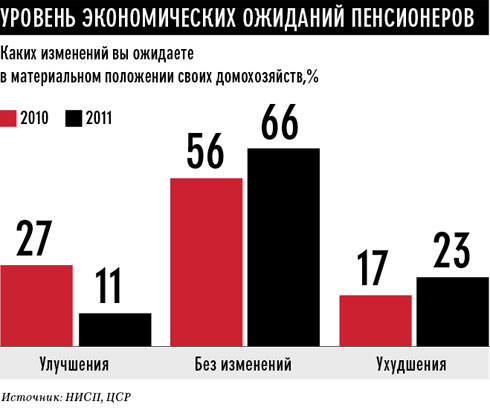
Obviously, pensioners , understanding threats, the authorities are preparing proactive steps: they promise to once again raise pensions and salaries to state employees. Everything is so, and the authorities, of course, will not abandon the election promises. But if oil falls to $ 80 per barrel, there may not be enough money to finance social obligations in 2012. And people understand this - this was shown by surveys conducted by an independent institution of social policy. It is pensioners, despite all the promises of the authorities, that are now the most pessimistic category of the population. Among them are the most people who do not believe in the possibility of further improvement of their financial situation.
What other consequences can the cheaper oil lead to? First of all, to the devaluation of the ruble. If oil continues to get cheaper, the outflow of capital will intensify - and it will be more difficult for domestic companies to borrow money abroad. All this will inevitably lead to the fact that the Central Bank will begin to lose reserves. In 2008, the Central Bank and the government for a long time tried to artificially support the ruble exchange rate, which later led to very unpleasant consequences. Now, most likely, the monetary authorities will not cling to the ruble’s course will not be so much and will allow it to smoothly decline in accordance with the growth of demand for foreign currency.
There are not enough reserves if a negative scenario begins to be implemented, what arguments the authorities have to confront it? There are much fewer opportunities than three years ago. The Ministry of Finance, even at the planned price for oil $ 93 per barrel, intends to borrow 2 trillion rubles. With a new wave of crisis, it will be impossible to take such an amount from the market. Meanwhile, with $ 80 per barrel, the budget deficit will be much larger - 7-8% of GDP, as in the midst of the crisis. And even 2 trillion rubles to shut up such a hole is not enough. According to our estimates, in order to finance such a budget deficit without reducing expenses, you will need to spend all the remains of state reserve - both the reserve fund and the national welfare fund.
So, they will increase taxes? Raising taxes will only aggravate the situation and can lead to an even deeper decline in production. The only real opportunity is to reduce budget expenditures. The budget will go and contains a huge number of economically and socially unreasonable expenses that were initiated exclusively for election purposes to increase the popularity of the authorities.
For example? Military Procurement Program. In the so far still unfounded and bloated army, where the entire public procurement system is extremely corrupt, they are going to pour 20 trillion rubles in 10 years - it is like trying to wear water in a grate. Most of this money will either be stolen or spent on an expensive and ineffective equipment for an ineffective army. There are also many such examples in the social sphere. For example, the increase in the salaries of state employees is in no way connected with the effectiveness of their work, and even more so, is not aimed at optimizing the inflated budget network.
However, it is pointless to discuss this. A sharp reduction in budget expenditures will immediately affect the income of the population and, of course, will reduce the popularity of politicians responsible for such decisions. It is unlikely that on the eve of the election they will be decided on this.