
Translated material
Crisis crossroads
In the economy
 Crisis crossroads
September 14, 2011 Maxim Blut

The Nobel Laureate in Economics, invited to Yaroslavl, Paul Krugman, did not please the inviting side. Speaking at the International Forum there, Krugman estimated the probability of a new crisis of 50%. This assessment, no matter how gloomy it sounds, seems too optimistic, because it leaves the same 50 percent probability that the crisis can be avoided.
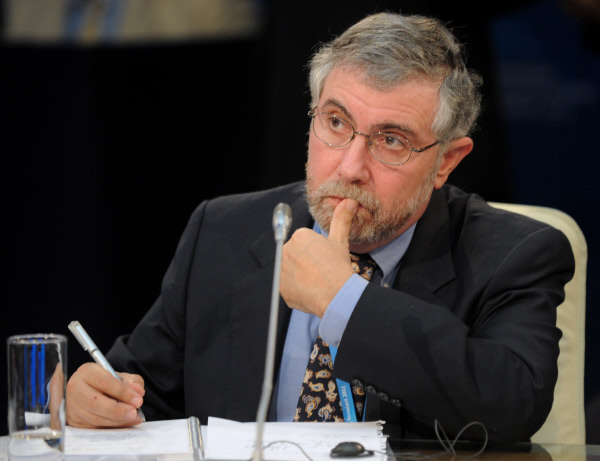 Krugman also believes that if the authorities of the United States and other developed countries take urgent measures, come up with new, more effective incentives, the world economy will be able to restart, and another recession can be avoided. Another, even more influential American economist Nuriel Rubini holds a similar opinion. “We need to increase economic growth not in five years, but now, today. We must begin to stimulate the economy in the shortest possible time, otherwise a new great depression awaits us, ”he told Bloomberg at the end of last week. The difference between Krugman and Rubini is only that the latter believes: the crisis has already "began its procession in countries with developed economies."
Of course, the 2008 crisis clearly demonstrated that preventive measures aimed at preventing the crisis are much cheaper than eliminating the consequences of the disaster that has already happened. However, the experience of the last three years also indicates that the "medicines", offered until recently, the world economy brought only temporary relief. Extraordinary budget incentives proposed by Obama, nor the Greece prescribed by Europe, the regime of strict savings did not lead to a stable sustainable growth in the first case, or to solve the debt problem in the second. The sad reality lies in the fact that the frequency and scale of financial injections by governments and central banks are constantly increasing, and the positive effect of these injections is more modest, and it lasts less and less.
The inefficiency of “treatment” is becoming more and more obvious, giving rise to the deaf discontent of the population, which pours into the strengthening of the parliamentary opposition, and the governments each time are increasingly difficult to conduct the next “salvation plans” through the legislators. This is clearly demonstrated by the summer battles in the American Congress, and the current stormy debate in the German Bundestag, where the mass of opponents of the endless salvation of Greece threatens to become critical.
The failure of the next package of incentives in these circumstances is only a matter of time, and judging by how the Greek crisis develops, the default on Greek debts can be declared within a few weeks, if not days. On Monday, the German newspaper Die Welt published an article by German Minister of Economy Philip Resaler, who was the first of the members of the German government about the possible bankruptcy of Greece. Judging by another information leaking into the press, now the authorities of European countries are more concerned about localizing and minimizing the consequences of the Greek default than the salvation of Athens from bankruptcy. And, despite the fact that governments and central banks are now much better aware of the state of the global banking system than three years ago (thanks to numerous stress tests of banks), Greece can become the new Lehman Brothers-the reason for the next financial collapse.
However, if it were in Greece alone, and all other countries of the world showed enviable financial and economic health, one could not worry. Unfortunately, this is not so, and today even the legendary Chinese economy does not look enough strong to pull the world out of the next recession threatening him.
Now it makes sense to discuss it is not the likelihood of the onset of the next crisis, but by which scenario it will develop. And this, in turn, will depend on the actions of key players in the world economy - the USA, the EU, Japan and China. There are only two options at the first stage. The first is the repetition of the events of 2008, with the only difference being that now the set of tools for governments and central banks is much more scarce than three years ago, and the scale of the problems is immeasurably larger. In fact, nothing but a “printing machine” is left. The second is a preventive inclusion at the full power of this “last argument”, which will help prevent financial collapse, but threatens with “stagflation”-economic stagnation against the background of high inflation (well, if without the prefix hyper-). The key question is how China will respond to the actions of developed countries. If Beijing takes decisive actions aimed at finding an alternative to the dollar, will begin to more intensively promote Yuan as such an alternative, then in a few years we can be in a completely different world.
As for the consequences of a new crisis for Russia, then everything will depend on the actions of the authorities. Which, in turn, will respond to the development of the situation in the global economy. Oil prices can be equally likely to fall to $ 50 and fly up to 150 (and, most likely, in the next couple of years we will see both numbers).
If you believe the Deputy Prime Minister Alexei Kudrin and the first deputy chairman of the Bank of Russia Alexei Ulyukaev, the government and the Central Bank are preparing for the upcoming crisis. The Ministry of Finance is going to reduce internal borrowings, prepares the budget for the fact that privatization revenues will not be an example below planned due to the fact that the state-owneds will be unprofitable and privatization plans will be revised. The department of Kudrin even took into account the connections of the Russian banking system with Cyprus and are preparing to give the country $ 2-2.5 billion, designed to keep the island’s banks.
The Bank of Russia is also preparing to combat the possible occurrence of liquidity deficit in the domestic banking system and the lips of the First Deputy Chairman of the Central Bank asserts the readiness to increase the volume of refinancing of banks. Both the Ministry of Finance and the Central Bank gather, while it is possible to increase reserves - each of their own, so that there is something to be safe if the crisis is more destructive, which is predicted.
In its own way he is preparing for the crisis and the Ministry of Economic Development. Last week, the department announced a “crisis” scenario, according to which the growth rate of the global economy by 2013 (when the peak of the crisis is predicted) fall to 2.9%, and oil price - up to $ 80 per barrel. At the same time, officials provide in this case the collapse of the Russian ruble by a third - up to 39 rubles per dollar. In other words, the country proposes a variation on the topic of “smooth devaluation” with the only difference being that in 2008, the barrel collapsed below $ 40, and the dollar stopped his height in 2009 below 32 rubles. I have already written about the destructive consequences of the devaluation of 2008-2009 repeatedly. Twice to step on the same rake - the stupidity bordering on a crime, although this stupidity will lead to the final transfer of the country's nonsense into the “manual management” regime, which the current authorities may be achieved.
Photos of RIA Novosti