
Translated material
Will the third be?
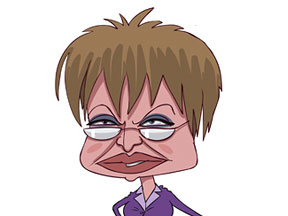
Valentina Matvienko became the speaker of the upper house of the Russian parliament. However, she, being formally by a third party in the state, is almost deprived of powers, and the Federation Council itself almost does not decide anything. Matvienko threatens to change the situation. However, she is unlikely to succeed.
The approval of the former governor of St. Petersburg Valentina Matvienko, the senator took place. Dmitry Medvedev has already congratulated Matvienko on the phone with a new post.
There was no sensation: the senators almost unanimously voted for her candidacy. 140 - “For”, one abstained, there were no opponents in the hall. In principle, explainable. What is the matter to senators representing a variety of regions, the most different business and the most different departmental lobby to who exactly the high authorities determined the post of speaker? Moreover, the powers of the speaker do not imply real political weight.
However, Valentina Ivanovna in her speech was in a businesslike way to the senators. She promised to engage in the modernization of social legislation, transport security, a change in the political system, and so on. That is, she announced the agenda of the chamber for the opening session. The agenda also does not depend on Matvienko in no way - her proposals, among the voiced, no.
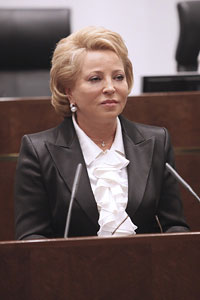 Valentina Matvienko at a meeting of the Federation Council. Photo: Federation Council
 She also affected the decentralization of the authorities, which politicians in Russia, including the president, talk a lot about. She spoke about the "sad experience" of the transfer to the regions of authority not fixed by financing. The Federation Council, she believes, should work with the regions and take into account their wishes when working on the legislation. Coordination and accounting of regions’s opinions can mean anything-from delaying the process for many years due to long-term coordinations (regions with very different interests) to the speedy implementation of some decisions to life with the “accounting” of the opinions of the regions. However, the opinion of the Federation Council and in this matter is unlikely to be decisive.
However, the speaker itself does not intend to put up with such a situation. “We must get rid of the label that the Federation Council will simply stamp the laws,” she said. In addition, according to her, members of the Federation Council should “speak out on all fundamental issues and at the same time not to ask anyone for this.” Thus, in her opinion, the authority of the Council will strengthen.
To enhance the significance of the upper house of the parliament, Matvienko has a recipe - it is necessary to weaken the dependence of the senators on the regions. This will allow "form a stable corps of senators." Now the region can withdraw the senator at almost any time, which, according to Matvienko, makes them dependent on the regional political conjuncture. This is already a strong political statement, however, quite strange, from the point of view of the functions of the Federation Council. In fact, Matvienko waved to the cancellation of the regional representation at the federal level.
This approach can make legislative work more coordinated, but rather weaken the role of the upper house, as a platform for solving contradictions between the center and the regions. And senators will turn into a kind of deputies from United Russia.
“I am for the election of members of the Federation Council, but in what form it is correct to do this in order not to weaken, but to strengthen the Federation Council - we will work with experts and lawyers,” she said. This approach is the right path to the emergence of a formal and emasculated procedure as if election, and in a rather remote perspective.
In fact, it is difficult to understand from the speech of Matvienko what mechanisms she believes useful for turning the Federation Council into a body where the interests of Russian citizens are represented (now, if they are represented, then in a rather mediative form). It seems that Matvienko does not set such a task for himself. The only intelligible goal is to strengthen the lobbying potential of the organ. Which, probably, will lead to an increase in the political weight of the speaker.
However, on this path, many obstacles will wait for her. First of all, the Russian political space does not tolerate the emergence of centers of power for no apparent reason. The only reason in the case of the Federation Council can only be the boiling activities of its chairman. Whether she can really become a major federal politician and even a real third party in the system of state power is a big question. There are many opponents of such a turn.