
Translated material
Physics in the rain
Professor of the University of Manchester Konstantin Novosyolov is not often in Moscow, and on September 10, he arrived for a day for a day. The full version of Natalia Demina’s conversation with the Nobel Physics Laureate 2010 Read on Polit.ru ( www.polit.ru/article/2011/09/15/novoselov/ ).
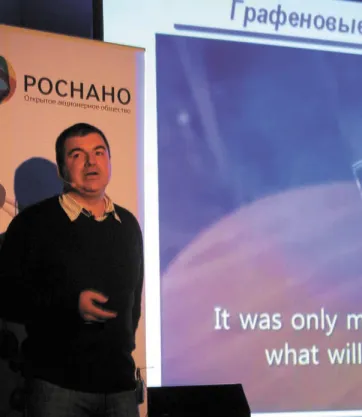
At the Book -Market book festival in the park to them. Gorky poured rain, the “market” did not work out very much, since there were few visitors. The lonely "Buran" is also the IOC in the rain, and a blue train with wagons traveled cheerfully in the park. Novoselov appeared at the Big Scene somehow imperceptibly, here journalists with and without cameras were waiting for him. “Are you going to come to Moscow in the near future?” I asked, until the series of non-stop interviews had yet begun and the laureate was waiting. "No. I would like to work, there is no time to travel. ” She handed him greetings from Mikhail Katsnelson, with whom he and Andrei Game have been working closely for a long time. Konstantin was clearly delighted; It turned out that he does not read the blog of his colleague, as a result, he does not know, for example, that he was at a conference in Italy. “What conference could he be there?” Konstantin wrinkled his forehead.
The conversation had to be recorded in marching conditions, not far from the big stage, under the tree, so as not to wet it.
-If you were now a physicist, then what area of specialization would you choose? Would you change it?
- To be honest, it’s very difficult to say. Physics, she is all interesting, but I was always attracted not only to measure, but also to do something with my own hands, so what I do in the physics of a condensed state and nanotechnologies quite suits me.
- And how do you work together with Heim? Maybe you remember the famous answer of Ilf and Petrov to the question “How do we write together” ...
- I have been a student of Andrei for a very long time and learned a lot from him. I consider him my teacher and everything that I can, a huge percentage, I acquired from Andrei, in particular the style of his work. How we work ... We are just trying to come up with some interesting ideas, and then embody, and, of course, it is always very useful to have someone nearby with whom you can discuss these ideas.
-Was there something fundamental, which would prevent you from making the necessary studies that deserved the Nobel Prize, not in England or Holland, but in Russia?
- I do not know in principle what needs to be done to get the Nobel Prize. There was never such a task before me, no recommendations, how to do it and what factors played, that they gave a bonus to someone, but they didn’t give someone, I can’t give it. It never interests me very much then, and even more so I am not interested in now, so I can’t give any recommendations. But I am sure that this is possible in absolutely any country.
- The whole world is excited by your new article in Nature Communications about the use of graphene in high -speed data transmission. Maybe tell me at least briefly?
- Let's honestly say that journalists wrote more about the high -speed data transfer than us. The idea to use graphene in high -speed photographs is not ours, this idea is probably coming from Klaus Kern (Klaus Kern) from MPI (Stuttgart), and then from IBM, they developed this topic.
What we did: improved these sensors, crossing the graphene with plasmonics, and made their effectiveness really enough to use in real devices. Whether this will be used for telecommunications or something else-this is, of course, not to us, but the fact that the idea itself was originally nominated by people from IBM gives some hope that this will find its application.
- Academician of the Russian Academy of Sciences Vladimir Zakharov told me that he was going to write a letter to you about this. Maybe you know that in Russia there is such an inventor - Victor Petrik? He claims that you did not rightfully receive the Nobel Prize, that it was he who created graphene, and so on ...
- There are a huge number of people who could receive a prize for graphene, for carbon materials, there are a huge number of wonderful researchers around the world, and in Russia too, and many of them are worthy of a bonus, but there is no name of Petrik among them.
- That is, his contribution to this area of science is negligible, equal to zero?
- It generally seems to me that he is not engaged in science.
- You are one of the youngest British academicians. Do you have a point of view, what to do with the Russian Academy of Sciences, how to reform it?
- To be honest, I don’t know statistics (according to the London Royal Society), but I trust your information, young, then young. I don’t know ... Still, there are traditions. In Russia, most of the science was made in academic institutes, and this must be honored. Is it necessary to somehow reform it? I don’t know, the look from the inside is more important here than outside.
- In the name of your Nobel lecture and epigraphs for autobiography, you used lines from Alice in Wonderland. Why does this work mean so much for you?
- It seems to me that this work is wonderful both in a philosophical sense and in the sense of wonderful literature. I really like the language, and how it is written, and the endless humor that it contains, all these jokes that are in it, we very often use them in life, so it was quite normal that they entered the Nobel lecture.
- In autobiography, you wrote that your literary tastes have changed from your youth: you used to love M. Twain, D. London, and now what do you like to read, unless, of course, there is enough time?
- There is always little time, in fact, but with the advent of the iPhone I read a lot, there is always the opportunity to download the book and read at any moment. If I’m at home, say, to allocate a day, although this has not been a very long time ago, then I usually take Leskov or Dostoevsky ... Brodsky ... In general, I try to read everything that comes to my arm in order to keep up with time, I just buy a dozen books in Russia or somewhere else and try to read them.
After the interview, I briefly spoke about the judicial “battle”, which is conducted with V. Petrik V. Zakharov and his colleagues from the commission to combat pseudoscience and falsification of scientific research of the Russian Academy of Sciences. Novoselov made it clear that he knew about this, but he believes that all the conversations about this person only advertise him. Then he went to the "tear of other journalists". The Culture television channel was most lucky, they promise to show the broadcast of Novosyolov in the program “Black Holes. White spots. " During his lecture, Konstantin was joking a lot and kept very well, despite the upcoming cold and gusts of wind, because of which the logos of one of the organizers of the event-Rusnano-now and then tried to fall on the Nobel laureate. He pushed them back and asked for forgiveness. The audience rejoiced at his jokes, and after the lecture, Novoselov patiently gave autographs and answered questions from the audience.
I express gratitude to astrophysicist Sergei Popov, mathematicians Viktor Vasiliev and Vladimir Pimkin, scientific journalist Maxim Borisov for help in preparing issues.