
Translated material
Maps of new planets
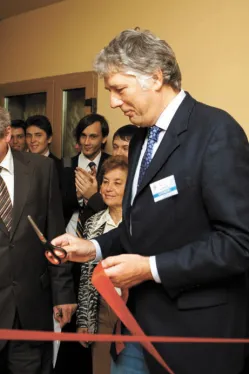
On Tuesday, September 20, at Moscow State University of Geodesy and Cartography (MIIGAIK), the opening of a comprehensive laboratory of research of extraterrestrial territories was opened, and abbreviated - Cliv. The science fiction name, causing the Brothers of the Strugatsky brothers, is true: the laboratory is devoted to the study of other bodies of the solar system, primarily the companions of Mars and the Moon.
The laboratory was created at the expense of the megagagant of the Government of the Russian Federation, won in the 2010 competition, in the field of "Space Research and Technology". The supervisor of the laboratory from the German side is Juergen Oberst, Professor of the Berlin Technical University and the head of the planetary geodesy department of the German aerospace center (DLR). On the Russian side, the laboratory is led by Kira Borisovna Shinggarova, Professor Migaik.
Although the ceremonial opening of Clivt took place almost a year after receiving a grant, the laboratory itself was created earlier, on the basis of the planetary cartography laboratory existing in Miigaik since the late 70s. As then and now, the main goal, or even super -price is the training of personnel to support planetary research programs, then the Soviet Union, today - Russia. The goal is all the more urgent because planetary research in our country is just beginning to revive after a more than 20-year break.
Jurgen Oberst for the first time began to cooperate with Russian colleagues in the early 90s. Constant contacts in scientific circles led to the emergence of a joint application for a government grant.
In total, about 40 people work in the laboratory in several groups: geodesy and navigation, cartographic, analysis of multi -pointral images, photogrammeters, comparative planetology, information systems and support. The first tasks that are already solving here are related to the support of the Fobos Grunct project and two lunar missions-Luna-resource and Luna-Glob.
In particular, laboratory employees deal with the issues of coordinate support for Fobos landing. Here, a map and gravitational model of Phobos are created according to the European apparatus of Mars Express and American Vikings. For the lunar program, it is planned to build an updated map of the moon, in particular its sub -suhing regions, for choosing places of planting of Russian devices.
Along with this, according to Jurgen Oberst, it is planned to re-process the historical data of Soviet lunar missions using modern programs (something similar, by the way, is done by Americans who re-analyze the data of the Vikings).
The period of megagagant ends in 2013, however, as the leaders hope, the life of the laboratory will continue after that. The plans include the study of the second satellite of Mars - Damos, as well as the Jupiterian and Saturnian Moon - Io and Enzelad. Of course, in many ways this will depend on the current space program of Russia, for which in the coming months there is a kind of “moment of truth”-the Fobos-Grunct apparatus is being prepared for launch.
Preparation for his start enters the final stage. On Thursday, September 22 in NGOs. S.A. Lavochkina took place a press tour before the removal of the apparatus to Baikonur. The project was represented by Maxim Martynov, chief designer for the Fobos-Grunnt OKR, Viktor Khartov, General Director and General Designer NGO named after S.A. Lavochkina, and Lev Green, Director of the Institute of Space Research of the Russian Academy of Sciences. Viktor Khartov emphasized that the mission is extremely complicated both in scientific problems and in design solutions: most official systems preserve new developments. “Frankly, the mission is very risky. But it is needed - to learn how to fly, you need to fly. ”
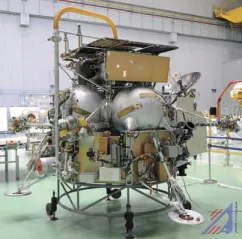
The Phobos Grunct, which was present in the same workshop, seemed to also listen to the speakers. The removal of the apparatus on the cosmodrome should take place this week, the start - in November of this year.
O.Z.
Photo by MIIGAIK and NGO named after S.A. Lavochkina