
Translated material
Stream production
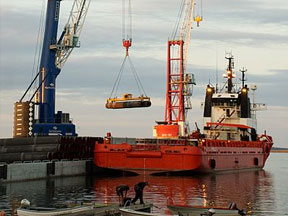
Gazprom launches the North Stream. However, in other areas of activity in Europe, the company has serious problems - searches in daughters and conflict with the Turkish authorities. The Russian side believes that the problems began due to the desire to build another stream-South.
The North Stream gas pipeline is ready for opening. “The construction of the first thread is completed, launcher work is underway and the pipe is completed by gas. Today, Vladimir Vladimirovich, I am ready to call you the exact date when the gas pipeline is commissioned: this is November 8, 2011. As they said in the old days, by the November holidays, ”said Alexei Miller, head of Gazprom at a meeting with Russian Prime Minister Vladimir Putin.
According to Miller, the second thread is built by 60 percent - 700 kilometers of the pipe have already been laid. “At the same time, we now, with the entry of the first thread, launch the second, very important and crucial stage of environmental monitoring. You know that at the first stage of environmental research, at the stage of design and construction of the gas pipeline, 100 million euros were allocated for these purposes. Now for the first three years we have determined the amount of funding for constant environmental monitoring of 40 million euros. In thousands of points along the pipe, measurements are made and will be carried out, and we will comply with all the environmental standards that are prescribed to us, ”the head of the gas company premiere.
The North Stream is a main gas pipeline between Russia and Germany, passing along the bottom of the Baltic Sea. The volume of gas supplied through the North Stream gas pipeline, which is planned to be released in 2012 (55 billion cubic meters per year), is equivalent to energy produced at 14 nuclear power plants and 50 coal power plants.
Environmental claims were the most serious argument against the implementation of the project and Gazprom managed to recapture them. Now, in the implementation of the North Stream project, it is already impossible to doubt.
In Germany, checks took place in E.on and RWE, as well as the “daughter” of the Russian company - Gazprom Germania. In Austria, OMV was checked, VemEx (the control package belongs to Gazprom) in the Czech Republic, Lithuvos Dujos was searched in Lithuania.
In Europe, they say that companies were checked for compliance with competition legislation. “Inspections conducted on Tuesday by the European Commission in gas companies of a number of European countries were not inspired by the poor mood of companies or governments. The European Commission is a guarantor of compliance with competition standards, European or foreign companies. All companies that receive income in the EU must comply with them, ”the European Commission representative Amelia Torres said today.
In Gazprom, of course, all charges are rejected. Gazprom works in European markets on the principle of equal partnerships with its customers. Our contract obligations are built on intergovernmental agreements, they are built on the principles of commercial expediency and fully comply with the market conditions. For us, of course, these events have become an unpleasant surprise, ”Miller said at a meeting with Putin.
A sudden statement from the Turkish officials who threatened to revise the gas supplies and demanding a reduction in its price from the Russian company is associated with the same.
“South Stream” is a Russian-Italian-French-German project of the gas pipeline, which will pass along the bottom of the Black Sea from the port of Dzhubga to the Bulgarian port of Varna. Further, its two branches will pass through the Balkan Peninsula to Italy and Austria. According to the plans, the gas pipeline should work in 2015 by the capacity of the new gas pipeline was originally planned for 30 billion cubic meters per year, but in May 2009 both sides agreed on its expansion of up to 63 billion cubes.
Events are associated or not (rather, there is hardly a direct connection), but in Europe they are really concerned about dependence on the largest gas supplier. Gazprom today supplies about a third of gas consumed in Europe. Moreover, Gazprom with its partners also wants to own the infrastructure for gas delivery to end consumers. What causes even greater concern of European officials who are afraid, in addition to purely political risks and energy blackmail, also losses from high prices.
So checks in gas companies in Europe are probably not the last. In principle, there is no “conspiracy against Russia” - normal practice, when antitrust authorities check companies that can be suspected of price conspiracy. Such a simple business reality. The sharp reaction of Russia is also understandable - Moscow is highly dependent on oil and gas revenues and cannot allow to offend its main “national treasure”.