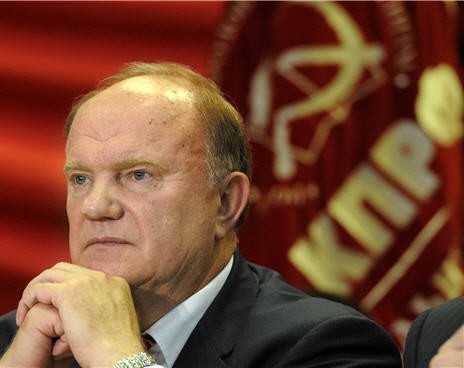
Photo: ITAR-TASS/ Artem Korotaev
Today I am starting a cycle of articles about political parties that will appear in the ballot balloon on December 4. A few words about who are addressed to these articles. They are not for those who have already decided on the choice, that is, not for the loyal electorate. They are for those who are guided by a strategy known as “Navalny's Option”: vote for any batch except “United Russia”. The basis of this strategy, in my understanding, is the statement of the following circumstances: (1) “Elections” on December 4 is not real, imitation; (2) None of the parties participating in them is completely independent of the authorities; (3) the result is largely a foregone conclusion; (4) Nevertheless, it is not absolutely predetermined, and mass voting for any batch, except for United Russia, can cause some damage to the political monopoly. On the fourth point, this strategy diverges with the option “stay on the sofa / go to Thailand”, for some reason known as “Boycot Elections”, as well as with the option of damage to the ballot, which some of his supporters call “Nah-Nah”. One of the problems with the “Navalny version” is that in terms of meaning it is a vote against “United Russia”, but in form it is necessary to support a certain other party. And this diverges from the second of the above points. Just throw a cube that has six faces - just according to the number of parties of the “legal opposition” - in my opinion, not such a bad option, but not too realistic. If the Anti -Communist falls out of the Communist Party of the Communist Party , he still does not vote for her: he simply will not endure this psychologically. Therefore, preliminary selection is needed up to two options, between which it would be possible to choose using a coin. And for such a selection, criteria are needed. There is no doubt that each voter will have such criteria. An absolutely objective expert recommendation is impossible here. The only thing I can do is share the considerations based on my personal priority, and it is that Russia switches from the current system of personalist dictatorship to normal modern state structure, that is, to democracy. I will give three arguments “for” and “against” each party - precisely those that seem important to me. Each argument will be accompanied by reservations that, in my opinion, these arguments do not eliminate, but limit the limits of their applicability. I'll start with the Communist Party.
It is completely undoubted that the Communist Party will overcome the seven percent barrier. This means that the voice filed for her will in no case be lost. The Communist Party has a relatively small one (according to my assessment based on survey data, about 5-10% of the electorate as a whole), but a stable and loyal support group. The average share of the Communist Party of the Communist Party in the regional elections of recent years was almost 20%. Of course, the number of real voters of the Communist Party of the Communist Party included not only convinced communists, but also many voters far from eternally living teaching, who found the Communist Party of the most convincing opposition party. But the Communist Party would have passed without them, only at the expense of loyalists.
| The option in which only “United Russia” and the Communist Party would have passed into the Duma is beneficial to the authorities. This allows, firstly, to preserve the situation of the superiority of “United Russia” (because for most of the Communist Party of the Communist Party, it is, whatever one may say, it is an unacceptable option), and secondly, when communicating with Western colleagues, it is as if the only alternative to Putin is communism. |
The organizational resources of the Communist Party allow her to monitor the elections, that is, to prevent theft of voices, at least for herself. Indeed, the Communist Party is the only “opposition” party that has a rather significant asset, and not only in large cities, but throughout the country. The party also has other material capabilities associated, firstly, with the receipt of significant state funding, and secondly, with the fact that it has factions in the vast majority of regional legislative assemblies.
| The Communist Party Assist consists mainly of elderly people who are often simply physically unable to put out the loading load and / or conduct it effectively. In the 2007 elections, and during the majority of the subsequent regional campaigns, the Communist Party monitored, but without impressive results. |
The presence of the Communist Party of the real membership base provides it with organizational autonomy from the Kremlin. Say, the recent raider seizure of the “right -hand business” had a precedent in the history of the Communist Party - in 2004, when Gennady Semigin tried to capture it with the active support of the authorities. It did not work out because the delegates to the Congress of the Communist Party were really delegated by local party organizations, and they had something to lose, in addition to supporting the Kremlin.
| The organizational autonomy of the Communist Party does not make it politically independent of the Kremlin. This is eloquently evidenced by the inclusion of Viktor Cherkesov in her election list. |
| The argument is “against” No. 1 |
The argument is “against” No. 1 . The ideology of the Communist Party, being archaic and including odious moments like praising Stalin, is absolutely alien to me personally and, I believe, most supporters of the "version of Navalny". It is disgusting to vote for such a party.
| Such an ideology is needed by the Communist Party to keep the nucleus of its electorate. The real positions of the Communist Party on many issues of socio-economic policy are far from not only from Stalinism, but even from the leftist, and in the cultural sphere it is obviously a conservative party. |
| The argument is “against” No. 2 |
Democratization is not for the Communist Party any important priority, and on some issues related to the restriction of political freedoms, it is quite sincerely solidized with the Party of Power. This is no coincidence, but because the Communist Party is one of the main beneficiaries of the authoritarian regime, which - due to the restriction of the freedom of political associations, contributes to the preservation of the provisions of the “second party”.
| Nevertheless, the Communist Party is objectively interested in eliminating the most extreme manifestations of authoritarianism like mass fraud in elections. |
| The argument is “against” No. 3 |
The Communist Party has no effective leadership, independent of the Kremlin. The image of the eternal loser, who was assigned to Gennady Zyuganov, is in harmony with his constant readiness to play along with the Kremlin at imitation events like “presidential elections”. The political tactics of the Communist Party are based on compromises with the authorities, the desire to “play by the rules” with a partner who constantly changes and violates these rules.
| The desire of the Communist Party to compromises is largely due to its political weakness. It is possible that with a greater number of Duma faction, the leadership of the Communist Party of the Communist Party would have led itself more independently. |