
Translated material
Presidential candidate Putin spoke about a project that was considered an attempt to revive the USSR in the West
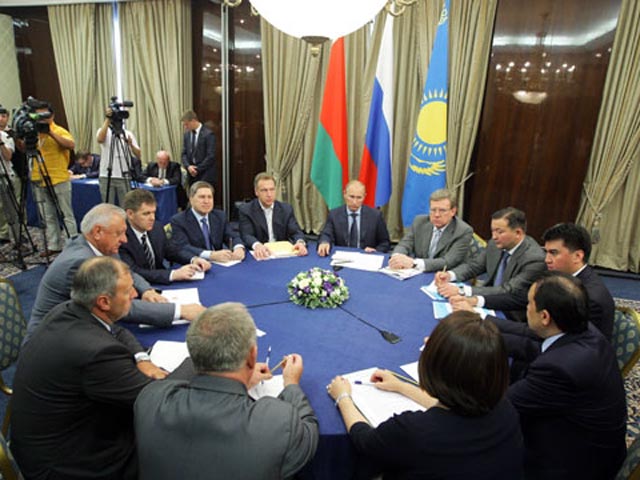
Having published his presidential ambitions , Prime Minister Vladimir Putin explained in detail about the prospects for the creation of the Eurasian Union in the post -Soviet space, which in the West had previously hastened to name an attempt to revive the USSR .
In his article, published in Izvestia , Putin directly states that this point of view is naive. “We offer a model of a powerful supranational association that can become one of the poles of the modern world and at the same time play the role of an effective“ ligament ”between Europe and the dynamic Asia -Pacific region,” he writes.
Recall that the premieres announced plans for the creation of the Eurasian Union in July as part of the Business Forum of the Customs Union between Russia, Belarus and Kazakhstan. He expressed the hope that the declaration of his education will be signed in 2012, and this ambitious integration project will begin work in a year - in 2013.
According to Putin’s plan, the Eurasian Union - this should be the following, higher level of integration, which is already taking place within the framework of the Customs Union and the Unified Economic Space (EEP) between Russia, Belarus and Kazakhstan. EEP "starts" on January 1, 2012 and creates a colossal market with more than 165 million consumers (about 500 million people live in 27 countries of the European Union - approx. Corny).
It was with the presentation of the EEP project that EEP Putin began the article, calling it "without exaggeration, a historical milestone not only for our three countries, but also for all states in the post -Soviet space."
The prime minister writes that citizens of a single economic space in which migration, border and other barriers will be removed, will be able to choose, where to live, receive education and work without any restrictions. Businessmen will also receive the right to freely choose which country to conduct business in Russia, Belarus or Kazakhstan.
Touching upon the previous model of cooperation, designed to save the production, economic and other ties of the former countries of the USSR - the Union of Independent States - the prime minister noted that "we can evaluate the effectiveness of the CIS in different ways, endlessly discussing its internal problems, about unrealized expectations, but it is difficult to argue with the fact that the Commonwealth remains to bring positions and develop a unified point of view on key The problems facing our region bring visible, specific benefits to all its participants.
“It was the CIS experience that allowed us to launch a multi -level and diverse integration in the post -Soviet space, create such demanded formats as the Union State of Russia and Belarus, the organization of a collective security agreement, the Eurasian Economic Community, the Customs Union and, finally, a single economic space,” Putin emphasized.
During the period of the global financial crisis, which forced the state to look for new resources for economic growth, the integration processes received an additional impulse. And attention was concentrated "primarily on the development of trade and production relations."
According to Putin, "in fact, it is about turning integration into an understandable, attractive for citizens and business, a sustainable and long -term project, independent of the differences in the current political and any other situation."
The prime minister noted that "it was such a task that was set when creating the EurAsEC in 2000," and "ultimately, it was the logic of close, mutually beneficial cooperation, understanding the commonality of strategic national interests led to Russia, Belarus and Kazakhstan to the formation of the Customs Union."
According to the prime minister, on July 1 of this year, control over the movement of goods was already removed on the borders of the three countries, "which completed the formation of a full -fledged unified customs area with clear prospects for the implementation of the most ambitious business initiatives."
Since 2012, citizens of the Russian Federation, Belarus and Kazakhstan will be able to freely choose where to live, study and work
EEP will be based on agreed actions in key institutional areas - in macroeconomics, in ensuring the rules of competition, in the field of technical regions and agricultural subsidies, transport, and tariffs of natural monopolies. And then - and on a single visa and migration policy. "That is, creatively applies the experience of the Schengen agreements that have become good not only for the Europeans themselves, but also for everyone who comes to work, study or rest in the EU countries," Putin writes.
The prime minister also emphasized that "for citizens, the removal of migration, border and other barriers, the so -called labor quotas will mean the opportunity to choose where to live, get education, work without any restrictions." “By the way, in the USSR - with its institute of registration - there was no such freedom,” he remarked.
Widespread opportunities are opening for business. “Now we are all switching to modern technical regions, and a coordinated policy will allow us to avoid technological gaps, trivial incompatibility of products,” the prime minister noted. “Moreover, each of the companies of our countries in any state will actually enjoy all the advantages of a domestic manufacturer, including access to state order and contracts.”
“Naturally, in order to gain a foothold in such an open market, business has to work on their effectiveness, reduce costs, invest resources in modernization. Consumers will only benefit from this,” the prime minister said.
Based on such prospects, it is logical to assume that a real "competition of jurisdictions", the struggle for entrepreneurs, will unfold between the EEP countries. “After all, every Russian, Kazakhstani, Belarusian businessman gets the right to choose - in which of the three countries he is to register his company, where to conduct business, where to engage in customs clearance of goods. This is a serious incentive for national bureaucracy to improve market institutions, administrative procedures, improve business and investment climate,” Putin explains.
“It is very important for us that the public of our countries, entrepreneurs perceive the integration project not as the apical bureaucratic games, but as an absolutely living organism, a good opportunity to implement initiatives and achieve success,” he emphasized.
The Eurasian Union will help to integrate into Europe faster and in stronger positions
At the same time, a gradual expansion of the circle of participants in the Customs Union and the EEP will also go through a full connection to the work of Kyrgyzstan and Tajikistan, the prime minister reports in his article. But this is not the limit. “We set us an ambitious task: to reach the next, higher level of integration - to the Eurasian Union,” he continues.
The Eurasian Union is an open project. We welcome the accession of other partners to him, and above all the countries of the Commonwealth. At the same time, we are not going to rush or push anyone. This should be a sovereign decision of the state, dictated by its own long -term national interests, ”Putin writes.
At the same time, he notes that "some neighbors of the Russian Federation explain the reluctance to participate in advanced integration projects in the post -Soviet space by the fact that this supposedly contradicts their European choice."
“I believe that this is a false fork. We are not going to be fenced out of anyone and confront anyone. The Eurasian Union will be built on universal integration principles as an integral part of the great European, united by the unified values of freedom, democracy and market laws,” the Russian prime minister emphasizes.
Putin notes that the customs, and in the future, the Eurasian Union will become participants in the dialogue with the EU. “Thus, joining the Eurasian Union, in addition to direct economic benefits, will allow each of its participants faster and in stronger positions to integrate into Europe,” the head of the Russian government concludes.
He is convinced that the creation of the Eurasian Union, effective integration is the path that will allow its participants to take a worthy place in the complex world of the 21st century. "Only together our countries are able to enter the number of leaders of global growth and civilizational progress, to achieve success and prosperity," he concludes.