
Translated material
Bread and Christmas trees
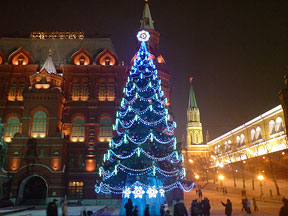
The Moscow authorities under Sobyanin did not abandon the practice of large -scale celebrations. New Year, for example, will cost a budget of 200 million rubles. A trifle, of course, but in the conditions of an unbalanced budget, leaves an unpleasant sensation. However, Muscovites are far from federals.
Moscow does not abandon the Luzhkov traditions of mass festivities for the holidays. This costs the budget is not that it is very significant, but still money. On the New Year, the design of the city will go twice as much as it was last year. According to RBC-Daily, in 2010, 90 million rubles went for registration, this year the holiday will cost the capital of 190 million.
The main article of expenses for the New Year is the installation of festive fir trees. 156 million of 190 - the number of fir trees compared to last year will double. The most expensive Christmas tree 11 meters high will be installed in the courtyard of the city hall and will cost the budget of 2.5 million. Muscovites and visitors will celebrate the New Year at once in three squares - Tver, Theater and Lubyanskaya, where the disco will be held. The cost of the organization of each of these events is about 5 million rubles. The design of the central administrative district of the capital will cost the most expensive thing - 12 million rubles.
Again-this accounting does not mean little in the context of other expenses of the Moscow budget. However, from the point of view of the symbols of power, an increase in expenses is more than indicative. The practice of the time of Yuri Luzhkov returned de facto when the holidays in the city were celebrated with pathetic and with an almost grand grand scale. City Day cost the city hall of 20 million rubles plus 200 million from sponsors. The last “Luzhkovsky” day of the city was as much. In 2008 and 2009, the city days were much cheaper. In the crisis of 2009, the city hall completely allocated less than $ 6 million on the city budget on the city budget.
Undoubtedly, there is also a Roman tradition that Moscow - the Third Rome - is quite excusable. In order to bribe plebs, Roman politicians from ancient times arranged for the distribution of products and circus performances. The Roman satirist Juvenal caustically described the morals of the Romans with the words “this people have long ... forgot all the concerns .... now restrained and only about two things, he dreams uneasily: bread and spectacles!”
With “bread” in Moscow, everything is even larger - the social sphere in the 2011 budget provides almost 16 percent of all the costs of the city (excluding expenses for education and healthcare and housing and communal services - more than half of the city expenses are obtained with them).
Thus, the metropolitan authorities, without any depending on the figure of the mayor, do not seek to limit the expenses on, seemingly non -productive and useless things, like mass festivities from the point of view of the urban economy.
Perhaps this is quite reasonably new power should adhere to continuity in the most safe areas from the point of view of the loyalty of the population. It is not for nothing that Dmitry Medvedev ordered him not to reduce social benefits when the Moscow Mayor was appointed to the post of Moscow mayor. A year on the eve of the election, it would be really short -sighted. Therefore, in 2012, Moscow promises not to increase travel tariffs in public transport.
Meanwhile, the deficit of the city budget, although it remains at the normal level, is quite impressive. In 2011, the deficit will increase by almost 100 billion rubles and will be 243 billion. Against this background, the policy of “bread and spectacles” looks rather dubious.
The state approved a doubtful for the balanced budget for the Army Refusement Program until 2020 at a cost of 22 trillion rubles. And those who tried to point out the redundancy and danger of these expenses, the Minister of Finance Alexei Kudrin was dismissed. Other federal expenses match the military. Against the backdrop of the federal government, the Moscow policy is directly a model of modesty.