
Translated material
Quantum technologies

Is the idea of a quantum computer real? How does the idea of the Russian quantum center see its creators? A series of interviews with physicists Oleg Astafyev , Alexei Kitaev , Evgeny Polzik and Alexei Ustinov took place during the first international quantum technology conference, held on July 13-17, 2011 in Moscow. Recently it became known that Alexei Ustinov became one of the second contest of megagrators and will create a laboratory at the National Research University of MISIS, and Oleg Astafiev conducted a series of experiments that may make it famous (but read about this in one of the following Nature numbers). Talked by Natalia Demina .
* * *
"Eyes are afraid, but their hands do"
Alexei Ustinov is a graduate of Fiztekh, doctor of physical and mathematical sciences, professor, head of the department of experimental physics, director of the Carlsruhe Physical Institute (Germany).
How real is the idea of a quantum computer? In your opinion, should we wait for him in the next 20 years?
I think that the use of quantum technologies for the benefit of mankind is very real and it will be noticeably quite soon and already happens. No need to reduce all the quantum technologies that we talked about at this conference, to quantum computers, because this is only one of the possible applications. It, of course, is difficult to implement, but the steps for its implementation and prototypes have already been demonstrated. As they say, eyes are afraid, but hands are done. And progress over the past decade has reached a colossal one.
In the field of quantum devices based on superconductors in which I work, 4-5 years ago it was difficult to imagine that today schemes of three cubes with errors of no more than a few percent would successfully work today. It's amazing. The times of the “life” of superconducting cubes have increased thousands of times over the past ten years. The progress is colossal. And of course, what will already go to the applications: these are quantum communications, quantum cryptography, quantum teleportation, i.e. The transfer of photons to a distance with the preservation of their quantum states. These are the technologies that have gone to life.
The conference discussed many beautiful and promising areas related to accurate devices, sensors, for the creation of which quantum technologies are used. This is what has a fairly large range of applications. Humanity will need not only quantum computers on which something can be calculated, because on the way to the embodiment of this idea, many what is already working and will be useful in the near future.
In my opinion, the idea of a Russian quantum center is a wonderful chance to create something high level in Russia. The main requirement is that the work of this center is evaluated on the Hamburg account, on the international panel. His International Scientific Council will consist of outstanding people, including Nobel laureates.
Will the money be Russian, and the examination is international?
The idea is to create a scientific center, which will be completely open in the international plan, which will attract here the best scientists from around the world for research. We plan to create it on the basis of the Skolkovo science city, since Skolkovo positions itself as an innovative center.
However, from the very beginning, we say that we are not going to promise some applications at once tomorrow. First of all, we want to make an advanced fundamental science, from which in the long run some kind of exit to the practice in the form of Spin -off can occur, which will bob up and engage in more applied quantum technologies.
But first, it is necessary to create a critical mass of several scientific groups that will work on topics reflected in the subject of our conference. The priority task is to make the Russian quantum center attractive to scientists, and over time and authoritative on an international scale. We would like to create a new scientific center that will have in the future a reputation comparable to Max Planck's institutions or similar quantum centers of other countries.
From right to left: one of the organizers of the conference Alexei Ustinov (University of Karlsruhe, Germany) with colleagues: Sergey Shitov (Institute of Radio Engineering and Electronics of the Russian Academy of Sciences) (in the center) and Andrei Pankratov (Institute of Physics of Microstructures of the Russian Academy of Sciences, N. Novgorod) (left)
Such quantum centers have already been created in several countries of the world and have their own characteristics. In Singapore there is a center engaged in theory. There is a quantum institute between Harvard and MIT in the USA, there is a similar institution in Canada. Another strong condensation point is Innsbruck (Austria), a quantum center where fundamental quantum experiments were made. In fact, this is a very important topic for modern science, and Russia has a chance to prepare a breakthrough in this area, based on quantum technologies.
It seems to me that in our country it will be possible to do something more interesting from the point of view of the experimental part. I judge this at least on the basis of the fact that a huge part of quantum science was created with the active participation of Russian scientists. Many founders of quantum science and laser optics have worked and are now working in Russia. And as for the solid state systems that I am engaged, a lot is being done in Russia.
You have submitted an application for participation in the 2nd competition of megagrators. What do you expect from this competition?
I hope there is a chance that my project will be among the winners. This is a substantially improved version of the project, which I already submitted in 2010. It seems to me that the first competition was very successful. Among the people who became winners and whom I know in the field of physics are Vladimir Evgenievich Zakharov and Yura Kivhar , these are very worthy people. I have no doubt that there was an absolutely objective international review. I believe that this is a very good business carried out according to international rules, and I would like this to continue further. I would like to revive and renew something in Russia.
I am pleased that if you win, you can be more in Russia.
I am very interested in this and would like to do something useful for the country that gave me an education that I love and in which I want to be more often.
Our task is to engage in And fundamental things, because without investing in science and education, you can not build either an innovative city or anything truly and competitive.
* * *
"Quantum computers have already been created"
Eugene Polzik ( Eugene Polzik ) - Professor of the Institute Niels Bora, Director of the Danish Center for Quantum Optics, Academician of the Royal Academy of Sciences Denmark.
How real is the idea of a quantum computer? Will it be possible to create it?
It depends on what you are ready to call a quantum computer. Firstly, you need to understand well that the quantum computer will not replace you with a laptop. Such computers can solve only certain problems. The most important (Front-Runner) tasks are quantum simulations that Richard Feynman also spoke of. You make a quantum system - an artificial system of atoms or ions - and in it model the properties of systems that you can’t build otherwise. And there are already such systems, and they will be improved, they will give predictions that, using ordinary computers, simply cannot be counted.
Evgeny Polzik (left ) with Pavel Bushev (University in Karlsruhe, Germany)
You can also talk about smaller quantum computers. It can be assumed that small computers that still have these entanglement, these related conditions, they can serve for very sensitive sensors, for very sensitive measurements beyond quantum limits. And such things are already being done. This is a rudimentary quantum computer.
Those. In a sense, quantum computers have already been created, and this area of science will develop. Based on how many wonderful scientists work on this topic around the world, something interesting will be sure.
* * *
"We can control single quanta"
Oleg Astafyev -in Fiztekh's ibalnik, candy-fis.-mat. Nauk, Principal Researcher Nec Green Innov. Research Labs and Riken (Japan):
How much does the idea of a quantum computer seem real to you? Do you need quantum technologies?
Of course, we need it. Even if the quantum computer is not made, then some new technologies and ideas will appear during our research. Humanity needs to move forward. We need a goal that everyone will strive for. In fact, what scientists have learned to do over the past 10-20 years are amazing things.
What did you manage to do over the years? Can you list the main stages?
Scientists have learned to manipulate with single quanta and not just manipulate them, but coherent, i.e. Without losing quantum information. Separate quanta, individual atoms, individual photons, again without losing coherence. Isn't that an amazing thing?!
In the photo: Oleg Astafyev
Are you a theoretical physicist or an experimenter?
Experimenter. I work with superconducting solid -state cubes.
What is a solid -state cube?
A solid -state cube is a quantum macro -system. It consists of a large number of atoms, but behaves in a quantum way, i.e. It is also essential as an ordinary atom.
Those. Can it be seen in a microscope?
Yes, yes, you can look at it in an optical microscope and its dimensions can be up to a micron. Superproofing allows you to make such a quantum system because there is no dissipation (as amended by lat. Dissipatio - “scatter” ), energy loss. Supercurry - it is incredible.
What is the Cubit physically?
This is a quantum system. At school, we were all told about the atoms that they have energy levels. Cubit is actually an artificial atom. An ordinary atom is very small, but you can collect a lot of atoms together and make a quantum system from them using superconductivity or spatial quantization. Those. Cubit is an artificial system consisting of many atoms, but behaving as one object, in the main features as an atom.
In fact, the cubes can be made not only on artificial systems. They try to make it on real atoms, in fact, the first half of the conference in Moscow was devoted to this - optical cubes and quantum effects on single atoms. If earlier physics studied quantum effects in a large number of atoms, now manipulations occur with single atoms. I repeat that now amazing things are happening in quantum physics.
Scientists descended to such a microworld!
They could not do this before, but now in this area very much progress has been achieved.
As far as I remember from the university course of quantum mechanics, it is counter-intuitive, have you already developed intuition in quantum mechanics? Can you understand in advance how the particles will behave?
Of course, yes. Since we have been working with them for a long time, that is, experience, we know that to expect from our system, but really in some areas it is counter-intuitive. Some things are really unusual and do not appear in our ordinary world.
What is most surprising and amazing you in the behavior of quanta?
It is surprising that we can control single quanta, that we manipulate them without losing information without losing coherence.
* * *
If you continue the traditions of the collection "Physicists are also joking", then we could say that quantum physics is gesture physics. This could be judged by the discussions that on the sidelines led among themselves physicists gathered at the first international conference on quantum technologies in Moscow.
* * *
In the photo: Alexey Gorshkov (Kaltech) (right)
* * *
Foreign conference participants
* * *
* * *
From left to right: Eugene Polzik , professor of the Institute Niels Bora, director of the Danish Center for Quantum Optics, academician of the Royal Academy of Sciences Denmark with Pavel Bushev (University in Karlsruhe, Germany).
* * *
In the center: Vladimir Manucharyan (Harvard University) and Alexei Kitaev (Kaltech)
* * *
From left to right: Yuri Makhlin (Institute of Theoretical Physics by L.D. Landau RAS) and Evgeny Ilyichev (head of the group of quantum detection laboratory Institute of photon technologies (iPht), Ina, Germany)
Photo by Natalia Demina.
See also: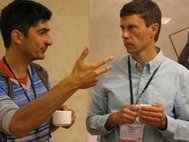 Another computer