
Translated material
Kharitonenko? And who is it?

At one time, the owners of “factories, newspapers, steamboats”, we really know little about business people of the Russian Empire - merchants and bankers. In the best case, we recall a dozen names, and then if the buildings built at their expense or the collections they collected as they were once named in their honor, and are called to the present day. The recent generation was no longer, for example, the Soldatenkovsky hospital (the Moscow City Council adopted a decision on its renaming to the hospital named after S.P. Botkin in December 1920, celebrating the 10th anniversary of the hospital). To find out who, in fact, the Soldatenkov himself was, at least Wikipedia is needed.
It is not surprising that the name Kharitonenko did not say anything to me, while, looking for buildings of A.V. on the network. Shchusev, I did not find a wonderful beauty Church - the temple of the Savior in the village of Natalievka (according to the then administrative division - the Kharkov province). This church was ordered by Shchusev and elevated at his own expense a certain Pavel Ivanovich Kharitonenko (1853-1914), a millionaire-saharzavodchik, who created a lot of wonderful and even unusual at the beginning of the last century in the beginning of the last century: a landscape park with rare breeds of bushes and trees; Manege with glass walls. Schusev also erected in Natalievka the entrance gates and other outrageous buildings in the Russian style; On the walls of the Church, bas -reliefs of Konenkov’s work were preserved. The original architecture has not been preserved by the manor house, known to us only from the photograph.
It turned out that in the nearby village of Kachanovka Pavel Ivanovich Kharitonenko acquired the estate for his daughter Elena (now the estate was restored and open to visits; see http://agritura.livejournal.com ).
It would be strange to stop here ...
Pavel Ivanovich Kharitonenko was the son of a merchant-Sakharozavodik Ivan Gerasimovich Kharitonenko (1820-1891), a remarkable person in different respects. Ivan Gerasimovich, who at one time graduated from only a parish school, later became a merchant of the first guild and a real state adviser. He owned a dozen sugar factories and founded the trading house "I.G. Kharitonenko with a son ”, who was engaged in sugar. In 1874, its trade turnover exceeded 20 million rubles. silver per year.
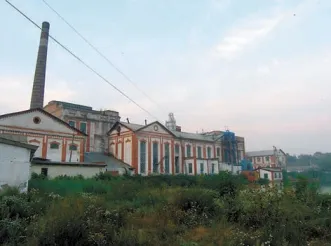
Although Kharitonenko Sr. did not receive a systematic education, he was undoubtedly a gifted person. In his native Sumy, he built churches, schools and hospitals, paid for the maintenance of students, constantly contributed a lot of money for the maintenance of hospitals and educational institutions, and not only in his native Sumy, but also in Kharkov.
And he loved Suma passionately, sought for his inhabitants the possibilities exceeding the city city at that time: for example, with the highest permission there was opened a cadet corps. The townspeople paid Ivan Kharitonenko with sincere sympathy.
In 1896, the children's hospital of St. Zinaida; Even a children's pharmacy was created. Natalya Maksimovna Kharitonenko, the widow of Ivan Gerasimovich, sacrificed another estate for the organization of a shelter for girls.
In the will, Ivan Gerasimovich ordered his son Paul to continue charitable activities. The text of this will is available on the network; He makes a strong impression both as an act of completing the earthly life of a deeply religious person, and just as an authentic document: a non-archivist rarely dealt with such materials.
The testament ended with the words: “Finally, I will bequeath my whole love to my wife Natalya Maksimovna, my son Pavel Ivanovich, daughter -in -law Vera Andreevna and my dear grandson and granddaughters. I ask them to love each other and love the city of Sumy the way I loved. ”
At the mourning ceremony, the then Kharkov Archbishop Ambrose said: “In his life there was a peculiarity that distinguishes him among the rest. He did not receive a scientific education. But it was struck by the development of the mind and various information acquired through self -education. He decently loved the Fatherland and had true concepts about the means of organizing his well -being. Ivan Gerasimovich passionately loved commercial activity, as the scientist loves his science, as the artist loves his art. ” (cit. at http://rusk.ru/st.php?idar=154506 ).
The son, Pavel Ivanovich Kharitonenko, who received a home education, was surprisingly in all his endeavors. He significantly reformed sugar production and made it as effective as possible for that time - at least one of his sugar factory (in paraffiev) works at this time.
Pavel Ivanovich was musical, well acquainted with the entire art elite. He was friends with Nesterov; Serov and Somov wrote a portrait of one of his daughters - Elena (in the marriage of Urusova, in the second marriage - oliv), which collected objects of decorative and applied art. This collection was so significant that it was dedicated to a series of materials in the magazine "Old Years", which later compiled a separate brochure "Collection of E.P. and M.S. Olive. PG. ", 1916).
Pavel Ivanovich himself was an honorary member of the Imperial Academy of Arts and the first chairman of the Society of Friends of the Museum of Extraordinary Arts, for which he sacrificed a lot of money. For many years he was the director of the Moscow branch of the Imperial Russian Musical Society; Twenty students of the Moscow Conservatory received a scholarship from Kharitonenko.
In the Temple of the Savior in Natalievka, a wonderful collection of Russian icons collected by Pavel Ivanovich was to be placed, mainly Novgorod writing: the temple was conceived as the place of the exposition of this collection.
Even during the life of Kharitonenko Sr., the subsequently became the famous mansion on Sofia embankment in Moscow, which became the famous mansion, was acquired. The interiors of the mansion Pavel Ivanovich ordered F.I. Shekhtel, then a novice architect (later, at world exhibitions in Paris and Glasgow in 1900-1901, Kharitonenko had its own pavilions that Shekhtel also designed).
Surprisingly, thanks to different departments that were engaged in foreign affairs during Soviet power, the interiors of Shekhtel on the Sofia embankment were preserved in almost unchanged form, as well as the appearance of the mansion, once designed by the famous architect V.G. Zalessky.
According to the will of his father, Pavel Ivanovich donated land and 500,000 rubles. On the structure of the cadet corps in Sumy (1899-1900), this is the only way to achieve the organization of the cadet corps in the county city. The project of the monument to Father Pavel Ivanovich was ordered by A.M. Guardian, author of the monument to Pushkin in Moscow. The monument to Ivan Kharitonenko stood on the central square of Suma until 1924, then he was destroyed and restored not so long ago.
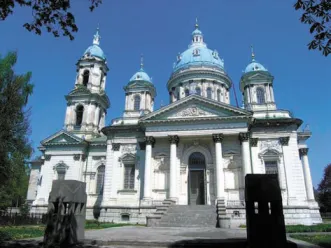
By order of P.I. Kharitonenko in Sumy with the participation of Shchusev built a Trinity Church - essentially a large cathedral. In addition, wanting to compose something like a guide to the city, Kharitonenko invited famous photomasters, as a result of which more than 300 pictures were imprinted.
When in 1899 Kharitonenko was erected into a hereditary nobility, on the coat of arms the motto was “rising by labor,” He died in 1914 in his Natalevka from tuberculosis - apparently from the form that was then called the "fleeting" - and was buried next to his father in the Peter and Paul Sumy cemetery. The family - a widow, son and daughter - emigrated in 1918.
Parks and estates in Kachanovka and Natalievka, as well as the Church and civilian buildings in Sumy, did not avoid tendering and vandalism. However, in private photographs of 2009, we see restored churches and estates and a very cozy green city of Suma.
I note in conclusion that the textbook-signal picture of Kramsky “Unknown” fell into the Tretyakov Gallery from the collection of Pavel Ivanovich Kharitonenko.
Rebekah Frumkin