
Translated material
Acceleration strategy in action
The 2011 Nobel Prize of Physics was awarded "for the discovery of the accelerated expansion of the universe by observing distant supernova." The work was completed by two competing groups of observers, and now their conclusions are confirmed by a large set of experimental data.
One paragraph is a modern astronomical picture of the world, starting with the simplest facts, can be described like this. We live on a spherical soil, which, like other planets, rotates around the sun. The sun is a star, along with several hundred more billions of such luminaries, it is part of the galaxy. In addition to stars, the Galaxy includes an interstellar medium - gas and dust from which stars can be born and which the stars enrich, throwing out the substance throughout their evolution. Our galaxy is only one of many. There are several hundred billions of large galaxies in an accessible region of the universe. The universe evolves. Far galaxies are removed from each other due to the expansion of the Universe, which began 1314 billion years ago. In addition to a conventional substance that makes up only about 5 % of the density of the universe, there are dark substance (about a quarter of density) and dark energy (about 70 %). Due to dark energy, the Universe expands accelerated the last few billion years. Here for the opening of the last fact, the Nobel Prize was awarded.
Three scientists who have received a prize are leaders of two different international research groups who conducted independent research on similar methods using more or less the same tools. Sol Perlmutter (S. Perlmutter) from the Lawrence National Laboratory in Berkeley headed Supernova Cosmology Project. Brian Schmidt, who worked in 1998 in the Australian observatory of Mount Strings and Siding Springs, and Adam Rice (A. Riess) from the University of California (now he works at the University of Jones and the Institute of the Space Telescope, USA ) Supernova Search Team. In 1998, they presented the results of data processing for several dozens of supernova IA on red displacements about 0.16-0.83, which corresponds to about 2 to 7 billion years ago.
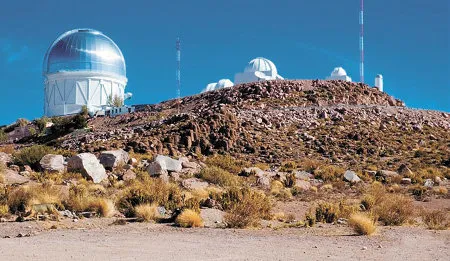
Supernovovs opened mainly on a 4-meter telescope in the Observatory Sierro Tololo in Chile, and then observations on larger instruments (for example, on the telescopes named after Kek) to determine red displacements. The result was two lists of several dozen distant supernova types of IA, for which distances and (independently) red displacements were known.
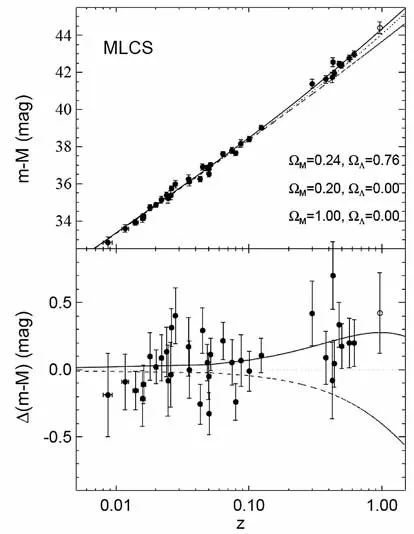
Supernomous types IA are associated with explosions of white dwarfs, whose mass due to the accretion of the substance in the double system exceeded the maximum one. They have an important feature. For most of them, you can determine the luminosity by the known parameters of the change in shine. Therefore, knowing the visible shine and true luminosity, we can determine the distance. Knowing the distances and red displacements for several objects, we can determine the various parameters describing the dynamics of the expansion of the universe within the framework of the basic cosmological model.
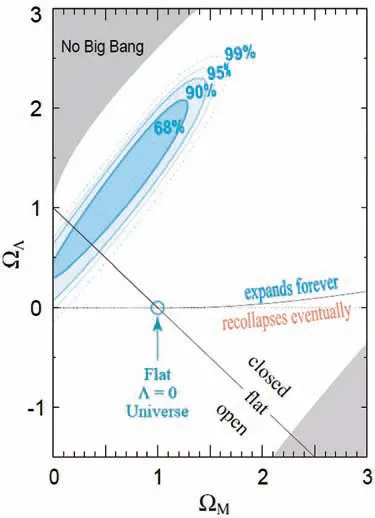
Data measurements and processing showed that supernovae are a little (10-15 percent) further than they should if the expansion of the universe slowed down. It is important to recall that at that time other observations were given at that time. On the one hand, observations of the relict background said that the density of the universe should be close to critical. The critical density corresponds to the “flat” universe, the expansion of which will slow down, striving to zero, if the universe is filled with ordinary substance. The authors of Supernovov’s work showed that if the density is critical and is determined by the usual (including dark) substance, then such a model does not withstand comparison with their data. On the other hand, many works said that ordinary (again, including dark) substances-about 20 % of the full density. And again, the authors showed that a model in which there is only a conventional substance with a density of 0.2 critical, does not correspond to reality if they use their results. Then a new parameter was added that corresponds to the contribution of something that makes a positive contribution to the density, but does not lead to the inhibition of the expansion, but to its acceleration. Such something should have negative pressure, and by 1998, theorists have already come up with several opportunities for such an impossible substance.
For the first time about the possibility of the existence of something with the properties of “anti-gravity” (i.e. negative pressure) in cosmological models, Einstein spoke. He introduced the so-called “lambda-member” into the equation for the dynamics of the universe in order to balance the gravity forces, striving to compress and get a stationary universe. Subsequently, with the light hand of George Gamov, they began to say that later Einstein himself considered the introduction of a lambda-member by his biggest mistake, although independent sources did not confirm such a sharp judgment of the great physicist. Then the models of the Universe, expanding at a high speed, were analyzed by de Sitter and other scientists, but all this never tried on the current state of the universe. A little later, the stage of the Desitter type became even a standard element of the cosmological picture.
Since the mid-60s, the model of the inflationary universe, which appeared in the formed form already in the 80s, has its history. She says that in the very early history of our world, about 10-36 s after the formal moment “zero”, it was short, about 10-33 s, an episode of a very fast expansion under the influence of a special field-inflaton. It was the stage of inflation that made our universe flat, homogeneous and isotropic, it was the decay of inflaton that made the universe hot. But, again, discussions of such accelerated expansion were not related to the present.
That something with negative pressure that we have now is called dark energy. The name was proposed by M. Turner in 1999. Nature is unclear. Maybe this is some kind of decaying field, and therefore the observed acceleration is only an episode, and then a slowdown in the expansion will begin again. Maybe we are dealing with a classic lambda-member (or, as they say, with a cosmological constant), which “confronts” gravity. Then, having begun to dominate the dynamics of the evolution of the universe once, dark energy will continue to accelerate the expansion. The surroundings of our local group of galaxies will gradually thin. Finally, maybe we are dealing with a field that will not only accelerate the expansion of the universe, but will become so significant that it will begin to break out and related structures such as galaxies or, in the end, stars, planets and their inhabitants. This is a model of the so -called big gap (Big Rip). It is not very popular, but so far it cannot be said that it is completely closed. What do we know about dark energy now? Firstly, thanks to the works of Perlmutter, Rice, Schmidt and their colleagues, we learned that it is. They tried to criticize the results of Supernovov, as the authors did a strong extrapolation. They applied our knowledge about close supernova IA to distant objects. However, today there is a whole range of data indicating in favor of the existence of dark energy, i.e. In favor of the fact that qualitatively the results of 1998 are true. Combining the data on Supernovovs together (which are now much more than 13 years ago, not tens, but hundreds), on relict radiation, various data on the spatial distribution of galaxies, according to the so -called weak lenszing and many others, within the framework of the standard scenario (isotropic and homogeneous universe, the fidelity of the general theory of relativity, etc.) The contribution of dark energy to the complete density is estimated 70-80%.
Secondly, we know that dark energy began to dominate the dynamics of the expansion of the universe not so long ago-about 7 billion years ago. Thirdly, the dark energy is evenly distributed everywhere and does not show any tendency to “getting bored”. Fourth, we know that modern data on dark energy does not require its strong evolution over time. Actually, at the modern level of accuracy, the evolution of dark energy is simply not visible, and its properties can be described by standard cosmological constant.
To figure out what dark energy is, new data on the observations and efforts of theorists are needed. In the near future, it is planned to commission new tools to clarify the cosmological parameters and identify the details of the dynamics of the past evolution of the Universe. This will allow you to discard many models. Further, theorists will continue to build models in which dark energy arises naturally. To verify (and inspiration) of such models, various efforts of the experimenters are needed, not only astronomers. We are talking not only, say, about accelerating experiments, but also about experiments on the study of the properties of gravity (verification of the law of universal gravity) on a small scale - at the level of millimeters or less.
The presentation of the Nobel Prize for the last (today) important fact that forms our cosmological picture of the world, proven by independent dimensions and sets complex important tasks for both astronomers-observers and experimenters in laboratories and theoreticians working in different areas, seems to be a more than true solution. But there is no doubt that in the future the prize is still waiting for those who will answer the question: “What is still behind the phenomenon discovered by the 2011 laureates?”
Sergey Popov