
Translated material
Pay for luxury
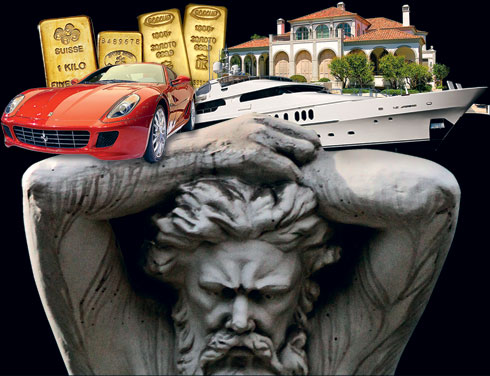
Taxes on the march. The State Duma plans to make changes regarding individuals to tax legislation. The meaning of innovations - the rich should share with the state more generous. Whom the state considers rich and what surprises are waiting for citizens in the fiscal sphere - the new tax transformations found out to the new tax transformations in his speech at the recent congress of United Russia. He spoke in ensuring that the tax system in the country became "as fair as possible." And for this, according to the prime minister, it is necessary to increase taxes on “consumption, real estate and property for people with great income” - for those rich citizens who, according to Putin, are becoming more and more in Russia.
 |
| Click to increase |

Rich - Share! According to the experts surveyed by The New Times, the most likely areas of tax increase for the rich in Russia are the introduction of luxury tax, real estate, as well as a return to the progressive income tax scale.
Alexandra Suslina, an analyst at an economic expert group, believes that there are no contraindications for the introduction of a luxury tax today: “On the one hand, its introduction will force more to spend the money of those who have it in abundance. On the other hand, it will force them to share, if they are so wealthy - especially in a crisis time, when income is significantly lower than expenses. ” Suslina recalls that in France, on the initiative of the rich citizens themselves, the so -called solidarity tax was recently introduced
* * It is paid at an increased rate by those citizens whose annual income exceeds € 1 million. “Real solidarity with the people is precisely in this,” the expert says.
However, Russia has its own experience here: in May 2010, the State Duma rejected the bill, initiated by justice, which suggested that owners of expensive cars, yachts and country houses would pay 1-5% of the value of property annually. Then it was proposed to include residential buildings, apartments, cottages and other buildings, premises and structures, lands worth from 15 million rubles, cars, airplanes, helicopters, yachts, boats more than 2 million rubles, precious stones and products from them, works of painting and sculpture costs from 300 thousand rubles. “The reluctance of deputies to vote for this tax shows that all the talk about the introduction of luxury tax is just the election rhetoric, which caresses the electorate’s hearing,” says Igor Nikolaev, head of the FBK strategic analysis department.
Anton Danilov-Danilian, vice president of Business Russia, categorically against such innovations: “It is not clear what to mean by the term“ luxury ”. There are concepts of property, real estate, excisable goods, but there is no “luxury” in the legislative list. ” The expert is sure: if such a tax is introduced, it will spur corruption - it will always be possible to bargain about what to consider a luxury: “The question arises: the Ford Focus car is a luxury or a means of transportation? Who will determine this line? Maybe an elementary bribe? "
The new scale for establishing social justice needs to introduce a progressive income tax scale, says Mikhail Delyagin, director of the Institute for Globalization Problems: “People with an income of more than $ 20 thousand per month would pay 20%tax, the rest - 13%. And people with income below two living wages (13 thousand rubles) would not have paid income tax at all. ” According to the expert, the current flat income tax scale is unfair: “Giving 13% for people with income below two living wage and with an income of 500-600 thousand rubles is a completely different social effect.”
"
The Holy Tax campaign on the rich may be reduced to the fact that the main fiscal blow will be on people with an average income
"
 |
| Click to increase |
If you introduce a progressive scale, rich people will begin to register in other jurisdictions, Anton Danilov-Danilian warns: "They will not pay here anyway." Igor Nikolaev is sure that the flat scale will remain: “I do not believe that it is touched. The authorities have repeatedly said that this scale is their great achievement. She was introduced in order for the economy to get out of the shadow, at least Putin explain so. What now, back into the shadow? "
Five cadastres are no easier to deal with real estate tax. The supervisor of the Higher School of Economics Evgeny Yasin recalls: talking about the need to pay this tax from the market price of real estate from the 90s, but everything rests allegedly in the absence of cadastrals for accounting for real estate at market value. Recall that the meaning of the cadastral assessment is to give a market price to these objects, which are still evaluated according to the norms of BTI, which have little in common with reality. “Yes, for such a period, one could have time to make five cadastrals,” Yasin is sure. But those rich, who should just pay high tax on their real estate, taking into account its market value, apparently, block its introduction, Yasin is sure.
“So far, we only hear conversations that a single cadastral assessment should be made that not all regions are ready,” says Igor Nikolaev. Last summer, the head of the Ministry of Economic Development, Elvira Nabiullina, said that a single real estate tax would be introduced after the cadastral assessment of the capture objects was completed (the land has already been evaluated). The fact that the evaluation process was delayed, Nikolaev sees a specific intent: “It is simply the high officials themselves, on whom the prospect of the introduction of this tax depends, and must fall under this taxation. Who wants to overplay yourself with an additional tax? "
“I won’t be surprised if, even ten years, the performers will not create a working mechanism for the collection of this tax and will still talk about the need for additional work,” Pavel Medvedev, a member of the State Duma Committee on the financial market, shares this opinion.
Some other experts, however, notice that the rich do not need to block and sabotage anything. They will always have the opportunity to “agree” with the right people regarding the “real market value” of their real estate. “A single real estate tax is conventional,” Delyagin believes. - A regular real estate market with constant transactions exists only in a few largest cities in the country. In Moscow, the concept of a market price is still valid, and, for example, it is already impossible to determine the market value of the apartment in some village of urban type. ” According to Delyagin, this means that the cost of the apartment will be evaluative companies. And a rich person will always be able to agree with the official, so that he appreciates his palace on Rublevka, relatively speaking, at the cost of a three -room Khrushchev.
The poor person will have a different situation. Local authorities need to increase tax revenues at all costs. And nothing will prevent an unreleased appraiser from calculating the cost of a typical three -room Khrushchev on the outskirts as a three -room stalin in the city center. “In such conditions, real estate tax will become a way to expel the poor and even medium -expired population from the prestigious fashionable areas,” Delyagin suggests. After all, there are still ordinary people with gardens on the Rublevo-Uspensky Highway and poor citizens with apartments in the center of large cities.
The climate summed up experts warns: talking about increasing taxes can completely result in the fact that the blow will not be rich, but in the middle and poor layers, as it turned out in the case of insurance contributions. We are talking about reducing contributions to social funds from the current 34% for a long time, and the schemes were offered different. At the end of August, the Ministry of Finance on his website posted the final version of the “main directions of the tax policy of the Russian Federation for 2012-2014”, and Prime Minister Putin approved it. In accordance with this document, the rates of contributions to social funds for 2012 will amount to 30% from annual salaries up to 512 thousand rubles (in 2013 - up to 567 thousand rubles) plus 10% from the amounts exceeding this threshold (for beneficiaries - 7%). A simple calculation shows that if the employee’s salary is more than 60 thousand rubles per month, then for the employer such a decrease in contributions from the current 34% to 30% turns into an increase.
This is concerned about the head of the RSPP Alexander Shokhin: “We have repeatedly said that such a regression can lead to the innovative sectors of the economy, where salaries are higher than the average in the country, the load on the wage fund will be even higher than the universal rates of 34%operating this year.” Therefore, Shokhin notes, the bets of insurance premiums must be counted again so as not to get the next tightening of the tax press for the business.
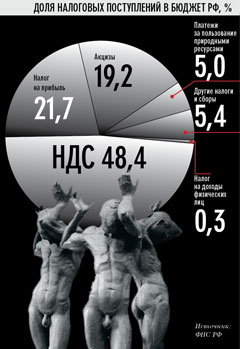
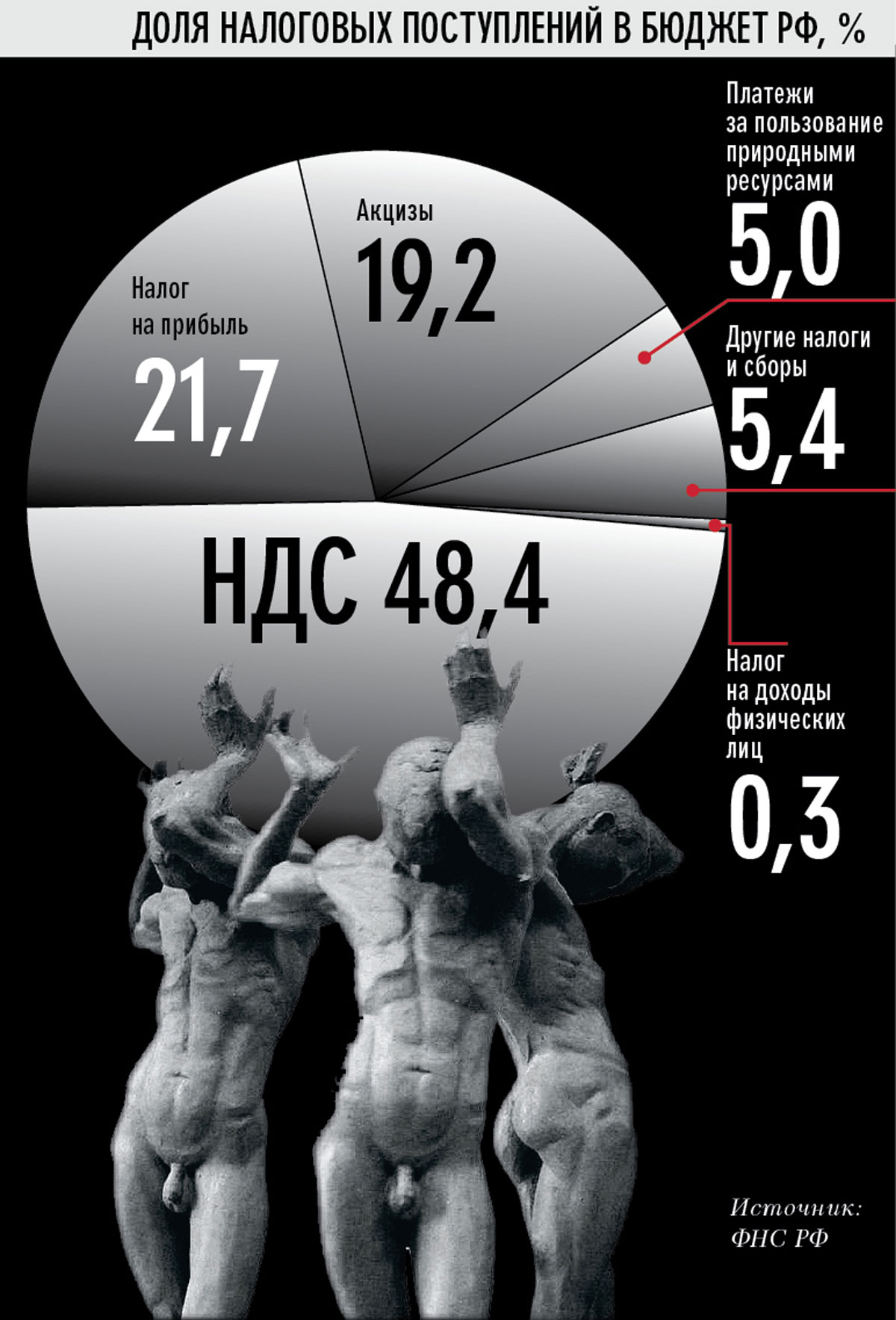
As a result, the Holy Tax campaign on the rich may be reduced to the fact that the main fiscal blow will be on people with an average income - owners of typical three -room apartments, used cars, six hundred and salaries of 60 thousand rubles. As for the employers, they have already shown on the example of insurance premiums that they are ready, instead of giving new taxes, lowering the salary or issuing it in envelopes. And for the state budget, the result of the tax redistribution will most likely be little significant, says Evgeny Gavrilenkov, the chief economist of the Troika Dialogue: “Our tax system is such that about half of the revenues to the budget comes from oil. Given this, the effect of the upcoming changes in it will most likely be inconspicuous. ”
In Russia, the tax burden is not at all beyond the world standards, according to Alexander Suslin from the economic expert group. Therefore, the problem is not at all in tax rates, says the analyst: “There is no need to invent new taxes. Business needs to create a normal institutional environment so that it does not seek to go into the shadow. ” However, the experience of recent years shows: the improvement of the investment climate is a task for the authorities is much more complicated than the adoption of a new tax.