
Translated material
The genome of a naked digger
The “Genoma of the Naked Sino” is not the name of the novel by Pelevin or Sorokin, although this text is read, consisting of 2 billion 700 million letters, with no less interest. The point is the unusual of a living creature, the genome of which was described on October 12 in the electronic preprint of Nature magazine. Mikhail Gelfand says what this study and its object are remarkable.
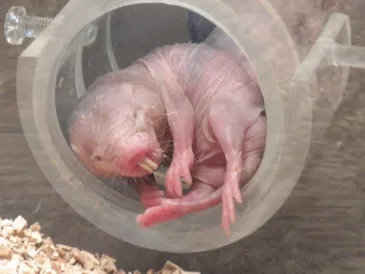
H Eterocephalus Glaber (in English Naked Mole Rat- Naked Mole rat, naked digger) is a rodent, a relative of the mouse-like rodents that lives in East Africa (Ethiopia, Kenya, Somalia). They reach a length of 8-10 cm and weigh about 30 g.

Naked diggers live in colonies in holes underground. The total length of the colony moves can reach several kilometers. Each colony consists of Koroleva female (it is larger and weighs 50 g), several (no more than three) propagating males and several dozen (up to three hundred) workers. Most of the workers are relatively small, their role is to dig a hole, to get food and feed the cubs. Larger workers are the defenders of the colony. Workers do not multiply; The queen is extremely hostile to the manifestations of sexual behavior in workers. When the queen dies, one of the self-workers takes her place, often after a harsh struggle between several contens.
Naked diggers feed on plant tubers. A scout who stumbled upon a tuber calls other workers to him. At the same time, they repeat the path of the scout, even if it is not perfect, which indicates the presence of chemical tags (this was confirmed in a laboratory experiment with replaced tunnels). Workers rush a hole in the peel of the tuber and then eat it in a little bit from the inside, without eating the whole and allowing to overgrow for many months. They dig a hole, forming a kind of conveyors: the first digger is loosening the earth with incisors (a specialist in naked diggers Chris Folks from the University of London, Queen Maria, calls them “saber -toothed sausages”), and the chain of animals behind him throws each other with their paws up to the surface.
Another caste, morphologically different from the workers, the queen and her males, are individuals who form new colonies. In laboratory experiments it was shown that naked diggers prefer to mate with individuals not from their colony, and field observations showed that new colonies (with just a few individuals) are usually formed by a female and a male from different colonies. How exactly does the formation of a new colony are not known, however, since lonely living males and females were seen, apparently this is due to the abandonment of the mother’s colony and an attempt to settle separately in the hope of meeting a partner. Since in favorable conditions the distance between neighboring colonies is several hundred meters (up to a hundred), apparently, this is not a completely hopeless enterprise.
The physiology of naked diggers is very unusual and reflects the extreme forms of adaptation to underground existence. They have no wool and subcutaneous fat; They do not feel some types of pain (burn with acid and capsaicin - a burning substance contained in red pepper); They are able to tolerate very low oxygen concentrations and high - carbon dioxide; They do not drink, extracting all the water from food; To save food, they practice eating their own excrement and dead cubs (otherwise they are vegetarians); They - the only mammals - are not capable of maintaining constant body temperature and regulate it, moving between the subsurrent and deeper areas of the hole.
All this is already enough to make a naked digger one of the most interesting animals. But biologists are interested in mainly because of another set of features. Naked diggers live up to 30 years - many times more than other rodents, they have no visible signs of aging, breeding (the queen and her males) to the very end, and they do not suffer from cancer; Moreover, attempts to experimentally cause cancer have not yet been successful.
Among the authors of the article about the genome, most of the scientists of Russian origin are made up of. We ask questions to the project manager, professor of Harvard University Vadim Gladyshev.
- The analysis of the genome carried out in the Ashi work made it possible to establish the genetic causes of many physiological features of naked diggers. Among them are the unique features of the UCP1 gene, the product of which is the main protein that allows thermoregulation; the absence of part of the regulatory area of the gene encoding neuropeptide P, which plays the main role in the feeling of some types of pain; Changes in the genes important to vision and the formation of hairline. An analysis of the intensity of genes in different conditions made it possible to detect features in genes associated with basic metabolism and breathing. But the name of the article mentions not only physiology, but also long -lived. What did the analysis of the genome have to explain the unusual life expectancy of naked diggers and their resistance to cancer?
- Slow aging is the most interesting property of naked diggers, and several of our observations are associated with the analysis of this phenomenon. For example, we found that human and mice genes, which change expression in aging, behave in many ways differently in naked diggers. We also described the changes in the P16 GEL, which is directly related to many aging diseases, including cancer, and in several components responsible for the telomerase function. And the actually unusual thermogenesis and the ability to live with low oxygen, possibly associated with slow aging.
- What can you still be useful to knowledge of the genome?
- It seems to me that at present, to study the specific organism, knowledge of the genome is as useful as, for example, the theory of evolution for biology. This is the basis on which everything is strung, and the system for study. In this regard, a naked digger is no different from other organisms. It is only strange that the genome of such an interesting mammal was not defined before.
- Among the authors of the article, scientists from the USA, South Korea and China, and for the first four authors - two of Korea and China - an equal contribution is indicated. How was the work organized?
- One group is still difficult to master large genomes, where the contributions of different specialists are needed. In our case, animals were from the USA. We prepared samples in Boston, and determined genomic sequences in China. The analysis was carried out in Korea, the USA and China. Since the body is really very interesting, there were no problems with motivation, and authorship reflected the contribution of different participants to this project.
- The BAS has three places of work - Harvard Medical School, the joint Institute of Harvard and the Massachusetts Institute of Technology and the University in South Korea. How would you divide your working time between Boston and Seoul?
- My laboratory is located at Harvard's medical school, in the branch of the genetics of the Hospital Brigs. In addition, I am an associated member of the Broup Institute in Boston and a university professor in Seoul. I am in South Korea several times a year, but I spend the main time in Boston.
- Among the authors of the article there are many scientists of Russian origin of several different groups. As it turned out that you met to implement this project - is it an accident or a reflection that it is easier to work with compatriots?
- Then several factors played a role. Firstly, in my laboratory there are many people from Russia, and several of them participated in the genomon project. Secondly, in our department there is another professor from Russia-Shamil Sunyaev, whose group conducted a genetic analysis of a naked digger. But, of course, the circle of communication played a role.
- At the same time, which attracts a naked digger, and with the availability of devices to determine genomic sequences, as it turned out that your group was the first - this is luck, the correct strategic calculation, or, like the queen of naked diggers, the suppression of competitors?
- In science, everything happens. Today we were the first, tomorrow-someone else. We were lucky with cooperation with the security center and laboratories that provided naked diggers. And we really wanted to know why naked diggers live for a long time. But it turned out that one such genome is not enough to answer this question. Therefore, we are now collecting samples of long-lived and short-living animals for a wider project.
Ebkim et al. Genome Sequencing Reveals Insights Into Physiology and Longevity of the Naked Mole Rat. Nature (Publined Online 12.10.2011) www.nature.com/nature/journal/vaop/ncurrent/full/nature10533.html