
Translated material
Serving Quasinauka
The origin and development of "extremes"
Today it is difficult to believe in this, but the fact remains: whatever the intensity of public passions at different periods of Boris Yeltsin’s reign, in the actual legislation in the 1990s, in principle, there was no concept of “extremism” and there were no state structures engaged in the fight against “extremism”, the prevention of “extremism”, etc. The concept of “extremism” was practically not mentioned by specialists engaged in the analysis of social processes. In the electronic catalog of the scientific library of Moscow State University. M.V. Lomonosov managed to find only three books dedicated to Russia and published before 2001, in the names of which the word “extremism” would be mentioned, one of them is dedicated to the “white” emigration of interwar years: “political extremism in Russia” by A.M. Verkhovsky, A. Papa and V.V. Prelilovsky (Moscow, 1996), "Phenomenon of Extremism" Ed. A.A. Kozlova (St. Petersburg, 2000) and “White Terror? Political extremism of Russian emigration in 1920-1945. ” Yu.P. Sviridenko (Moscow, 2000). There was almost nothing more; The vagueness, infinity and extreme subjectivity of the term “extremism” were good causes that encouraged scientists to refrain from its massive use.
For the first time, this concept arose in Russian law in connection with the signing of June 15, 2001 by the Declaration of the Shanghai Cooperation Organization, entitled "On the fight against terrorism, separatism and extremism." In the Shanghai Declaration, exclusively violent acts directed against the existing constitutional system, political regime or public security were characterized as “extremist”.
Ten years have passed since then. During this time, the authorities established full control over all federal television channels; We canceled the elections of the heads of regions, introducing the procedure for their appointment by the president from Moscow; Both of the liberal parties - the "Union of Right Forces" and "Yabloko", etc., expelled from parliamentary politics in the State Duma in 2001. Surprisingly, however: the more state power crushed the political opposition and civil society, the more and more often it was said about the dangers associated with “extremism”. Hardly all this is at least somehow connected with the real struggle with terrorism; On the contrary, this struggle itself is an example of the manipulation of the same kind: so far no one still understood how the inhuman terrorist attack was connected in Beslan with the procedure for the election of governors and why these elections were canceled as the “answer” to Beslan ...
On June 27, 2002, the State Duma adopted Federal Law No. 114 “On Combating Extremist Activities” and the accompanying federal law No. 112, which since then numerous additions have been made. July 6, 2007 “In connection with the commission of state administration in the field of counteraction to extremism,” the State Duma adopted Federal Law No. 211. The definition of “extremism” became wider and wider, like the circle of potential “extremists”. The apotheosis was the Decree “On the Interdepartmental Commission on Combating Extremism in the Russian Federation”, signed by Dmitry Medvedev on July 29, 2011. The leaders of all the most important power structures of the country “at least once a quarter” will be gathering together in order to “put a barrier” “extremism”.
The commission has not set any tasks in time, which could provide for the possibility of completing her work; This campaign had the beginning, but the authorities do not plan its end yet. It never occurred to anyone to ask a question where such a confidence that the problem of “extremism” will not be solved or another or not resolve by itself ...
This campaign was accompanied by the emergence of a new Kvasinauka industry, which can be called "extremism". “Scientific” conferences were held in various regions: “Actual issues of research and prevention of extremism” (St. Petersburg, 2004), “Actual problems of counteracting religious and political extremism (Makhachkala, 2007),“ Extremism as a socio-philosophical phenomenon ”(Eagle, 2008),“ Countering youth extremism ” (Omsk, 2008), “Actual problems of preventing extremism in the youth environment” (Ulyanovsk, 2009), “Extremism as a philosophical problem” (Novosibirsk, 2010), “The legal foundations of counteracting extremist activity” (Tyumen, 2011); Books were published: “Youth Extremism” (Moscow, 2005), “Extremist crimes” (St. Petersburg, 2006), “Political extremism of youth in the post-Soviet period” (Tver, 2006), “Political Extremism: Features of evolution in the transition from an industrial society to information” (Volgograd, 2007), 2007). “Anti-state extremism: criminal law and criminological aspects” (Moscow, 2008), “extremism and its causes” (Moscow, 2010), “qualification of extremist crimes” (Moscow, 2011) and many others ... “Extremism” has become one of the central topics in the public and legal sciences of Russia, although its scientific significance is comparable only with only comparative Lysenkovo biology. The highest certification commission approved dozens of dissertations of lawyers, sociologists, psychologists, philosophers, who were harnessed to the chariot of the state “anti -exploration”. In the Academy of the Office of the Ministry of Internal Affairs of Russia in Moscow in 2010, the dissertation was defended "Constitutional and legal foundations of the activities of the internal affairs bodies of Russia to limit the fundamental rights and freedoms of man and citizen in the context of counteracting extremism." Here, things are already called their proper names: the struggle with extremism climbed -on, because it creates the conditions for "limiting the basic rights and freedoms of man and citizen."
One of the countries that signed the Shanghai Convention is China - a state in which the Communist Party has been ruled by more than sixty years. Let's think about it when reading the article by M.I. Khalikova "Social Extremism", recently published in the journal "Bulletin of Udmurt University. Economics and law ”:“ The history of our state already has the experience of social extremism. The most striking example of this is the Great October Socialist Revolution, which occurred in Russia in 1917, as a result of which workers and peasants came to power. A wide wave of red terror swept through Russia, all representatives of the bourgeois class and even wealthy peasants (fists) were subject to destruction. In our opinion, these repressions ... were extremist in nature and promoted the exclusivity and superiority of the class of workers and peasants, exemption from capitalists and exploiters. ”
In many ways, the thesis defended in his dissertation “Extremism as a socio-political phenomenon of the modern world” to the degree of candidate of political sciences I.D. Lopatin (she was protected in Yaroslavl in 2007), who claimed that “in Russia we can talk about the widespread expansion of extremism from the second half
XIX century, especially from the beginning of the 20th century. ” Naturally, the Chinese partners would never have signed under the Convention in which the Great October Socialist Revolution or no less brutal great proletarian cultural revolution in China would be characterized as acts of “extremism” with which the contracting parties undertake to fight. However, it seems in Russia the thesis of the October Revolution and its consequences as manifestations of “extremism” is not all shared by all, and, apparently, not even the majority. According to a survey conducted by the analytical center of Yuri Levad on October 12-16, 2007, 24 % of citizens believe that the October Revolution opened a new era in the history of the peoples of Russia, another 31 %-that it gave impetus to the social and economic development of the peoples of Russia, i.e. 55 % of the respondents estimated it positively and very positively, while 26 % - negatively and very negatively (19 % found it difficult to answer). Does this mean that 55 % of Russian citizens are supporters of the declared illegal ideology of “social extremism”?
The misunderstanding of what, in fact, is “extremism”, sometimes leads to entertaining conflicts. So, M.I. Khalikov in the article “Extremism (criminal law aspect)”, published in 2008, came to the conclusion that his ideological motivation is the obligatory characteristic of “extremism”: “Extremism is recruited by a certain ideology, which would be incorrect ... It is noted that of all encroachments on law enforcement of values. Extremism is only ideologically motivated actions. ” The current legislation, however, does not require that its ideological motivation be proved to recognize one or another activity of the “extremist” in court. Moreover: as noted in the resolution of the Plenum of the Supreme Court of the Russian Federation of June 28, 2011, the “Shanghai Convention on the fight against terrorism, separatism and extremism of June 15, 2001, it stipulates that terrorism, separatism and extremism, regardless of their motives [sic!], Cannot be justified under any circumstances, and persons guilty of those guilty of the guilty of the commission of such acts should be held accountable in accordance with the law. ” The very concept of “ideologically motivated actions” does not appear in the current legislation.
U.A. Edilsultanov in the article “The main trends in the development of Russian legislation in the fight against the manifestation of religious extremism”, published in 2009 in the journal “Vector of Science of Togliatti State University”, writes about “The emergence of a new type of socially dangerous activity - criminal extremism”. However, Russian legislation, in principle, does not know any type of “extremism” except “criminal”!
E.N. Plugs in the Dissertication Institute “Religious Extremism in Modern Russia, which was protected in 2010 in 2010: the problems of theoretical interpretation and political practice” went in this semantic confusion even further, noting in the theses of his work: “A characteristic feature of modern extremism and, as a result, terrorism faced, is the merger of ethnic extremism and the merger of ethnic extremism and is criminal terrorism. " But is terrorism that is not criminal, i.e. criminal (the word "criminal" comes from lat. Criminalis, from Crimen - crime)?! What then is, according to the author, the investigation, what and why?
About how, by and large, no one can say anything minimally intelligible about the interconnection of the concepts of “terrorism” and “extremism”, in particular, the methodological manual published under the heading of the main university of the country - Moscow State University named after M.V. Lomonosov - in 2010 and entitled "prevention (prevention) of extremism and terrorism." It gives such a definition (p. 44): “Extremism is considered to be committed by individuals to extreme views, most often in the field of politics. They say that from extremism to terrorism one step and that terrorists, as a rule, are people prone to extremist methods. ”
This definition gives rise to a lot of questions: who is it customary to consider all this? What views are considered extreme, and who can be an arbitrator in this matter? Who claims that there is a specified relationship, “what is one step from extremism to terrorism,” and on the basis of what? What are "extremist methods"? - There is no such concept at all in the current legislation!
The same methodological manual says (p. 30) about “preventing the spread of extremist thinking and behavior”, and one can only guess how far one can go if, in the name of the fight against “extremism,” begins to control the types of thinking and behavior of all citizens of the country.
The decision of the Plenum of the Supreme Court, adopted on June 28, 2011, states that “in accordance with Article 1 of the Federal Law“ On Combating Extremist Activities ”, terrorist activity is a variety of [sic!] Extremist activity (extremism).” If terrorism is only one of the “varieties” of “extremism”, then it is natural that “extremism” is not doomed to “reborn” into it. Again, it is appropriate to ask how much-at least approximately-the varieties of “extremism” have the legislator and the Supreme Court, and what is the specific specific weight of terrorism among them? If terrorism is only one of the “varieties” of “extremism”, does the manual for students have reality, entitled “extremism - ideology and the basis of terrorism”, released this year by the Publishing House of Education?
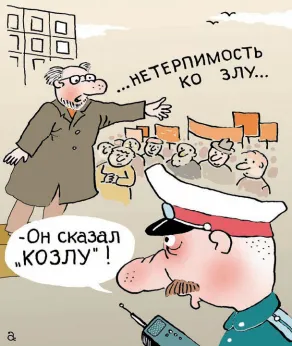
As well as the campaign to combat the obscure “rootless cosmopolitans” during the late Stalinism, the current struggle against “extremism” contributes to the injection of isolationist hysteria, forming the blurry image of an external enemy, supposedly only thinking, how to weaken and ruin great Russia. Here's what it is said (p. 27), for example, in the book “Prevention (prevention) of extremism and terrorism”, published under the head of the Moscow State University: “A significant role in the system of factors for the formation of terrorist threats for Russia is played by the desire of a number of Western and Middle Eastern states to weaken the Russian Federation as a great power, to the implementation of a number of other strategic aspirations and introducing their development standards and imposing their development standards through inspiration. And support as terrorist and other extremist groups and movements in various regions of the country ... This activity is carried out to a large extent through the direct and indirect use of special services of individual foreign states, as well as other state institutions and non -governmental organizations, including an extremist and terrorist nature. ” Similarly in the dissertation E.N. Pluzhnikova, protected at the Institute of Sociology of the Russian Academy of Sciences, states that "the main factors that canalize religious extremism in politically are the subversive activity of foreign special services and religious extremist centers in the Russian Federation." But what does this have to do with sociology as a science? How could the degree at the profile scientific institute of the Russian Academy of Sciences be awarded for this?
Under the use of preventive measures in the absence of a guilty unlawful act (!) In the context of the fight against “extremism,” the theoretical base was also summed up. As noted on the website of the Federal All -Russian Research Institute of the Ministry of Internal Affairs of the Russian Federation, starting in 2005. The topic of counteraction to youth extremism has become one of the main ones in its work. Speaking on June 18, 2009 at a round table on the topic “Countering the spread of extremism”, head of the scientific information department of the Institute, Lieutenant Colonel E.V. Dorokhin noted: “One of the conclusions obtained as a result of the research institute is the provision that administrative preventive measures are represented by one of the effective means of combating extremist offenses, and some measures of administrative suppression can also be applied in the absence of a guilty illegal act.”
If someone else had doubts about why the authorities needed a campaign to combat “extremism”, then to the present moment they may disappear. In the framework and under the cover of this campaign, the authorities built a whole system of legal mechanisms, allowing them to deprive anyone of a number of significant civil and political rights and freedoms (a detailed analysis of these mechanisms is made in the author’s books). There is no shortage of lawyers, sociologists, political scientists, religious scholars, philosophers and other representatives of socio -humanities who are ready to get into a campaign designed to create a comprehensive mechanism to protect the authorities from their own people, rather, on the contrary: the opportunity to earn their pennies, feeling the involvement of the new “general line”, was very attractive for many quasi -bounced ones. The votes calling to change their minds and stop, stopping to participate in this process of subtacy scientific prostitution, unfortunately, is not heard at all.
Alec Epstein, sociologist, doctor of sciences (Ph.D.), author of the book “Police of Thoughts. Power, experts and the fight against extremism in modern Russia ”(Moscow:“ Gileya ”, 2011).