
Translated material
The first start of the "Union" from Kuru
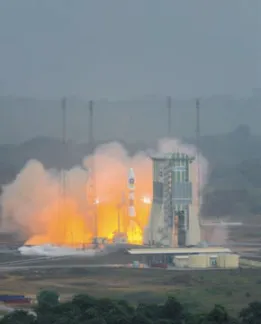
October 21 at 14.30 Moscow time. From the Guyan Space Center, the Russian Ruis-ST launch vehicle with two spacecraft (KA) of the European Navigation System Galileo took place. In 18 hours 19 min. The spacecraft successfully separated from the accelerated block "Fregat-MT" and began an autonomous flight. Thus, the creation of the European satellite navigation system Galileo was launched and at the same time the launches of Russian missiles from the Guiana Space Center began.
The Union project in the Civil Code is carried out on the basis of an intergovernmental agreement between Russia and France, signed in November 2003. It is planned that 2-4 launches will be carried out annually.
For the French concern "Arianespas", the ability to use Soyuz-ST for its launches will be an important addition to the range of existing missiles, allowing you to expand the range of services provided to customers. Russian media capable of deriving a useful load weighing 3-4 tons will occupy an intermediate position between the Vega light missile, designed for a weighing of 1.5 tons, and a heavy-class Arian-5 heavy-class rocket, intended for satellites weighing up to 9.5 tons.
The Guyan Space Center, also known as the Cosmodrome Kuru, is located on the Atlantic coast of the French Guiana, 50 km from Kayenna - the capital of this French overseas department. Especially, a new launch complex was built to launch Russian missiles in the Civil Code.
Due to the location of the Civil Code in the equatorial region of the Earth, the modernized Russian rocket "Soyuz-st" will be able to bring spacecraft more mass on orbit than when launches from the Baikonur and Plesetsk cosmodrome.
Roscosmos is responsible for the implementation of the Union in the Civil Code of the CCC from the Russian side and coordinates work with domestic enterprises of the rocket and space industry involved in the program.
Based on materials from the press service of Roscosmos and ESA