
Translated material
Trap of systemic "realism"
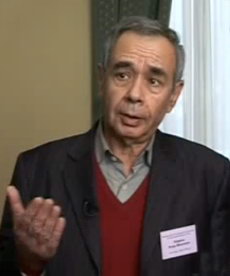
Interview with Doctor of Philosophy Igor Klyamkin
 - And from politicians and analysts, you are increasingly hearing “we are at a dead end” ... Do you think so too?
- The “old” history of Russia is over, it is obvious to me. It can only be renewed artificially that we are observing today. The monopoly state traditional for our country, standing over the law and society, is not able to answer new challenges. Previously, it could not, but now it cannot and cannot.
The way out of this state is possible only to the legal state. However, our imperious monopoly is protected by the current constitution, the exaltation of the president over other branches of power. And if not a single political party proposes, going to the polls, to eliminate this legal shell of the monopoly, then, therefore, all our political forces are ready to put up with the monopoly. And thereby freely or involuntarily support it.
-If the monopoly state is a traditional form of organizing the management of this vast territory, then when historically it has developed? Many are looking for him during the time of the Mongol colonization. Are they there?
- His embryos in the territory of future Muscovy appeared in the XII century, during the reign of Andrei Bogolyubsky. Then, under the influence of the “Mongol autocracy” (when the “main” was the Khan, the Mongol king), a special type of monopoli state began to take shape-the Militarist state. This is when not only a military, but also a peaceful life is built according to the military model, when the state administration is likened to the army administration. Old Russian historians, for example, Klyuchevsky, paid attention to this at one time.
The militarization of everyday life has become an original Russian way of entering in modern times without mastering its values. Not everyone managed such an entry, by the way, the Mongolian and Byzantine empires collapsed on the threshold of the new time. The Moscow state acquired the final form under Ivan the Terrible, which created the Russian analogue of the Mongol government, and its inertia affects this day.
- But in Western Europe there were absolute monarchies. Why in Russia the monopoli state turned out to be so tenacious?
- In Europe, the absolutism was preceded by feudalism. He assumed legal relations when the vassal has not only obligations to overlord, but the right and disputes between them could be resolved in court. There was nothing like that in Russia. The European type of self-governing trade and craft cities has not been established in it.
- That is, in Europe and in the Middle Ages there were the beginnings of the rule of law, which involves the rule of rights and rules over personal relations and subordination? When not “you are the boss - I am a fool”, but the “boss” over all the bosses is the law?
- Yes , and absolutism did not etch there, such freedom in relation to the law and society as Russian autocrats, European monarchs could not afford, and therefore the attitude to the state there was formed differently than in Russia. If you look, say, Russian folk proverbs and sayings, then we will find in them the sacralization of the king during the hostile perception of all institutions and estates that stand between him and the population. And the boyars, and the nobles, and priests, and officials, and judges, and even the army. “Not from the king, oppression, but from the royal favorites” is about the boyars. “Praise the rye in the stack, and the master in the coffin” is about the nobles. “Hell is priests, clerks and unrighteous judges” - this is about the church, bureaucracy and court. “A soldier is like a wolf: where it got, and tears there” - this is about the army. In Europe, of course, the state was also not idolized, but there was no such negative perception there. Such perception, by the way, revealed in Russia the way to power to the Bolsheviks, who at first seduced the population not only by their hostility to the former state, but also with promises about the "death" of the state as such.
- And what do we have now? The sky -high rating of the father of the nation, the president - and the low degree of trust in the government, the Duma, the army, the police, the courts. The king is good - the boyars are bad.
- Only the “king” is no longer sacred. This is the inertia of the outgoing political culture. The current government is trying to rely on this inertia, trampling the sprouts of alternative culture. Including, by its integration into someone else's system for it, through all these "folk governments", "agencies of strategic initiatives" and other simulacra.
- Were there any examples of states of the same militaristic type in Europe in Europe as Russian?
-Something similar was observed in the Ottoman Empire, the experience of which in the post-INSEMOL Muscovy, by the way, was very carefully studied. But this empire began to weaken over time, and then broke up. Peter the Great did not appear there, and he could not appear. In Russia, everything related to faith was weakly rooted, the church was weakened by a split, and therefore a very serious ideological resistance of the forced westernization carried out by Peter was not observed here. And in the Ottoman Empire there was Islam, and it was impossible to overcome its resistance to westernization. The militaristic states are usually considered Prussia, but there, too, everything was without their Peter. The Prussian model is somewhat different than the Russian role, with a different role of the law and another, not forcibly recruiting way of forming the army, and therefore its historical fate was also otherwise
- Peter is to blame for everything? Would not have been modernizing the traditional state, would it die, and this would give a chance to something else?
- Without Peter, the history of the country would go differently, but how exactly, we cannot know. However, Peter was in Russia, and he carried out his transformations, bringing the militarization of the state and society to the limit. He created a state for war and only for the war. But the human nature of such a state cannot withstand for a long time, and therefore after his death the demilitarization began, which manifested in the concessions of the nobility, which ended with his liberation from the mandatory public service. And then this demilitarization continued until 1917 with partial kickbacks at Paul First and Nikolai the First. It came to the release of peasants from serfdom and the creation of a representative institution in the form of a State Duma, that is, restrictions on the autocracy. And here everything collapsed, replacing the second turn of the militarization-in Stalin's times. Then, as you probably remember, we had everything “struggle”, “front” and “assault”. Then the monopoly ruled the party officially called itself the "combat organization", and its members - "soldiers."
And after Stalin, the next wave of demilitarization began, and again the system could not stand it. An event occurred, the 20th anniversary of which we celebrate this year, and the significance of which is still underestimated. In peacetime, almost bloodless, the military superpower broke up, stuffed with nuclear warheads and had the largest army in the world!
- Gorbachev, trying to adapt the old system to new challenges, “rebuild” her, actually led to her dismantling?
Demilitarization, that is, the transition from the principle of power to the principle of law, from order to the law, sooner or later leads to the dismantling of the monopoly state. But in Russia, people are accustomed to realize the common state interest only as a military man who arises when there is an enemy and the threat of a great war. What is common interest in peaceful life, they understand badly here, and as soon as demilitarization begins, society scatters into separate parts, is atomized. How to get out of a demilitarized state to a rule of law - this issue remains the main thing today.
-The Yeltsin elite, although abstract, set the task of modernization-democratization, went to power with this. Why didn't it work?
- The Soviet state disappeared, and Yeltsin theoretically had a choice: either the convocation of the Constituent Assembly, or new elections with the subsequent adoption of a new constitution. This is a political alphabet with which it is recommended to be considered when the formation of new states. But Yeltsin did not want to conflict with the congress of people's deputies then and thereby laid the foundations of the crisis, starting economic reforms with old institutions. After all, what was this congress? It was not a parliament, but an institution endowed with the former constitution with all the full power, he had the right to accept any issue for consideration and solve it ...
-But did Yeltsin have real power in the 91st year in order to radically reform the state?
- This is a question for historians, this has no relevant significance today. It is important for us that while maintaining the old institute, the conflict with him Yeltsin and our reformers was inevitable. And that no democracy was possible at the same time could only be the use of democratic procedures of each side in order to affirm their monopoly on power. Having dismissed the congress in 1993, Yeltsin made it his constitution. In the Constitution of the RSFSR, it was written: “The congress of people's deputies determines the main directions of international and domestic policy,” and now they wrote that “the president determines the main directions of foreign and domestic policy ...” We still live with this kind of elective autocracy, a kind of elective autocracy.
- That is, the construction of the Putin vertical was predetermined?
- The constitution did not interfere with this. It is no coincidence that Putin praised him only for the constitution at the funeral of the first president of Russia: it was she who allowed what he did. The state of the 90s was the initial stage of the present-as Lenin NEP was the initial stage of the Soviet state. After 1993, the legal power monopoly was in Yeltsin, but not completed to the end, and his personal political resource had already been exhausted by that time. It was a weak state that could not afford to encroach on the freedom of the press, regions, oligarchs, more or less free elections to the Duma ...
- And then Putin became president ...
- And he completed this system to the end: he subjugated the legislative power, the press (primarily television), the regions - after Beslan. From a weak unlawful state, a stronger unlawful state has obtained, which lives due to rising oil prices and gas. The traditional Russian monopoly gave a new form of total imitation. Everything is imitated: the legality, independence of the judicial system, freedom of the media, democracy - everything seems to be, but there is nothing. But such imitations are a clear sign that the monopoly system has outlived itself. These imitations create, by the way, the feeling of the historical impasse that you mentioned.
- But the president and the prime minister often say that the institutions work poorly, promise modernization, reforms, the fight against corruption ...
- The need for modernization to one degree or another is recognized by both members of the tandem. But they want to find a resource for moving forward inside the system itself. And after the elections, having changed, according to the plan, in places, they will try to do this. However, no such modernization will most likely work out. Now is not the times of Peter the Great and Stalin. Everything, they drove, there will be no third militarization, with the modern type of technology and the current state of Russian society, modernization with its help is not feasible, but even without militarization, while maintaining a monopoly, there will be no use. It is impossible to modernize through the fact that it itself needs modernization. The monopoly has no internal resources, but external impulses like the threat of a large war have long disappeared.
Yes, the authorities are still trying to rely on the inertia of the previous type of consciousness. Hence the simulation (yes, also imitational!) “Militaristic” rhetoric like “Russia, forward!”, And political terms like the “Popular Front”. Hence all these searches of the “fifth columns”, “anti -Russian conspiracies”, Putin's flights to the military Aircraft, camouflage Medvedev, endless appeals to the memory of the victory over Hitler Germany. But no modernization impulses from these imitations can no longer be extracted.
-But if in Russia another state, except for the monopoly, has never been, and demilitarization has always ended in cataclysms, why will it now be different? The integrity of the country is perceived by the population as the highest value , but I do not want to repetition of 1991. Moreover, now the schism will go very much ...
-Firstly, demilitarization has already occurred, and the question is how to get out of it to the rule of law. Secondly, what we have now is not an alternative to decay, but its delay by paying tribute to people like Kadyrov. And if the breakdown can also be repaired, which many already doubt, then a carefully thought -out reform of the political system. And for this we need a wide discussion, introducing the question of such a reform on a political agenda. In the meantime, he is on the extreme periphery of public consciousness. Politicians , including the most liberal, carefully bypass it, it is not updated Any wide intellectual-expert environment. Separate statements have been heard for a long time, since the late 1990s, there are also separate specific sentences, but they do not become the basis of an alternative political agenda.
-In his report at the Yabloko Congress, Grigory Yavlinsky spoke of the Constitutional Assembly, but in passing: they say, it will become 10-15 years later on the agenda, when the political crisis is lifting ...
- If he said so, then it looks strange. Thus, he admits that in our political system there are resources of self-reforming, for 10-15 years quite sufficient. It is not clear why these resources have not yet been used and why, if there are existing ones, they will not help to avoid the crisis. It is also not clear why the party, which declares its opposition, seeks to take a place in this system. To help accelerate the crisis? Or to promote the extension of the life date of the non -viable system?
Talking about what will happen in so many years is quite in the spirit and style of President Medvedev. This is when the strategic goal breaks away from today's tasks and from the goal turns into a non -binding forecast.
- Now it is often heard that the case is still not in the Constitution and not at all in the laws, but in their non -fulfillment, that is, in law enforcement.
Law enforcement is also determined by the monopoly legal structure. When everything is closed to one figure, she is forced to rely on power and bureaucratic groups and allow them to steal and atrocities in exchange for loyalty. It is no coincidence that corruption has grown significantly under Putin, amazing the entire system, and continues to grow. By the way, possible violations of the Constitution are also laid in it, in the monopoly powers provided to the president. Without them, it would be impossible to mount such an institution such as a constitutional court into a “vertical of power”.
- Maybe they do not talk about the change in the Constitution, because this goal seems unrealistic?
- I think there is a kind of trap of systemic "realism." Everything related to changes within the system seems more realistic than its transformation. But remember our gentlemanly opposition set: honest competitive elections, an independent court, free television, the election of governors, eradication of corruption ... Is this more real? In addition, if a constitutional monopoly on power is preserved, then the most honest elections will be just a struggle for this monopoly, and the meaning of the opposition’s statements will be reduced to the fact that its representatives, having come to power, use the monopoly that he has gained better than it is being done now.
Illusions are all self -deception, and in all respects. Suppose, as a result of honest parliamentary elections, United Russia will lose, having lost the majority in the Duma. And what will we have? The repetition of the 90s: the president with autocratic powers and the irresponsible Duma, which, without access to the executive branch, fights the "anti-people regime". That is, the same thing from which the Putin regime grew up later.
- But our constitution was actually written off with French, there the president also has very great powers, and nothing!
- The French in the Constitution does not record that the president determines the main directions of politics. Yes, he appoints the prime minister, but the parliament approves the government program at the first meeting after the elections. And if you offer the premiere from the wrong party that has the majority in parliament, or a candidate that has not passed the coordination with the opposition, then his program will simply not be approved. And the right to dissolve the parliament after three such failures of the French president, unlike Russian, does not.
We are not a French model, but an autocratic Russian, dressed in French. By the way, under de Gaulle and some time after him, the president and prime minister represented one party. And then France was faced with a situation where the party won the parliamentary elections, the president of the opposition. And after that, a practice arose when the president appoints the prime minister of a representative of the party of the parliamentary majority. Politicians We agreed on this in order to avoid political and constitutional crises.
— А почему у нас так нельзя? Наша Конституция не запрещает правительство парламентского большинства. И разве тандем не доказывает гибкость её конструкции? Есть президент, который вроде бы определяет основные направления политики, и есть премьер-министр, про которого все знают, что основные направления определяет именно он...
— Кто с кем будет у нас договариваться? Для начала оппозиция должна победить на парламентских выборах, чего политическая монополия пока успешно не допускает. И, подозреваю, что, кто бы ни стал собственником монополии, не допустит. Правительство парламентского большинства у нас тоже может только имитироваться, что, возможно, нам и предстоит наблюдать после выборов.
Что касается тандема, то сама возможность его появления свидетельствует о том, что речь идет о монопольной власти не лица, а определенной группы, определенного клана (условно «питерских»). Она не стала по примеру коллег из Казахстана и Средней Азии менять конституционные правила и выдвинула из своей среды технического президента. Внутри такого тандема могут быть разногласия, но они не могут относиться к тому, что касается сохранения властной монополии. И Медведев ее сохранил, добровольно передав тому, кто имеет на ее изобретение больше авторских прав. Те, кто ждал от него чего-то другого, ошиблись не в нем. Они ошиблись в понимании природы нынешней российской политической системы и роли в ней отдельных личностей.
— Итак, элита не хочет или не может выработать альтернативу и предложить её обществу, общество пребывает в глубоком пессимизме, власти готовы биться за сохранение нежизнеспособной системы до конца...
— Вывести страну из этой ситуации и в самом деле может только глубокий системный кризис. Избежать его не удастся. Кто и как будет Россию из него выводить, сегодня не ясно. Но он будет тем глубже и катастрофичнее по своим последствиям, чем дольше будет сохраняться система властной монополии, охраняемая российской Конституцией. И если не привлекать внимание общества к этому коренному вопросу, оно, как и прежде, будет ориентироваться на очередную смену монополиста, а не на преодоление самой монополии. То есть еще раз наступит на те же грабли.
Вопросы задавала Мария Зверева