
Translated material
Vadim month and Arkady Speepel in a soft polemic
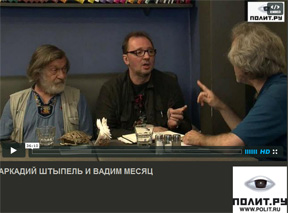
Polit.ru represents the next program “Neutral territory. Position 201 ”with Vadim month and Arkady with a pin. Talks Leonid Kostyukov. Moscow, cafe " Neutral territory
Leonid Kostyukov: Our guest is a poet, publisher, essayist Vadim month and poet, critic, essayist Arkady Shtypel. This is not the first time Arkady Shtypel for the first time. Therefore, our guest is Vadim a month, and Arkady Shtypel is a host guest. And now we will have this: I will only ask as the owner, occasionally expressing my opinion, and Arkady will ask and express my opinion. Well, Vadim will answer. So this is all with us.
Arkady Shtepel: Why? Vadim, too, can ask something.
L.K.: Of course, maybe.
Vadim Month: I will fight off on aid questions.
L.K.: Yes, You will fight off on aid issues. Why did we have such a polemic? The polemic - by the way, it arose at Polit.ru - about the place of the poet, the appointment of poetry, about what is the goal of poetry and what is not. Something was already expressed there, many polemic moves, there were even more moves ...
V.M.: Rhetoric?
L.K.: Constructive, in my opinion. In fact. Now it will be a dialogue on a scale of real time. And maybe there will be some meaning in this.
To begin with, I would like to determine the category from which it would be possible to move. Now everyone is dealing with computers, and we all have some files. The file can be a movie, music, a picture, a poem, a novel and so on. And there is a file name, because each file has its own name, it has a certain label. In the same way, let's say, there is a poem, and there is some kind of annotation to it: a poem about the space, God, the relationship of man with philosophy, that is, the “Poem about ...” here, for example, “The poem about the mouse killed by my plow”, or the poem about the butterfly, the cockroach, and so on.
And these “oh ...”, which is about the poem, they are scattered along a huge plane. At the same time, - here I already express my position - every time I already understood what the poem was about, and they ask me if you can, without getting into the file, say something about its value, I answer the categorical “no”. In this place, a poem may be successful, but may not be successful. Annotation is the intention of the poem, or it is some result, taken as if in the other direction. And at the same time, the luck of the poem is in this place of the map. This is a successful or failed vertical, some kind of ray that absolutely nothing to do with the place on the plane.
I have such an opinion that the value of the poem has nothing to do with the intention of the poem . I wonder what our guests will say on this topic?
VM: Well, this is how you get. The intention may coincide with the embodiment. If we are talking about this book, then ...
L.K.: No, we are not talking about this book now.
VM: Do we speak at all, in principle?
L.K.: Yes. We rather talk about your discussion.
VM: Intention is the same mental category, it is integration, it cannot verbalize. There is some kind of general state of mind. If you stay in it, if you support it, then when you get into it, then everything is fine.
L.K.: That is, any, even absolutely mediocre poet, graphomaniac, can he get to any place of the plane?
VM: Well, yes. But the probability is small.
L.K.: If a good intention - why not?
VM: Intent is not a semantic, not intellectual category. That is, you cannot choose some goal from your mind and shoot at it. Or some other mind is used here. It's easier to talk about the state of mind. When you achieve it, your poems or coincide in phase with this state of mind or do not coincide. If you do not really own these spiritual, spiritual states, then in principle you have the opportunity to get into this hole, but ...
Generally speaking, I did not quite understand what the problems of your question are?
L.K.: Problems here is. As I understand it, you have an opinion that poetry should do something: some questions, some kind of affairs.
V.M.: No, no. Everything is wrong.
L.K.: Hidden - and not even very hidden - the pathos of my statement, consists in the fact that poetry owes nothing, that poetry can do the smallest things, and a brilliant poem can be born from this.
VM: You see, I said that it would be good to return the meaning. But this says, rather, about my personal fatigue from the manufacture of graceful trifles or some incomprehensible patterns.
L.K.: And what are these patterns?
A.Sh.: What is the thing here? What you are talking about, this applies not only to poetry, but also to prose to the same extent.
L.K.: Perhaps less for prose. To small prose - yes.
A.Sh.: And not only to the small.
A.Sh.: That is - what is this story about , what is this novel about ? He can be about something very important, but at the same time he can be completely no.
L.K.: This is of course. But he cannot be absolutely unimportant and to be great.
A.Sh.: But even if we talk about prose, there is still an intention, there is an important or unimportant topic, but there is still how it is done. So you say that a mediocre poet can fall into some kind of nerve, to some point and write one brilliant poem.
L.K.: I'm not saying that. We now want to indicate a certain starting position. I say that a mediocre poet can be some kind of thinker, can understand what is important and what is not important. He may not be a poke method, but absolutely consciously engaged in important things.
V.M.: Thinking with verses is very different from brain thinking.
A.Sh. : Yes, these are different things. We involuntarily applied the term here, which in itself is not quite correct. What is a mediocre poet? He is not a poet. And if he is not a poet, then why talk about it at all. Nepota does not have cool texts.
L.K.: He has no cool texts. In my opinion, he has absolutely everything dead. Here I can throw several names, several figures. Here, for example, Vyacheslav Ivanov. Absolutely mediocre poet, no. Yes? And at the same time, he connects a lot. He is engaged in very important things - he is engaged in the world, god, cosmos and so on, and so on ...
A.Sh.: Yes, for God!
V.M.: I also do not really love him.
L.K.: So, the intention of the poem has nothing to do with the poem.
V.M.: Yes. But if you are talking about a separate poem, this is completely different. If we are talking about this book, then this is a way of life.
L.K.: We are not talking about this book at all.
A.Sh.: Well, you never know any intentions, the result is important.
L.K.: Can absolutely brilliant verses, absolutely brilliant, are written about trifles? For example, about traveling on a bus?
V.M.: Of course.
A.Sh.: They can. Although I do not understand what "absolutely brilliant poems."
L.K.: Absolutely brilliant poems? I think that it is possible not to stomp in this place for a long time, to use the term Mandelstam: these are the verses that change the substance and composition of Russian poetry, the Russian language.
VM: There are really chemical, incredible things that happen.
L.K.: Yes, yes. This is not an elegant trifle that you are talking about.
V.M.: If you keep in mind Mandelstam, then, of course, there is no. The meaning is over the poem, it is clear what it does. There, not only, as he said, the acquaintance of the words occurs, there are some kind of shifts of matter incredible, given the phonetic and semantic work.
A.Sh.: And Mandelstam has elegant trifles.
VM: Yes, I am not against elegant trifles. I say that I'm just tired of it, that's all.
L.K.: What is an elegant trifle? Can an elegant trifle cause tears, excited, absolutely turn over?
VM: You know, if she turns over, she is no longer a trifle. It can cause changes in the subtle worlds.
A.Sh.: Begless? It is not entirely clear what we are talking about.
VM: You understand when you are talking about the poem as a text, you might often think that you are talking about the so -called "literature".
A.Sh.: Text - He is the text. Well, what are we dealing with? We are dealing with what is written on paper or sounds verbally. All the same, this is a text.
L.K.: "Text" is a decrease in pathos.
VM: This is very charming, but it is tired.
OK .: I often had a situation at the master class when you can say something, which equally applies to the poem and the story. Then I was forced to use the word "text" in a neutral absolutely sense.
A.Sh.: Normal word. Do not load it with unnecessary connotations.
L.K.: What does unnecessary mean? But what if the text is the most necessary connotation? Can you imagine that it can exist there?
A.Sh.: This is a completely different matter. I say that the word “text” itself is completely neutral. And to say that texts are something so second -rate is not worth it. Everything is texts, we know nothing but texts.
L.K.: This suggests a second -rate. Because every poet would like him to write "not all."
A.Sh.: You never know what anyone wants.
VM: I agree. Naturally, this is a paper, and there is something on it ...
A.Sh.: Yes. And there makes sense.
VM: You see, there are books that you put under the pillow, and the disease passes from it. And there are newspapers and something else ... I think so.
A.Sh.: With me from an unread book that will just lie under the pillow, nothing will become.
V.M.: It will not happen to you, but is it good for you?
L.K.: No, I think it will not become, because it is necessary to somehow absorb it.
VM: Well, I don’t know, you can even read it. It depends on the book.
A.Sh.: Favorite book is another matter. Yes. When you just take her in your hands, you already feel something.
VM: My comrade was in a state of clinical death, and I thought what kind of book would bring to him? I gave him "Dunno on the moon."
A.Sh.: That's right.
VM: And "Dunno on the Moon" can also help.
L.K.: Vadim, why do you put a little negative meaning into the word "literature"? You say that we do not want to engage in literature? Why do musicians want to make music, and we do not want to engage in literature? Why?
VM: You see, for me this is some kind of extension. Maybe I have been there for too long, maybe this is a property of character, but nothing more. You see, I am embarrassed that now literature is being created for literature, it remains within the framework of the literary community.
L.K.: Why does it bother you?
V.M.: Well, I don't know. I would like to expand these frames, because poetry initially appeared as something necessary for people, as something necessary. I saw a record about magic, or about something else. I couldn’t talk a lot about magic, but the poet who causes rain during the drought, or the poet, who turns trees into warriors who go into battle ... In general, I am talking about a poet who does something like that.
L.K.: That is, poetry necessary for people?
VM: Yes, something needed by people, something that can help and save. Simple, like an idea.
L.K.: We have a workshop in the literature, which-and, as you said correctly, we can relate differently: with sadness, with sadness, with indignation-we have a workshop that, in general, serves itself.
V.M.: I treat this without sadness, sadness and indignation. I'm talking about the fact that you can expand and just get out of the ivory tower. Why not?
L.K.: We have people who leave this ivory tower. And if you take poetry, then Emelin, Vera Polozkova - these are exactly those people whom you consider to be in the forward, pioneering.
VM: You know, there may be different ways. There is a horizontal movement, this is such an expansion into another. And it seems to me that the main movement should occur vertically.
L.K.: “Must” is a little wrong word.
VM: We can say - "It will be better if." Will it go? It is more clear to me when it occurs vertically, when it occurs at the level of some spiritual formation. And they, of course, exist, and no one relieves you from constantly being in it.
L.K.: Vsevolod Nekrasov? How is it to you from the point of view of spirituality? It seems to me that this is a very strong poet, incredibly strong.
VM: It is quite possible.
L.K.: For some reason, he did not go out to everyone, but Assadov came out, Emelin, and so on. Does this lead to thought that this spiritual formation is not connected with the exit from the professional workshop?
VM: If we are talking about spirituality, then this, apparently, does not mean a way out of the professional workshop. I am embarrassed by the fact that the professional workshop simply does not consider these concepts anymore. He moves to the field of philology, that as a science can be cute, pleasant and so on, but ...
L.K.: Vadim, I just do not see this at all. Speaking conditionally, we have critics and writers - separately, philologists - separately. Well, at the RSU, maybe ...
VM: I, by philology, do not mean the study of the text, but the poet’s work as a philological. Or, for example, when the poet writes outright damp, but a philologist suits it, because it coincides with his theories.
L.K.: Then let's with the names, with the surname. Because I don’t see such lousy sheep in our herd.
VM: lousy sheep? ..
L.K.: Well, yes, so that the poet as a philologist works ... I just see that many poets come from their lives.
VM: Well, Brodsky’s work was largely philological.
L.K.: Brodsky died. He is not among us. Brodsky’s work, perhaps, is in many ways philological, but our poets, those that ...
V.M.: The work of Volodya Gandelsman is largely philological, despite the fact that, of course, a very high degree of emotional.
L.K.: But if the poet grinded something a little,-including what he came out of his heart is already philology?
VM: No. Of course, skill should be present.
A.Sh.: Well, guys, I somehow do not really understand this pathos. In my opinion, any poet, he may be not educated, but still a philologist. He works with the matter of the tongue, he works with the words, he is looking for the greatest expressiveness, he digs in the roots of words, searches for connections between them, compares them. Again, there is no poet who would not know, he would not read contemporaries and predecessors.
L.K.: Of course.
A.Sh.: Therefore, in the depths of the brains, some kind of philological work is still taking place.
L.K.: At the same time, there is no poet who would not come from his phobias, from his fears, anxieties, from the fact that he had left his wife and so on.
V.M.: And how do you like this wording: poetry how to get rid of selfishness?
L.K.: Poetry How to get rid of selfishness? This is an interesting move.
V.M.: Can there be such a move? I would say that this thought is preferable for me.
L.K.: Maybe I would say this: the growth of the poet as getting rid of selfishness. This is a thought that is very close to Swarovsky, Rovin, Shvaba. This is the departure from the lyrics to the epic. This is a very important thing.
V.M.: The epic does not mean avoiding selfishness at all.
L.K.: Let's just say: elements of the epic. Departure from pure lyrics.
VM: Do you really think that the lyrics are just individual egoism? I don't think so.
L.K.: I think that pure lyrics are absolute egoism.
VM: These tears may be completely unrelated to your person. It can be common tears . I am sure that there is some kind of collective unconscious, and how much you get into the phase with him, there are so these tears.
L.K.: Then I will say what, in my opinion, pure lyrics. It seems to me that the absolute illustration of the concept of “pure lyrics” is Boris Red. He has some limitation. Well, even purely biographically: it exhausts the spectrum and dies, that is, everything is very honest in some respect.
V.M.: There is no bank of ideas, oddly enough. The passion is one that is not very male, in my opinion. Anyway, sooner or later you have to talk about ideas. About the fact that the poet was able to convey to us. However, the redhead builds a good bridge with Soviet poetry. Which is also a lot.
L.K.: I think that it's not even a bank of ideas. Here, let's say, you lie, and for the first time you hear your little daughter crying at night, because she needs to change the diapers. And for you this is a terrible experience, because it is for the first time in your life.
VM: This is a cosmic experience.
L.K.: Yes, space experience. And you joyfully get up and change the diapers. And after half a month she cries for the eightieth time, and for you this is no longer an experience, because it is no longer fresh. But she still cries, and you have to get up and change her diapers. So, the lyricist is one who no longer changes diapers in the eightieth time. He sends his wife for this: “Nastya, change so that he does not yell,” he is no longer interested. And the epic is when they come to the world for the eightieth time, as in the first. The freshness of emotions here does not matter.
VM: The freshness of emotions always matters.
L.K.: The freshness of emotions is important for the lyrics, and in the epic it does not have that meaning. Or some other mechanism acts here.
A.Sh.: You are going to some abstractions all the time, guys.
L.K.: Well, what abstractions are diapers.
VM: Well, well, speak specifically.
A.Sh.: Very specifically. For example, the poet composed a poem about how he first heard his child cried, and how he went and changed his diapers. Very good. This poem can be wonderful, it can be absolutely no, it can be completely ugly. What is the case with you, he wrote this poem when the child cried for the first time, or did he write this poem when the child had long grown out of the diapers? The poem can be good and bad. But where does the lyrics and the epic?
VM: Sometimes this context does not matter, sometimes it can.
A.Sh.: So this is not the point.
L.K.: It seems to me that this is when the poet comes from the severity of his emotions in contact with the world.
VM: Or shows how thin, sensitive it is. By the way, there is nothing bad in this, but sometimes it looks comical.
L.K.: This is such an egocentric.
A.Sh.: That is, I am in the center of the world, and people around me. To some extent, all people are self-centered. But I do not really like it when they tell me what Zoshchenko wrote: "And here is another minor case from personal practice." You see, the lyrics are also a rather later invention compared to the epic.
L.K.: I agree.
A.Sh.: Lyrics are a world of private lives, private feelings, if we take Europe as a whole. We know that the lyrics arose in antiquity, but that is not the point. After all, it still goes in waves. Today, now, we have a certain reader fatigue from this lyrical stream.
L.K.: A year ago she was definitely.
A.Sh.: And now there is still.
L.K.: There is already even fatigue from a new epic.
A.Sh.: This is itself.
VM: I do not quite understand what a new epic is.
A.Sh.: We are mathematics, we know that everything in nature is happening according to wave laws.
V.M.: But it does not seem to you that this sinusoid is - it gradually calms down? In this material environment, which becomes more and more material, the spirit is silent. It will subside soon - and the crains of everything! Where is this very American prose? Look what is happening with a rock music. Either now the period is so transition, or it is connected with some kind of non-information technology: too much this stream? I do not know what it gets in - either in matter or in an excess of information.
L.K.: Is this not due to the fact that time is slowly, through some agents, makes its choice? When you look at what was fifty years ago, wherever you are, and whatever you are, the choice has already been made there, and you are dealing with the peaks. When you look at what is being done now, you are dealing with a suspension.
VM: Well, this is too optimistic, I would like to think so. But, on the other hand, the same John Dos Passos or Hemingway in those days were quite in sight, were clear and well known. Now I do not see this.
L.K.: Good. In the 75th year, you are sitting among what is being written in literature. Neither “Moscow-Petushka” nor “school for fools” do not reach you.
VM: Well, this is another matter. Systems of this blocking, of course, exist. Just now they have become different.
L.K.: They exist. Now the thing is one of a thousand - it hangs somewhere on the Internet, but you have no access to it.
VM: That is, the main question is the creation of some interpretative mechanisms in order to show what is good and what is bad. Sooner or later, but you still come to this.
L.K.: Of course.
VM: Some kind of gradation, some hierarchy should be, right?
A.Sh.: And she is building all the time. She is moving all the time, she changes. Moreover, take at least such a good landfill for the consideration of things as a silver age,
V.M.: There the symbolists were in sight, and then acmeists.
A.Sh.: That's not the point. Some authors of that time, who were quite by hearing, were known, influential and respected, we no longer remember them today. And the masters also have a lot to read a lot today.
L.K.: In principle, Balmont has almost everything.
A.Sh.: Yes, even at the block.
VM: Yes, even the block has almost everything.
A.Sh.: And even what is read, there you still see that, for example, this is already somewhat funny.
L.K.: The Silver Age is such a fashion for poetry. This is not a take -off of poetry, this is a take -off of interest.
VM: This is a serious question.
A.Sh.: There was a take -off there.
VM: Who determines this hierarchy?
L.K.: We.
VM: Expert community? Time? Is there any other scale of values? I want to imagine such a reference point, where everything that I do is zero, and then from this zero, negative point of view to imagine that not only the human determines this.
A.Sh.: I do not have a very stormy, but still a diverse biography. I once worked in a fitting team. My colleagues have these classes were absolutely parallel.
V.M.: Did you find a common language with them?
A.Sh.: Absolutely.
V.M.: Could you talk about poetry with them?
A.Sh.: Not really.
L.K.: And about Mayakovsky?
A.Sh.: Could, of course, but it was inaccessible. At the same time, I am not at all saying that these were some undeveloped, stupid people. They had their own interesting constructions, conclusions. At this work, I learned many to me until the well -known wealth of my native language. And by the way, not only obscene, but also folklore.
VM: You know, the wealth of the native language, they somehow come from everywhere.
L.K.: The usual folklore move that electricians give out the huge wealth of our language, when they stick two fingers, where it is not necessary.
VM: Good. The word "folklore" was uttered. Speaking about this fading amplitude, I see that folklore components associated with some roots are less and less. You will not agree with this?
A.Sh.: And what are these roots, which are becoming smaller and less?
VM: Well, some kind of vitality.
L.K.: Is a joke folklore?
A.Sh.: But we are not talking about jokes, and do not talk about little prose. We are talking more about poetry.
VM: We are talking about the spirit, about folk things.
A.Sh.: I'm not talking about the spirit, I'm talking about verses.
L.K.: The higher the tree has grown, the farther its crown is from the roots.
A.Sh.: This is natural.
VM: You see, another thing happens here. There is a unification of the world, and these things are lost anyway. And this is a shame.
L.K.: We left the topic of our conversation a little. You asked who determines this hierarchy. I am ready to answer this question to you.
VM: And do you have an answer? - This is amazing.
L.K.: Yes, I have an answer. And this answer, it is suffered. There is, for example, a certain poet. His posthumous fate is determined by those people - moreover, they are not necessarily authoritative specialists - who love his poems very much. Who do not just love them, but love them very much . Here, for example, there is some kind of poem, or some selection of poems, the author of which lived in obscurity and died. And I just need this selection for life. I will find money, I will publish it with my money. I will find a way to publish this book.
VM: A good explanation. The most important thing is that you say that someone needs it. This is important.
L.K.: Yes, to those who love very much. What is the author mass, “mass cultural”? He loves a huge number of people, but this slight love, it does not move the mountains.
VM: Well, yes, this is work for a short -term result, for the present. You see, there is also heroism in this: you do not wait for anything further.
L.K.: And if what you did, five or six people need, these five or six people are curled up for you after you die. Or maybe before that. It seems to me so.
A.Sh.: To some extent - yes.
VM: You can come up with some higher explanations.
A.Sh.: No, this is completely normal. This is what is happening every day. Well, take your publishing practice. You publish the one you like. You like what this person does, it seems interesting to you, it seems significant. Everything is right. Any of us happened to come with the verses of a person besides Alekhin, for example. We come and say: "You look, you look."
L.K.: Of course, it happened.
V.M.: I am terribly do not want to admit pessimism, which covers me from my publishing practice. But I hid him for so long, and now I will continue to do it.
A.Sh.: Why pessimism? You are published class books.
VM: Well, they don’t buy! Neither good nor bad.
A.Sh.: With the purchase, another thing. You see, guys, there are some simple economic factors. In the Soviet Union, Blessed Memory, a thin book of poems - well, here is about the format that you release - cost somewhere the cents of the seventy.
L.K.: And even thirty .
A.Sh.: Well, this is very thin. Typically, such a book cost the cents of seventy, and a bottle of vodka cost about three rubles. That is, a fan of poetry could without much damage to acquire it.
L.K.: My friend has published the first book of poems back in the USSR, in the old system, in old prices and all that place. The circulation of the book is 1000. It was such a thin book, it cost 15 kopecks. The whole circulation is easy to smash - cost 150 rubles. The whole circulation! Moreover, this is not a profit, but the cost of the circulation, plus printing and so on. Even if he assumed that he had left, - well, he probably left, - then the profit turned out ...
V.M.: Well, of course. And he still received a fee. This is also money.
L.K.: And what! - 1000 rubles. That is, he received a fee six times more than the cost of the circulation. It was so uneconomical.
VM: I also then managed to publish a book and get money.
A.Sh.: From an economic point of view, this is pure ugliness, of course. But…
L.K.: This is rather mysticism.
A.Sh.: No, not mysticism. Today, Lviv on OpenSpace.ru has placed the material that in Norway the state purchases publishing books. The state buys 1000 books from the circulation at a firm price. Here.
L.K.: So this is in Norway.
A.Sh.: Of course, nothing would have happened from this. And there is an expert council, which rejects about 80% of applications.
VM: The same legends are beautiful about Brazil.
A.Sh.: This is not legends.
L.K.: In the USSR there were very strong discounts.
A.Sh.: But there were ...
L.K.: Your ideological affairs.
A.Sh.: Yes, and we all know this. We know - passed. And by the way, even if we try to introduce this Norwegian system in us, there is still no money in the state. These gingerbread cookies are not enough for the entire breathtaking horde of poems, and when experts appointed by the state begin to choose, we understand how this will end.
L.K.: We even understand who will be experts.
VM: And which is the orava more: under the Soviet Union or now?
A.Sh.: Writing?
V.M.: Yes.
A.Sh.: Yes, approximately the same. It's just that then you write to the table and write. The boys and I then just planned to publish some manuscript magazine-we just planned it! - And we were taken by the ass and dragged into the KGB. And now? - Yes, for God's sake! Here is the Internet - do whatever you want.
L.K.: At that time there was the attention of the authorities to the poet, but now there is no.
V.M.: Abido, yes?
L.K.: Good. We move on. The theme of magic in poetry. The theme of magical influence. I can express the thesis, why does the magic do not suit me?
V.M.: No, I can also express a bunch of theses.
L.K.: That's what magic does not suit me. Let's not even start with poetry. Suppose there is some village, there is Irka, Borka, Pashka, Lyubka ... There are some youth and, let's say, some kind of fatum standing above them. It would be nice if Irka was with Pashka, and Borka with Lyubka. But Irka, she seems to argue with this, and this is the self -will, which Fedor Mikhailovich wrote about. Her reins is under her tail, because she wants to be with Borka. She goes to the local healer and says: "I have cooked a potion, love spell."
What is magic in my understanding? In my understanding, magic is some means indifferent to goals. The customer determines the goals, relatively speaking. And therefore, this is not the same knowledge that can be appreciated. If she did not go to this healer, but to someone more knowledgeable, he would say that she did not need it. He would say: "You have to be with Pashka." And I understand this.
And now we are already taking a step towards poetry. There are poets who call themselves magicians. Well, like Bryusov. Bryusov called himself a magician.
VM: It was just a tribute to fashion.
A.Sh.: Your pontarman your Bryusov.
L.K.: Of course, of course. He was not a magician, of course, he wanted to be him. What is magic in poetry? Magic in poetry is this: "I - I want!" I have an intention, so I chose this intention, regardless of the laws of the universe. I chose it of my own free will - "I want." And then we let all the forces of magic.
VM: But you still cannot get around the laws of the universe.
L.K.: Why? Well, here is a well -known story with Moses and Pharaoh Volvami. He speaks on behalf of God - unkind, I must say, things, and they - without any God. They are rubbing something there, they do something ...
V.M.: There they even feel sorry for them.
L.K.: They do it without God. But they do something. That is, these magicians, magicians, they do wrong things all the time, but sometimes something comes out with them. It seems to me that this magic is contraindicated in poetry. It seems to me that in poetry we are always looking for the unity of the goal and means. So that in the right direction it acts, and in the wrong direction, no.
V.M.: Yes. That's when I said that I did not like secular poetry, I did not mean magic. Of course, poetry comes from all this, and, of course, this must be borne in mind. Of course, there is a chance to jump out on some magic formula if you are good in this environment, verbal or spiritual, you get. This is curious and it may work. But in general, this lower astral does not seduce me absolutely, because it pursues some selfish, selfless goals. “Merciful” - in such a situation it is a keyword.
I just say that if poetry is done by some constant formation - and this formation is quite discrete - then this is an initiation that is practically identical to some constant suicides of itself. They still exist! Yes, it exists.
A.Sh.: There is nothing to argue here.
V.M.: For me it is different . Because one thing is simply the existence in the horizontality of this text and the work of literature, and the other is work on oneself.
I told you that our contradictions are not so fundamental.
A.Sh.: Yes. These are just terminological discrepancies. You see, I love clarity in reasoning, and you like to figuratively go somewhere in empires.
V.M .: I do not think it is.
A.Sh.: Maybe, in part, therefore, you are misleading the reader.
V.M.: Father, everyone has their own concepts of clarity. You know, some people understand me at a glance, but I have been taldy, explained something, but could not explain anything. Well, I could not explain - I am to blame. Yes? Well, I don’t know why all this seems vague to you.
L.K.: I understand well. In our youth, we played charades, guessed phrases. I had such a strong understanding with one guy that at some point they just stopped putting us in the same team. What was it for the moment? - I I show him just like this ( shakes his head ), and he says to me: "Nihilism is lackey thought." He guessed the whole phrase one gesture! We were told that this is already too much, and they sent us to different teams. Because there are always people who understand at a glance.
VM: Moreover, they can be completely unfamiliar. There are some kind of souls, there are old souls, young. I don’t know how all this happens, but some resonances appear.
L.K.: Of course.
A.Sh.: Here we got into some pause.
L.K.: Next, I have about the myth. What the myth does not suit me.
VM: Speak!
L.K.: I say. The myth does not suit me that it is equal to everyone. It is available to every poet, he is available to a mediocre poet, that is, to the one whom we called "non -ease." A myth is such an external skeleton of a poem, story or something else. There is such a concept of "Litinostic poetry." I myself graduated from the Literary Institute, but at the same time I understand this negative attitude to the Lithuanian Institute very well - there really is a lot of harmful, dangerous and so on. What is "Litinosttic poetry"? This is when a person is not ready, a person is very internally uncultured on some day at a lecture on antiquity, according to ancient Russian folklore, stories and so on, and so on ...
VM: Are you talking about book knowledge?
L.K.: Yes. When this is not felt, not experienced, not missed through itself. And this person in the evening is a hostel and writes a poem in which Cassandra, Job - all in a heap.
VM: This is the “literature” that we are talking about.
A.Sh.: Well, why take some lower points? There are some mythological figures. They are tenacious.
V.M.: Not about figures now.
L.K.: Are there poems based on myths?
A.Sh.: There is, but that is not the point. Well, take Cain, Cassandra, take someone else ... For us this is just a sign. We do not believe in these figures at our daily level, these are just such designations. And when the poet takes and some kind of sign revive - well, both beautiful and good.
After all, what is a myth, strictly speaking? - This is such a fable that a person believes in. As soon as a person ceases to believe in it, it ceases to be in his own meaning of the word by the myth. It becomes literature.
V.M.: You know, you talked about the laws of the universe, about physics, mathematics, and so on. These laws work. I am sure that the purely mythological space may not be connected with these figures, with these names, even these actions, but it acts according to completely accurate laws. If you feel how it works, if you turn on it, connect to this, if you live this, it arises with you. You do not illustrate some story about Cain, Cassandra or someone else, these things exist , you are in them. This coupling - it complies with the laws of the myth, or does not correspond. If it does not correspond, you get a naked, stupid illustration than many sin. If you make some of your fairy tale, then it is a fairy tale.
L.K.: The myth is more related to artistic prose.
A.Sh.: Or even to science fiction.
L.K.: It seems to me that this mythological coupling is more related to prose, to the talent of the writer.
VM: Now it is more and more mixed. There are poems in which myths are clearly created, they are unhooked from something, and then a terrible fairy tale is invented.
A.Sh.: Because a myth is always a plot.
VM: This is not necessary. It can be a plot or some kind of glimpse of the plot, they can be references to the plot.
A.Sh.: Maybe implicitly, maybe this is a plot grain, but what about it? Where without the plot?!
L.K.: This can be designed in the poem.
A.Sh.: You can, why not.
L.K.: The myth is associated with a special gift, there is mythological thinking.
V.M.: It confuses me that it leaves. Firstly, I'm not sure that now it is in great extent in demand. And secondly, that the carriers of this mythological thinking are becoming less and less. Maybe I'm wrong.
A.Sh.: What a myphotrac Fedor Svarovsky!
V.M.: I do not see any organics. I don't understand what it is. Probably good.
L.K.: I think that more successful myth -producers are not among writers. Думаю, что они среди политтехнологов, пиарщиков, рекламщиков.
В.М.: Ну, я эту сферу вообще не знаю.
Л.К.: Ты ее не знаешь, а я думаю, что там очень много успешных мифотворцев. И вот когда они попали в это коллективное бессознательное…
А.Ш.: А есть оно, это коллективное бессознательное?
Л.К.: Коллективное бессознательное есть.
А.Ш.: А ты откуда знаешь? Юнг написал?
В.М.: Аркадий, а ты знаешь, как мир устроен? Как поэзия устроена? Я вот не знаю.
А.Ш.: Ну, кто ж это все может знать? Мы знаем какие-то фрагменты.
Л.К.: Достаточно в праздник сходить на демонстрацию или в воскресенье на футбольный матч, чтобы почувствовать это коллективное бессознательное.
А.Ш.: А почему оно бессознательное?
В.М.: Я говорю о том, что мы берем какие-то языковые формулы - не обязательно клише, - которые меня иногда поражают. Откуда они берутся, я не понимаю?
А.Ш.: Вот ты говоришь, достаточно пойти на футбольный матч. Вколачивается гол, и я, сидя у себя дома, кричу: «А-а-а-а!» И в это время еще сколько-то миллионов людей кричит: «А-а-а-а!» Что, у нас коллективное бессознательное?
В.М.: Это массовый психоз, это другое.
А.Ш.: Нет, просто такие правила игры. Эмоция - она же должна блеснуть. То есть сам термин «коллективное бессознательное» мне кажется довольно смутным.
Л.К.: У многих было во сне, что вот ты идешь, вот ты находишься на мостовой, едут машины… И вот очень близко бордюрчик, и надо сделать всего лишь шаг, а ты все время проскальзываешь, проскальзываешь. Это общий сон.
В.М.: Сны – это уже другая категория.
А.Ш.: У меня такого сна не было, у меня немножко другое.
В.М.: Ты летаешь во сне? Я знаю психологию, я знаю, как это делается. Нужно просто где-то подняться, где-то напрячься.
А.Ш.: Не летаю, я падаю со стремянки. But that is not the point. Просто о кошмариках, которые снятся очень многим людям, можно говорить, что это коллективное бессознательное, а можно говорить, что это сходная физиология, что это замыкание каких-то нейронов. И здесь ничего относящегося к ментальности нету, это просто физиологический эффект. И вообще, меня это не очень интересует.
Л.К.: По вашему диспуту, по вашей полемике я вижу…
В.М.: А я не вижу никакой полемики. По-моему, у нас просто дружелюбный разговор.
А.Ш.: У нас полемика дружелюбная.
Л.К.: Это очень хорошо, что мы сходимся, то есть я не хочу специально искать точки расхождения. Сейчас очень много тем в обществе, в культуре, которые разобщают.
В.М.: Да, ты знаешь, в поэзии есть вещи, которые объединяют людей.
А.Ш.: Но можно найти и точку расхождения. Такой точкой может быть твое замечательное стихотворение «Сообщение о квиритах». Мне оно очень нравится, ты знаешь. Считаю, что это великолепное стихотворение, оно давно написанное и известное. Но, наверное, ты не удивишься, если я скажу, что когда я слышу или читаю это стихотворение, мои симпатии на стороне квиритов.
В.М.: Ну, нормально. Понимаешь, оно не однозначное.
А.Ш.: Конечно, оно не однозначное.
В.М.: Мои симпатии, разумеется, не на стороне квиритов.
А.Ш.: Вот тебе и точка расхождения!
В.М.: Послушай, я тебе говорил, что это стихотворение было написано непосредственно после начала иракской войны. Оно имело абсолютно политическую подоплеку. Вот об этом я мог бы и не говорить.
А.Ш.: В иракской войне тоже непонятно, кто там варвары, а кто квириты.
В.М.: Вот это – вопрос. Я помню, у Димы Кузьмина и у Олега Дарка была такая дискуссия как раз тогда, когда эта война как раз и начиналась. А я сидел где-то в Америке и читал ее. Мне было колоссально интересно, что в России такие страсти накаляются.
Л.К.: У них был там очень яркий момент, когда…
В.М.: …когда они тоже решали, кто варвары, кто нет.
Л.К.: Когда стали бомбить Югославию, там в какой-то момент Олег Дарк звонит Мите и говорит:
- Слушай, но это же ужасно! Terrible! Just disgusting. Нам надо как-то всем подняться, сделать, может быть, какой-то сборничек, какой-то альманах.
Митя ему отвечает:
- Да, Олег, конечно. Надо сделать альманах.
И вот они это долго обсуждали, а потом один оказался на стороне НАТО, а другой - на стороне Милошевича.
В.М.: Слава Богу, что в «Квиритах» не видно этого подтекста вообще. Но, с другой стороны, в той же самой Америке этот стишок отказался печатать мой друг. Его выкинули из одного журнала, где он приводился просто в качестве образца какого-то.
А.Ш.: Почему?
VM: I don't know. Было сказано, что призыв к террору.
А.Ш.: Призыв к террору?!
В.М.: « Потому что они – не люди. А мы – бессмертны». Потом я уже стал под вопросом говорить: «А мы бессмертны?»
А.Ш.: По сегодняшним дням и у нас могут тебя за экстремизм в этом стихотворении притянуть.
В.М.: Экстремизм можно найти в чем угодно живом. И наоборот, когда я читал в Амстердаме, мне сказали, что я подшучиваю над мусульманами. То есть совершенно по-разному можно было воспринимать стихотворение – и слава Богу. Вообще говоря, если бы я комментариев не писал к этой книжке, то моя политическая позиция была бы не ясна. В общем, я за индейцев, если говорить проще. Ты – за бледнолицых, а я – за индейцев.
Л.К.: Я думаю, что это не так важно.
А.Ш.: Немножко не так. Я не то чтобы за бледнолицых – я люблю индейцев, но вот власти им давать нельзя.
Л.К.: Про Федора Михайловича кто-то сказал: «Я, скорее, не с Алешей Карамазовым, а с Иваном. Мне больше нравится Иван». Думаю, Федору Михайловичу это приятно было бы услышать.
А.Ш.: Это часть его многогранной личности.
В.М.: В том-то и дело. Это какое-то многоголосие: и квириты, и кельты, и скифы – все живут. Самое удивительное, что они вместе могут жить в одном человеке.
А.Ш.: Известное стихотворение « Да, скифы мы, да, азиаты мы…», на мой слух, сегодня звучит несколько смешно.
В.М.: Да Бог с ним, с этим стихотворением, сама тенденция, сама скифская тема интересна. Сама тема интересна как движение к самостоятельности какой-то. Вот эти себя цивилизаторами называют, а мы – скифы. То есть это воспевание идентичности – это нормально.
Л.К.: «Скифы» - это после первой мировой по времени, насколько я помню.
А.Ш.: Если не до.
В.М.: Дело в том, что тогда серьезные были дискуссии о благородстве, о бескорыстности, в которых и Блок участвовал.
А.Ш.: Есть подозрение, что он его не вполне серьезно писал. Там есть одна смешная штука.
Л.К.: У меня есть подозрение, что он не был мыслителем.
А.Ш.: Среди поэтов мыслители не часто попадаются.
В.М.: Скифская легенда держится не только на стихотворении Блока. Есть такая скифская традиция, и она вполне может быть интересной. Будем считать, что здесь какой-то поиск идентичности, что, на мой взгляд, полезно. Потому что эта вещь может примирить с остальным миром. Ведь самое главное - понять свое место, в том числе и литературное место. То есть когда ты понимаешь, кто есть кто, все будет нормально. Это проще.
Л.К.: Это точно. Есть ли что-то еще, что бы ты хотел спросить?
В.М.: Я помню, что Аркадия раздражало обращение к архаике. Я знаю, что для тебя древние люди, они в шкурах.
А.Ш.: Ну почему в шкурах? Ну, были и в шкурах, и не только.
В.М.: А можно рассматривать это как высокую культуру, которую мы потеряли. Тоже ведь подход вполне нормальный.
А.Ш.: Что значит «мы потеряли»? Во-первых, от этой культуры уцелели материальные и текстовые свидетельства, мы кое-что об этом знаем. А во-вторых, мы - люди уже другой культуры. Ну да, если бы мы ее не потеряли, мы не имели бы своей современной культуры.
В.М.: Нет, я не говорю, что я ее знаю. Я просто пытаюсь к ней обращаться, пытаюсь ее понять. Это тоже обогащает поэзию.
А.Ш.: Обращаться? - Ну, кто ж мешает. Это, безусловно, обогащает поэзию. Я только против идеализации этой архаики, когда ты пишешь, что мир дрейфует куда-то назад, к фундаментализму, к каким-то таким вещам. Вот если он дрейфует, то мне не нравится.
В.М.: А я не знаю, что опаснее, глобализм или фундаментализм. Я честно говорю, что я не знаю.
А.Ш.: А чего тебе плохого сделал глобализм?
В.М.: Ну, глобализм разный бывает: ротшильдовский, рокфеллеровский.
А.Ш.: А чего тебе плохого сделал ротшильдовский глобализм?
В.М.: Либеральную жандармерию. Ну, чего тут хорошего-то?
Л.К.: Я услышал один раз довод, который меня потряс: «Вы знаете, а мы были в Ливии, и там неплохой уровень материального существования. Мы не понимаем, почему их надо бомбить».
В.М.: Да нет, это вообще абсурд. Американцы почему-то уверены, что они должны нести эти «прогрессивные» идеи, что тоталитарные государства мешают существовать демократии. Пускай сами выбирают. У меня близкие друзья говорят, что нас надо было вовремя бомбить.
А.Ш.: Вадим, мы с тобой большую часть своей жизни прожили в государстве, которое вовсю занималось этим «прогрессом». И оружие давало, и бомбило, и танки вводило.
В.М.: Ну, правильно.
Л.К.: Мы этого не одобряли.
А.Ш.: Правильно, не одобряли. Но, ты понимаешь, какая штука, есть, конечно, принципиальный подход, что всякое применение силы, с любыми намерениями, оно глупо и безнравственно…
В.М.: Оно бессмысленно.
А.Ш.: И бессмысленно. Есть более узкие, прагматичные подходы, что при случае можно и силу применить, и превентивный удар нанести, если это целесообразно. Вот если стоять на точке зрения целесообразности, то попытки установить демократию там, где не вызрели для этого надлежащие условия, приводят к противоположному результату. Это примерно как в свое время свержение шаха в Иране. Тогда все прогрессивное человечество радовалось, что свергли тирана, но в результате власть досталась куда более мрачным силам.
Точно так же произошло и с Ливией. Каддафи – это, конечно, ужас-ужас, и к тому же он на всю голову чокнутый ( Беседа состоялась в июне 2011 года – Полит.Ру ). This is not the point. Просто я понимаю, что те силы, которые с ним борются, - это не силы прогресса и демократии. Потому что это искусственное, слепленное из племен государство сейчас посыпалось. И от того, что свергнут ненавистного Муамара Каддафи, станет еще хуже. Но вот эти вот расклады – это совсем не то, чем мы с вами занимаемся.
В.М.: Унификация мира все равно приводит к поверхностности восприятия, исчезает эта яркость красок и глубина колорита.
А.Ш.: Какая унификация мира?
Л.К.: Макдональдс вместо национальной кухни.
А.Ш.: Здесь кроме Макдональдса есть много мест, где можно прекрасно поесть.
В.М.: Я думаю, что просто из противоречия наступлению этой унифицирующей силы стал возрождаться фундаментализм. Вот, например, ты в этнической рубашке, я вижу.
А.Ш.: Это мне приятель привез из Перу.
В.М.: Значит, ты тоже за индейцев.
А.Ш.: Я и здесь по Москве в украинских вышиванках щеголяю. They are beautiful.
В.М.: Правильно. Вышиванку – каждому москалю!
С этим глобализмом сходно все. Мы в переходном периоде, поэтому возникают такие, пока невнятные, реплики и дискуссии. Но все равно к каким-то формулировкам мы придем.
Я говорил, что поэт должен принести какую-то весть . Мне очень нравится эта идея. Я ее пока, к сожалению, не сформулировал, но я надеюсь, что мы с Аркадием Моисеевичем какую-нибудь весть принесем.
А.Ш.: Как говорят на моей малой родине, дай Бог нашому тэляти вовка зъисты.
В.М.: Иронию понимаю.
А.Ш.: То есть, конечно, хотелось бы весть принести.
Л.К.: Тогда, я думаю, мы эту часть сворачиваем, а дальше - стихи.
*******
В.М.: Ну вот. Главный герой этой книжки - Хельвиг, которому в следующем томе предстоит стать северным Буддой. Здесь рассказывается одна из историй его рождения. Вообще первый том начинается от сотворения первого человека и рождения северного Будды Хельвига.
РОЖДЕНИЕ ХЕЛЬВИГА
Чтобы ты родила
разграбили десять гробниц,
сожгли разноцветные косы
великих блудниц,
заключили временный мир с силами зла.
Мы сделали все,
чтобы ты родила.
В последнем кургане
был найден наш первый царь,
в ладье обгорелой
стоял вожделенный ларь,
в нем государев пояс с остатком тепла.
Мы сделали все,
Чтобы ты родила.
Это наша земля,
и на этой промерзлой земле
мы охватили два мира
в священной петле,
смешались ржаная мука и сырая зола.
Мы сделали все,
чтобы ты родила.
И в ночь, когда
оголтело поют соловьи,
мы поясом медным
опутали бедра твои,
одеждою бога, сожженного нами до тла.
Мы сделали все,
чтобы ты родила.
Один за другим,
в обряде длинных ножей,
в шатер твой вошли
вереницы лучших мужей,
чтоб их сосчитать не существовало числа.
Мы сделали все,
чтобы ты родила.
Народ беспощадный,
кто же теперь мой отец,
ты, или в шапке собольей
звездный мертвец?
Земля стала плоской, а раньше была кругла.
Она сделала все,
Чтобы ты родила.
МЛАДЕНЦЫ
Младенцы в материнской утробе
с безжалостными лицами китайских
правителей глядят друг на друга,
перебирая четки грядущей войны.
Щурясь в отблесках северного сияния,
они спят, не обращая внимания
на крики иноземных проводников,
рычание сторожевых собак.
Мы создаем их на радость себе,
зная, что приумножаем скорбь:
на случай, если силы иссякнут
или наша дорога зайдет в тупик.
Близнецы внушают ужас одним народам,
но обоготворены другими.
Мы больше не знаем, кто есть мы,
поэтому просто идем на свет
по земле, лишенной ступеней.
Два болотных шара в твоем животе
трутся нагревающимися боками,
чтоб однажды, исполнившись превосходства,
вырваться из воды в настоящую бездну,
пытаясь разом заглотить весь ее воздух,
даже не пробуя его на вкус.
ГЕРХОЙ
В этом месте пучина, срываясь с цепи,
разгибает крюки якорей.
Ты прошел полземли, но сейчас – отступи
перед городом мертвых царей.
Он стоит под надзором высоких лесов,
Опоясан излуками рек.
По небесному кругу закрыт на засов
горбылями мрачных телег.
Там бесовские тропы уводят людей
в непролазную темень болот.
И одну из назначенных богом смертей
не минует ни этот, ни тот.
Этот город чудной охраняют костры
Из степной конопли и дубовой коры.
И свечение душ сквозь древесную клеть
полыхает как свежая медь.
Там совиные очи в бойницах горят
Смотрят вдаль до полярных морей.
И планеты на башнях расставлены в ряд,
но дворцы не имеют дверей.
Каждый мертвый правитель посажен на цепь,
чтоб войти в череду праотцев.
Для живых у нас только – пустынная степь,
но есть место для мертвецов.
Суть державы есть сердце великой беды,
необъятной для пустобрех,
что щепоткою соли сжимают персты,
словно правду, одну и на всех.
Сколько пышных столиц и заветных храмин
Было смято ордою зверей!
Но за нами остался город один,
это город мертвых царей.
Уходящие в вечность к рогатым богам,
Не снимайте масок своих.
Этот топот я чувствую по шагам,
среди вас – много родных.
Красной охрой намажу я другу лицо,
После смерти он станет добрей.
Принесет мне на память воловье кольцо,
Обод вечности мертвых царей.
ВОДА ВОЗВРАЩАЕТСЯ
Сыну Артемию
Вода возвращается. Лужи кишат мальком.
До лодки, оставленной на береговой мели,
идем вместе с сыном усталые босиком.
Вода забрала наши земли и корабли.
Меняется карта моей обжитой страны.
О чем, обреченно вздыхая, ворчал старик?
Луна умирает. Кануны смертей луны
вскрывают в змеиных норах живой родник.
Мы не воскуряли молитвы для Маниту,
Не уповали на гордость подземных сил.
Есть кто-то другой, кто уверовал в правоту.
Мы не просили. Но он за нас попросил.
В наши родные озера пришла вода.
Любимый, сегодня ты выведешь к солнцу флот.
Душа замирает, услышав щелчок кнута,
в ударе весла возникает гусиный взлет.
Наш лагерь затоплен. Рябит водяная дрожь.
Кострище дымится, в проточной воде треща.
И в рыбьем глазу установлен тяжелый нож,
которым мой мальчик пришпилил к песку леща.
Хороший охотник. Я чувствую жесткий нрав
хозяина мира, внимательного игрока.
В руке его непокорность столетних трав,
как долго хранится в ладони его рука.
Звереныш, что ставит на каждом боку клеймо.
Он чертит волшебные метки на темном дне.
Он каждую рыбу читает словно письмо.
И нашу судьбу выбирает в случайном сне.
Он помнит: еще недавно он был водой.
Всезнающей влагой, душою большой земли.
Он все еще связан с береговой чертой,
затерянной где-то в ночной, мировой пыли.
Вода возвращается. Крепнет угрюмый дух.
Испуг истончается. Вот исчез без следа.
Свобода, что овладевает сердцами двух.
безмерно серьезней и яростней, чем беда.
И песенка:
Пересохла реченька
Не хлопочет не спешит
На ее сыром песочке
Камень к камушку лежит
Камень к камушку лежит
Наши кости сторожит
Наши беленькие кости
Каждый камень сторожит
Выплакала глазоньки
На речные камушки
Не вернулась реченька
К моей милой матушке
Подниму я на руки
Дорогую доченьку
И по речке мы пойдем
Как по степной дороженьке
Пересохла реченька
Как мое сердеченько
Дай мне силы уберечь
Дорогую доченьку
Дай мне силы уберечь
Дорогую Дашеньку
Еще Нейтральная Территория Позиция 201:
Вера Павлова об ангеле Сведенборга, важности завершенной формы и хороших людях
- Александр Бараш о русской поэзии и Вечном городе
- О влиянии жизни на литературный процесс. Данил Файзов и Юрий Цветков.
- Гуманитарии невероятно востребованы. Интервью с Дмитрием Баком.
- Мандельштам, Пастернак и поезд. Интервью с Аркадием Штыпелем и Марией Галиной.
- Филологическая критика - это безобразие. Интервью с Анной Кузнецовой.
- Поэт Инга Кузнецова: в стихотворении конечная точка движения никогда заранее не известна
- Ты самая любимая... Рустам Рахматуллин.
- Русская поэзия второй половины ХХ века: фокусировка взгляда. Иван Ахметьев.
- 500 poets and the myth of the Moscow party. Данила Давыдов..
- "Есть некая труба, в которую дует Господь Бог, и в этой трубе есть пылинка, которая создает некое звучание". Dmitry Grigoryev.
- "Россия богата на каких-то очень хороших и деятельных людей". Дмитрий Стахов.
- "Иногда ощущаешь себя поэтом, но чаще - самозванцем". Marina Boroditskaya.
- "В каждом Божьем поколении появляются вдруг нормальные люди". Бахыт Кенжеев .
- "Человеческое Я не в состоянии представить свое отсутствие. А.Василевский.
- "Поэт, даже когда и врет как сивый мерин, имеет все шансы стать пророком и провидцем". Ю.Гуголев.
- "Обычно о нефтяной отрасли говорят, как о чем-то примитивном и тянущем Россию назад". Владимир Дребенцов.
- "Предстоят достаточно тяжелые времена в Европе". Alexey Novikov.
- "У меня нет такого ощущения, что литература – мои штаны". Dmitry Vedenyapin.
- What is life, Kostyukov asks Logvinova. Hello, says Logvinova
- "Если не было бы Фиделя, Куба бы отдавалась всем подряд". Sergey Markov
- "Люди специально доводят себя до истерики, это в природе поэта". Ната Сучкова.
- "Мы немножко стали бессмертными". Александр Переверзин
- "В Америке люди живут, чтобы работать, а в Латинской Америке работают, чтобы жить". Алексей Пименов.
- "Свобода является условием подлинного творчества". Михаил Кукин.
- "Если мы граждане той страны, которая совершает преступления, мы несем ответственность за это". Vladimir Gandelsman.
- "Поэзия - это что-то вроде однокомнатной квартиры, пространство на одного". Alexander Belyaev.
- "Мастер знает больше, чем может. А гений может больше, чем знает". Сергей Шабуцкий.
- "Поэзия в Интернете относится собственно к поэзии, как прогноз погоды к погоде". Alexey Alekhin.
- "К пришедшему слову притягивается потом все стихотворение, слово им обрастает". Надежда Делаланд.
- "Меня называют главным концептуалистом советского рока, я не знаю почему". Vasily Shumov.
- "Я не пишу, потому что оно молчит". Михаил Кукин.
- "Читающая публика и поэты говорят на абсолютно разных языках". Maria Galina.
- "Советская литература признавала всегда только один-единственный ствол, одну-единственную верхушку, и это многое калечило". Ирина Ермакова.
- "К поэзии всегда необходима странная химическая добавка, которая сделает поэта любимым". Екатерина Капович.
- "There is nothing good and there is nothing wrong with belonging to a particular race." Leonid Yablonsky and Yuri Plusnin.
- "Проблема добровольной миграции сейчас более актуальна, чем в прежние времена". Иван Кривушин.
- "Мы уже очень давно живем в очень открытой экономике". Andrey Yakovlev.
- "Я не могу сказать о себе, что я тянулась за Пушкиным" . Екатерина Соколова.
- "Это общество должно просто рухнуть, чтобы Бетховен стал опять Бетховеном". Vladimir Martynov.
- "Что такое критика, как не дело вкуса?". Михаил Эдельштейн.
- "Если бы поэт сжег квартиру, это было бы любопытно". Boris Kherson.
- "И на фоне этого «никак» ты начинаешь понимать, где начинается «как»". Dmitry Kuzmin.
- "Культура возникает из желания заполнить пустоту". Константин Кравцов.
- "В 60-е годы, по-моему, была надежда". Dmitry Vedenyapin.
- "Изначально начинают заниматься поэзией мерзавцы". Виталий Пуханов.
- "Поэзия – что-то вроде мешка с таблетками". Maria Stepanova
- «Я не люблю, когда актер свой профессиональный навык переносит в обыденную жизнь». Даниил Спиваковский
- "О своем влиянии на умы я никогда не думал". Leo Rubinstein
- "Мы живем в мире, который мы вычитали". Timur Kibirov
- "Как-то легко жить, не занимаясь режиссурой". Ираклий Квирикадзе
- "To say about the poet that he is a poet at the level, is, in general, a slap in the face." Sergey Gandlevsky
- "I am writing myths." Vsevolod Emelin
- Ukrainian poets in Moscow. Vladimir Kostelman and Roman Chigir
- Here Dmitry Ozersky reads poetry and dances an apple