
Translated material
Cossacks and Buddhism. 2.0
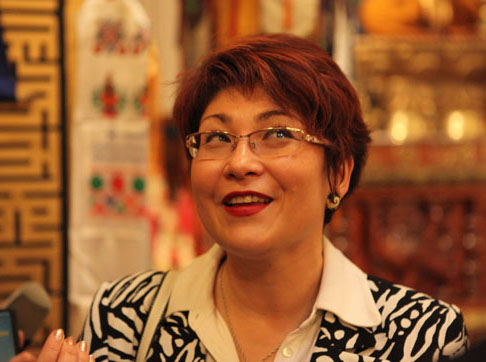
In the family of the director of the institute, Pandito Hambo Lama Itigelov Yanzhima Vasilyeva, the grandchildren of the famous Lama, a porcelain tray in a silver rimmed is stored. With this tray in his hands, the grandfather of Yanzhima, the Cossack of the Yangazhin village of Garma Vasiliev, met the Tsarevich Nikolai Alexandrovich near the village of Kabansk in 1891. It was not by chance that the stately Cossack-Buryat with an impeccable military beaning and good Russian was chosen to offer the king of bread-salt (according to the Russian tradition) and at the same time white food and hadak (according to Buryat custom).
The mother of this Cossack was the older sister Hamba Lama Itigelov, who had not yet headed the Buddhist sangha of Russia, but, they say, also met with Nikolai Alexandrovich in Buryatia. Tsesarevich returned from a trip to the Far East, where, as you know, he received a saber on the head from the Japanese policeman. In Buryatia, Nikolai Aleksandrovich was provided with medical care, and the head of the Buddhists of Russia Choinzon-Dorzhi Iroletev, who specialized in Tibetan medicine, was healed by the heir to the throne. Apparently, Buddhist treatment methods really helped Nikolai, because later the Buryat lamas began to regularly call in St. Petersburg for the healing of the royal family.
Dasha Dorzhi Itigelov himself also had to go to military service, but at the direction of the abbot of the Aninsky datsan, where Iteigelov was trained and even then showed himself an extraordinary llama, the inhabitants of four villages paid compensation for him for twenty (!) Years.
The Buryats were appreciated as good warriors, border guards (there was a restless border with China nearby). The indigenous people of Buryatia possessed the qualities necessary for the border service: observation, fired perfectly from onions, were good riders. The Buryat regiments alternately carried the guard on the border. In 1764, they were assigned their own names: Ashebagatsky, Tsongolov, Ataganov and Sartolov (subsequently the 1st, 2nd, 2nd, 4th, 4th Buryat regiments), they were under the leadership of the border commander (commandant of Troitskosavsk, now the city of Kyakhta), which was also submitted by the Russian Cossacks who lived on the border. Atigan Cossacks from the Selenginsky district of Buryatia glorified their small homeland on the battlefields. In the Patriotic War of 1812, the Atigan Regiment (also known as Selenginsky) in the battles near Smolensk lost almost three quarters of the train, but he himself caused great damage to the enemy. Atagan Cossacks participated in the Battle of Borodino, where 155 people lost. This regiment is also known by the fact that he victoriously entered Paris.
In March 1851, on the basis of four horse Buryat Cossack, two Russian Cossack regiments and the Tunguska Cossack regiment, by decree of Emperor Nicholas I, the Transbaikal Cossack army was formed. Subsequently, the Selenginsk regiment participated in the Russian-Turkish, Crimean and First World War. The regiment participated in the defense of Sevastopol of 1854-1855. This is reminiscent of a commemorative plate on the Malakhovs Kurgan, as well as the Selenginskaya street. The banner of the regiment is stored in the Faceted Chamber of the Moscow Kremlin.
The name of the Selenginsky Infantry Regiment was carved on the marble slabs of the Cathedral of Christ the Savior and in the St. George Hall of the Moscow Kremlin in honor of the victories of Russian weapons. In 1904-1905, the Cossacks participated in the Russo-Japanese War. By the way, before this war, three hundred Cossacks received the blessing of Hamba Lama Itigelov, and they all returned home alive. In gratitude, the Cossacks even composed a song in honor of the future imperishable Lama.
After the establishment of Soviet power, like many Cossacks who were in the service of the tsarist government, the Cossacks of Buryatia were subjected to repression. The revival of the Trans -Baikal Cossack army began in 1990, and seven years later the Trans -Baikal Cossack army was entered in the register of military Cossack societies of Russia. With the assistance of the Cossacks, Orthodox churches and datsans are reviving. Several military units are renamed Cossack, they are served by young men from Cossack families. When the head of the Buddhists of Russia arrived in the St. Petersburg Dutsan in the St. Petersburg Datsan, the Cossacks also welcomed him, except for the clergy and parishioners. I think Hambo Lama did not expect that the Cossacks of the North-West would be imbued with the idea of many years of friendship of their Transbaikal brothers with Buddhists and conclude an agreement on cooperation with the St. Petersburg datsan.