
Translated material
Beat "on the passport"
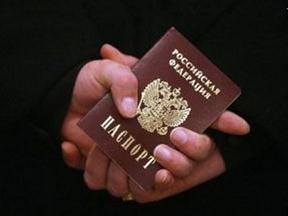
The Russians advocate the return of the “Fifth Paragraph” - the columns “Nationality” to the passport. Irrational desire probably reflects a growing request for identity, which power and society is not able to satisfy. And the "policy of multiculturalism" in the Russian version is not realized in any way.
Russians are extremely worried about the national question. For example, according to the fresh data of the “Levada Center”, half of Russians (or rather 48 percent) advocates the return to the passport of the column “nationality”. There are much less opponents of such a measure - 38 percent (the data quotes Interfax).
The dynamics is also characteristic - since February 2010, the number of supporters of the return of the “national” column increased to 10 percent, the number of opponents fell by 7. It turns out that an increasing number of Russians want to return “nationality” to official documents.
The phenomenon of the column “nationality” in the passport is that it existed in the USSR not for citizens, but for the state.
Through the graph, some citizens - say, Jews - were discriminated against other, more trustworthy nationalities. And any agent of the state - for example, a teacher of the selection committee at a university - could easily see whether the “harmful” nationality sitting in front of him applies, simply looking into the passport. In other words: the column “nationality” was a means of coercion and restriction of freedoms and principles of equality. Along with the registration or de facto prohibition of traveling abroad for most citizens.
Why do citizens more actively advocate for the return of the “nationality” column to official documents? It seems that the answer should be sought in the complete inability of the authorities to pursue a national policy at any time - there is no policy itself - and regulate the rule of law on the streets. And even wider: the absence of any intelligible goal -setting in the country (who is to blame - an abstract state or an even more abstract society - it does not matter) leads to the need to fix some simple and understandable foundations. Say, nationality in the official state.
You can, of course, see in the growth of "national" sentiments of the election agitation. Say parties to the whole coil launched their agitation on the national issue (the LDPR was especially clearly unfolded here), the voter was commanded. However, the party agitation should not have reached the broad masses and should not have been influenced by the survey that was conducted at the end of October.
Therefore, these are parties, which the president directly forbade playing with national themes in the elections, try, as they can, the request of the masses to satisfy. Our president, of course, is fake, but the voter is quite tangible to himself. How to do without national problem? And here we are not talking about the graph in the passport, but about things are much more serious and complex.
The policy of “Russian multiculturalism” did not take place, no matter how much Dmitry Medvedev urged her not to “bury” it. And the authorities cannot offer any intelligible national project (the present, not packed in this PR sheath of targeted programs for the purchase of medical equipment). But it can quite defiantly pour money into the corrupt economies of the North Caucasus, which citizens cannot like it. Such a policy of reconciliation of the Caucasus is good or not, but citizens definitely do not like it.
And citizens respond to a helpless state, which is trying to solder the nation through the hypothetical tour of the Bolshoi Theater in the Caucasus and other equally effective events, in their manner. A more active and young part of these citizens comes to some point to the Manezhnaya Square, those that are less prone to active action complain of neighbors, friends and sociologists on the “dominance of the Caucasians”. And they demand to return the “fifth point” so that it is immediately clear whether our people or not. In order to “beat”, contrary to the old joke, not only “by erysipelas”, but also “according to the passport”.
They offer a kind of recipe to the state, so that the army of officials can identify citizens by national principle. It is likely that there is also a request for some hierarchy of nationalities - after all, otherwise why should I indicate and identify? If everything is equal, then there is no such need in the designation.
It is not entirely clear why the Russian authorities do not cause not just anxiety, but already a panic. The authorities seem to say that the collapse of the country can be the consequence of the growth of nationalist sentiments. And they continue to pronounce the useless, it seems, and few convincing mantras about punishment “regardless of nationality” and the Bolshoi Theater.
Indeed, in this case, people are not able to unite around a kind of general idea and make some efforts to protect their interests. However, this is for the time being - the national question will still become extremely unpleasant for the authorities and events on the Manezhnaya Square then, God forbid, they will show an extremely small and insignificant incident.
However, some small identities are also formed, and regardless of the national question. Rallies of fishermen and protests of motorists are also a form of self -organization of citizens. Yes, for a particular occasion and without a special ideology. However, it is difficult to say where such a protest ends and politics begins. And where is the guarantee that of the supporters of the return of the “fifth point” to the passport will not recruit activists of some kind of no existing one in nature (we hope that it will never arise) “Russian Hitler”. The February Revolution, too, due to a lack of bread, happened, but everything turned out to be known than. For the then powerful power.