
Translated material
Julia Child as a symbol of American culture
Almost half a century ago, an American colleague, a francophile and a passionate cook, gave me a book of French cuisine recently published in the States. I read it with pleasure and even learned something. However, my knowledge remained largely theoretical, primarily due to the lack of "raw materials", i.e. products. And when the “raw materials” became accessible, I no longer had the strength or much desire for these fun.
Meanwhile, in the 90s, I have repeatedly seen this modest volume in the kitchens in Sweden, then in England, and the book of the book indicated that they used it diligently. As for the author/authors, their names did not say anything to me. And recently, this book was mentioned by another owner - my American acquaintance, who watched the film dedicated to the “main” author of this book - Julia Child.
The 2009 film - with Maryl Streep as the main character - was found on the Internet. And then I realized that Julia Childe is not just the author of a popular table book, but a person important for understanding American culture.
In our country, the thematization of the “culture of everyday life” as an independent subject of research took place in post -Soviet times, and mainly in the context of attention to Soviet everyday life. And since the latter is conceived not only as scarce and poor, but first of all as miserable, the whole thickness of the then everyday life is investigated and described as obviously devoid of a value dimension or - even worse - as focused on the “top” values. But such a position would be justified in the same case - if the Orvelov project was completely successful ...
Let us return, however, to our heroine-American Julia Child (1912-2004). I’ll start in the middle to make my interest in this, undoubtedly, outstanding personality. So, Julia Child became famous as the author of the table book “Mastering the Art of French Cooking” (1961), which immediately became a national bestseller and quickly brought Julia to the Boston educational television screen as a popular host of French cuisine. Moreover, for the next ten years! Subsequently, Julia wrote several more table books, and to this day very popular.
What I did not expect in any way is the opportunity to join the American admirers of the art of Julia Child not only in the imagination: it turned out that many of her television recordings are available on YouTube, while they are well preserved.
With a dozen videos I looked. That's truly “The Medium is the Message”! It is difficult to compose a character who would look more “more likely” than this almost two-meter height, who with equal naturalness holds in the hands of a huge living lobster, whips one egg with a small whisk and wields a huge tesan of the butcher ... at that time she is already fifty.
What did she do before? I must say that at least after the outbreak of World War II, the life of Julia Chalda was very saturated with events. (The relevant information is on Wikipedia and several informative publications in the American press; in addition, a strong impression makes her video interview.)
Julia Child (nee Makli-Ms) was born in 1912 in Pasaden (California) in a wealthy family. She studied in an expensive private college and, according to her, was thinking about becoming a writer. In the meantime, she wrote for advertising publications.
Life seriously for Julia began with the outbreak of World War II. According to her, everyone wanted to be something useful to their country, but growth (188 cm) turned out to be an obstacle to enrolling it in a regular army. So Julia Makquilims was taken to OSS - the recently created military intelligence department, from which the CIA (CIA) was formed after the war. If we take into account that all the information in those days was stored in paper form, the role of a person who skillfully disperses secret file cabins and catalogs will become clear.
Julia Mquilims served where she was sent - including on Ceylon and in China. On Ceylon, she met the field of Childe - an artist, a poet, a francophile, a gastronom and an expert on French cuisine, who also worked for OSS. They got married already in the States in 1948, and then Paul Childe was appointed to Paris as an employee of UCIA (State Information Agency) - services, to a certain extent similar to our TASS.
So Julia Childe was in Paris. And since she was not used to sitting idle, she signed up for a listener in one of the famous French culinary schools - Le Cordon Bleu. Later, in her interview, she recalled not once how she was amazed at the pleasure that she suddenly delivered a meal to Ru-Ana when she was served a rather ordinary French dish of Sole Meuniere , a naval-fried marine in a panel.
In Paris, Julia met her two future co -authors - Simona Beck and Luazette Bertolle. This was the beginning of a turn in her future fate. In 1951, they all together opened the French cuisine for American women called “Three Gournets” (unlike the word gourmet, familiar to the Russian ear, the female family sounds somewhat strange).
By that time, Bek and Bertolla were busy preparing the book of French culinary recipes. However, in order for such a book to take the final form and receive commercial prospects, it took another ten years. Finally, in 1961, for three signatures in Alfred A. Knopf, “Mastering the Art of French Cooking” was published. (These upheavals are partly reflected in the film "Julie/Julia".)
The success of the book prompted Boston educational television in 1963 to invite Julia Child to conduct the program "French cuisine" ('The French Chef). Some of these programs I looked at YouTube.
Generally speaking, for American television, culinary television programs were not at all new, but it was Julia Childe who made these programs a national hit. Moreover, three years later in the American press, the direct influence of her book and television programs on the culture of food in American society was noted in the American press. In 1966, culinary courses could not accept everyone. In supermarkets, the demand for delicacies, spices and seasonings, previously considered exotic, increased.
If earlier, about 6 varieties of cheese were offered in the supermarket, now, to stay “at the level”, it was necessary to place 50 varieties. Managers noted that the range of food was updated by 60%. Trade began to bring special profits with “sophisticates” like pickled chickens, smoked sturgeons and black caviar from the Caspian.
Julia Childe actually became the heroine of the time when America left far about food in the past and became interested in the culture of food. As for popularity, then, of course, Julia’s manner was especially attractive to hold on her own.
A large woman, in tennis shoes of the 44th size, in front of the viewer, fearlessly and with equal success was controlled with large “French” knives (demand grew on them immediately), with an air souffle (housewives immediately acquired appropriate forms) and with living lobsters.
Television recordings conveyed to us the naturalness of Julia Child, her freedom in speech and movements. When Julia throws a pancake in a pan to turn it over, and he falls past the pans, then, putting the pancake in place, she says: “So what? We are alone here in the kitchen! ” - and this is not perceived as a stage trick.
In the 2009 film, Maryl Streep, playing Julia Child, turned to the audience, who not only had not seen her heroine on TV, but perhaps she would not remember her name - although she buys her books. In the USA there are many culinary books and dozens of successful culinary television programs. And although Julia Chaild was not the first on television - but in one respect she, it seems to me, was the best: she was “one of the; The same " as her spectators.
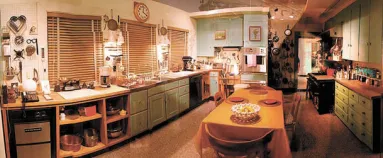
It is worth noting that the keepers of American culture and history took care of the memory of Julia Child as an important component of the American cultural heritage. Her kitchen, once carefully planned by Peter Childe, with all knives, shotguns, French copper pots, pans and other utensils, was bequeathed to the Smithsonian institute and became available for viewing there.
Rebekah Frumkin