
Translated material
The gait saves the bone
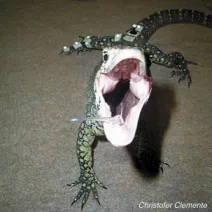
Animals are large and small and weigh, respectively, differently. The heavier the vertebrae, the more massive its skeleton, especially the legs - thin bones will not withstand the big weight and crack. You can compensate for the load on the bone not only with the thickness of the limbs, but also their proper setting. Mammalian paws are brought under the body, which rests on them like columns. But crocodiles and lizards, even the largest, are deprived of such supports due to the features of the structure of the skeleton. In reptiles, the femoral and shoulder bones are directed perpendicular to the body and parallel to the ground, and the limb bends down at the elbow or knee. The body of the animal is as if suspended between the paws; To keep it in this position, you need fair muscular efforts, so reptiles, if possible, fall on the ground with a belly. But sometimes you need to get up and go. And then the lizards are in the position of push -ups on spread out legs, which is difficult and inconvenient, especially for a large creature. And when walking, the muscles twist the femoral and shoulder bones, which, because of this, experience the loads large than that of mammals of a similar size. Therefore, the diameter of the bones of the limbs of reptiles should increase more than the masses than in mammals. But it turned out that the speculation of the skeleton of lizards does not completely compensate for the loads caused by a large mass. The insufficient thickness of the bones of the lizard is compensated by a special gait.
This study was conducted by Australian scientists, and the main work fell to the graduate student of Christopher Clemente, who came to the University of West Australia (University of Western Australia) from Harvard. He had to catch in Bush of 11 types of Varanians, from the tiny deserted Varanus Eremius weighing only 40 g to the weighty colorful Varan V. Varius (8 kg), take it to the laboratory and release to a specially built “hippodrome”. The gait of lizards was fixed when they moved at a speed equal to half of the maximum, and for the convenience of observation, paper marks were glued to key places. At first, the researchers suggested that the larger varats straighten their legs when walking, picking them up under the body to give their pose a verticality and thereby reduce the load on the femoral bones. But it turned out that this is not so. Large lizards, like small ones, ran in the “squeezing” position, and to make life easier they have another trick. At every step, they briefly apply on the stomach, and the larger the lizard, the more time it spends in a reptile state. Such a gait allows you to reduce the load on the bone and give rest to the muscles.
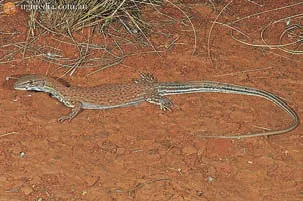
And yet. The angle of rotation of the thigh when walking in large lizards is smaller than that of the lungs, so the muscles are not so strongly twisted. Due to these tricks, heavy lizards go slowly, their speed is always less than that of a mammal of a similar size, but the bones are intact.
The turn of the spread out of the spread out along the axis of the body greatly facilitated the life of a terrestrial vertebrae. When the paws are brought under the body, you can calmly gain mass, go or run a much wider step and even stand on the hind legs. It was such a setting of limbs that the dinosaurs had. No lizard can compare the size of a tyrannosaur. Even the largest, Komodsky Varan, weighs a little more than 160 kg. And all because of the position of the paws.
Natalia Reznik
Clemente, CJ, Withers, PC, Thompson, G. and Lloyd, D. (2011). Evolution of Limb Bone Loading and Body Size in Varanid Lizars. J. Exp. Biol. 214, 3013-3020.