
Translated material
Dungeon within the framework of security
On the Police Day, Medvedev was concerned about the safety of transport and the emergence of the metro throughout the territory of Big Moscow. Russian tops are returned to the topic of safety regularly. And every time another attack shows that everything is bad in this area. Because no one wants to apply effort.
On the day that was previously called the “Police Day”, and now they are called “the Day of the Interior Employee”, President Medvedev went to a meeting with the police department of the Ministry of Internal Affairs in the Academic District of Moscow. Having told them about the successes of the reform of the Ministry of Internal Affairs (they, of course, do not know anything about the reform), Medvedev turned to the topic of expansion of the metro.
First of all, the president proposed expanding the metro into territories newly annexed to Moscow. “We need to drag the subway to New Moscow, it is necessary to plan this,” the president punished, demonstrating the usual flight of thought for himself.
“Big Moscow” with bureaucratic mini-gorods or one city, if it appears in nature, then in 15-20 years-the term is unimaginably long for Russian planning culture. The planning horizon is traditionally limited by 5-10 years, it is customary to look even with populist goals. To imagine that in the middle of the forests near Moscow, which today occupy a significant part of the new lands of Moscow, suddenly the letter “M” will appear and the entrance to the underground tunnel could only a person with a very rich fantasy.
However, the mayor of Moscow, Sergei Sobyanin, who was present at a meeting with the police, assured Medvedev that plans for the development of the metro in the direction of New Moscow are being considered. Priorities, however, more earthly order. “Over the next five years, it will be spent 100-120 billion rubles a year for the construction of the subway, it is planned to open 35 new stations ... We look further - 20 years in advance to draw the metro in the microdistricts, where it is not, to strengthen the density of the lines,” Sobyanin shared.
Speaking about the metro, the mayor has not forgotten about the police. The introduction of new stations, according to Sobyanin, will require additional efforts of the Ministry of Internal Affairs. The President also noted on the topic, saying that “an increase in numbers does not mean”, and employees of the Ministry of Internal Affairs should ensure the security of the city “around the perimeter”. He recalled how he went down to the Moscow metro after the attacks in March last year and stated that the security system should work, and not “turn into a formality”. And he called to go down to the subway Sobyanin and the head of the Ministry of Internal Affairs Rashid Nurgaliev. It might even seem that the mayor of Moscow urged the Ministry of Internal Affairs to work more, and Medvedev expressed displeasure of their work directly on a professional holiday.
The topic of security, however, is quite serious. After a series of raids for transport infrastructure facilities, Dmitry Medvedev and Vyzhas to various chiefs, including police. In January 2011, when Medvedev visited the Okhotny Ryotnaya metro station, the president was shown the latest security funds - an X -ray, a gas analyzer, a small framework for testing things, and so on. The president proposed installing devices at all metro stations. Similar measures also concerned other objects of transport infrastructure.
The metro and the Moscow government took under the visor. According to the plans of the Moscow Department by the end of 2011, 46 metro stations are planned to be provided with the following equipment: special video surveillance systems, metal detectors, devices for localization and safe storage of explosive devices, personality identification complex - all these devices will be controlled from one remote control by security officers.
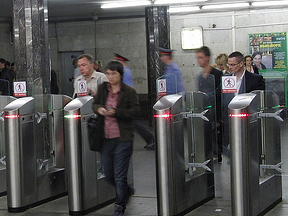
Of course, in addition to Moscow there are other cities, but in Moscow, the established framework of metal detectors are practically not used. They stand calmly and do not drive anyone through them.
The attitude to security “from a terrorist attack to the attack” in Russia is traditionally this - despite the dismissal and requirements of the high authorities to urgently establish everything, the “competent authorities” quickly begin to treat the requirements coolly. And extraordinary imperious shouts are not supported by proper financing. However, when something explodes again, the navigation and campaign begins. The logic is simple: to show zeal and leave disturbing times, and then the high authorities will find other concerns and there will be no one to control the fulfillment of the requirements again.
Without the large superiors, the system is not only safety, but also fire extinguishing, irrigation of fields, any other-the bureaucratic apparatus does not want to change anything radically or cannot due to lack of funds. And the authorities in particular do not allow any public control over the “competent authorities” by the public in particular. And the public, admitted, requiring significant efforts on its part, control is little interesting.