
Translated material
The Russian army sends the Caspian monsters to the utilles, which shocked NATO (photo)
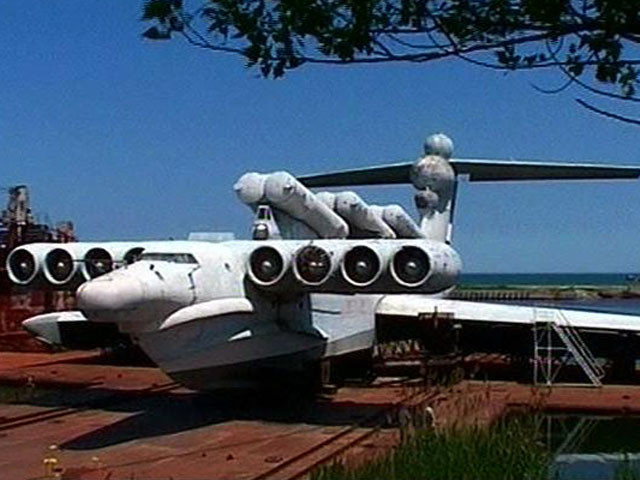
The Russian military decided to abandon the development of ekranoplanes - "flying ships", which during the Cold War were considered promising and formidable weapons. The latest samples of the Caspian monsters, which 25 years ago shocked the NATO military, will be disposed of in the coming months, Izvestia found out. From the composition of the Caspian flotilla, the adkoplanes were excluded three years ago, in connection with this in the Main headquarters of the Navy.
"In the state defense order for 2011-2020, financing of developments and construction of ekranoplanes is not provided. These ships are also not present in the development of the Navy for the next decade," a senior representative of the Ministry of Defense told the newspaper. “Even talking about their revival is not conducted. Now the fleet has many other serious tasks, not as bold as before. We prefer not to build illusions anymore,” said the representative of the Glavkomat of the Navy.
The first ekranoplanes were developed in the middle of the last century in the Nizhny Novgorod Central Design Bureau Rostislav Alekseev. The flying ships used the effect of the aerodynamic screen - due to the air pillow separating the ship from the water, they could slide above the surface. The low -flying Soviet screen planes were not available for enemy radars and for missiles that could not detect a target that does not concern water and does not rise above 100 meters above it.
At the same time, an aluminum-magnesium alloy machine could cover a huge distance in a few minutes, having several hundred paratroopers with heavy weapons on board, and on the way to free the bridgehead for their landing with controlled missiles.
In the 1980s, the Caspian Flotilla included the 236th division of the ships of the screenplane. It was based in Kaspiysk and in its composition there were three transport and far "eaglet" project 904, as well as one missile screen "Lun" of Project 903.
The founder of the ekranoplanes of Lun and the Eaglet became the experimental 544-ton KM-6 (ship ship), which was created in the only copy, whose abbreviation was deciphered as a “Caspian monster”. The first copy of the Monster crashed in 1969, when the pilot lost a visual horizon due to strong fog and crashed into water at high speed. The second copy, also due to the pilot’s mistake in 1980, crashed and sank in the Caspian Sea (the crew managed to be saved), says the websiteof the Air Force of Russia .
Orlenka was not terrible a storm of 2-3 points, it flew steady at a height of 1 to 10 meters, but during the tests it rose at 100 meters. Such machines were intended for a quick transfer of troops and equipment, which loaded through a leaning "nose" of a barracks. The first instance of "Orlenka" - S -21 - crashed in August 1992, then the flight mechanic died in the rank of warrant officer. The second sample - S -25 - cut into scrap metal in 2000, the third - the S -26 - stands on the Khimkinsky reservoir. The eagle eagle was completed in the summer of 1989 with combat shooting flights with combat firing.
The shock screen -lane -bearing "Lun" - the S -31 factory board number - could develop speeds of up to 250 knots (463 km/h) and was armed with six controlled anti -ship missiles "Mosquito". Until 2008, he was based in Kaspiysk. Subsequently, Lun was mothballed in a dry dock, and all his secret electronics were handed over to warehouses.
The website of the Air Force of Russia makes an disappointing conclusion: after the collapse of the USSR and the change in the situation in the world, the ekranoplanes became for military burden - "not ships, and not planes, and what to do with them is not clear." As a result, there is only one thing left - to send them to the scrap.
The Russian army of the future: without "bobes" and "Kalashnikov", but on foreign armored vehicles and with bayonets
In the coming years, the Russian army is waiting for unprecedented re -equipment - the country's leadership decided to spend a record 20 trillion rubles on the implementation of the state defense order until 2020. Journalists began to discuss what the army of the future would be armed with, and what types of weapons remained overboard the new program.
First of all, it became known that the Ministry of Defense decided not to purchase Kalashnikov machine guns anymore: the legendary AK-74 stopped arranging the army according to its characteristics. In addition, the soldiers have already been bought for the soldiers for a long time - until Russian experts create a new generation of small arms for them.
But the Russian military left the bayonet -knife - despite the development of military technologies, he "remains the last argument of the fighter when the cartridges end," they decided in the Ministry of Defense. In the US Army previously, recruits would hardly have to go on a bayonet attack in the Army of Bayonets - in the era of "digital wars".
The most tangible "losses" for the new state defense order was carried by Russian manufacturers of armored vehicles. Thus, the Ministry of Defense refused to purchase new BTR-90 armored personnel carriers from manufacturers, the creation of which went a lot of money from the budget. As the creators of the armored vehicle complained, it disgraced the BTR -90 for the whole world - after such "anti -advertising" from the Russian military, it is unlikely to decide to buy other countries. However, engineers promise many design ideas and developments when developing a new combat platform , which will become the basis for heavy combat equipment of the Ground Forces of the Russian Federation.
By the way, in the state defense order until 2020, they decided to abandon the famous "bobes" - UAZ -3151 cars. The “UAZ” of this type may come to replace the advanced “UAZ-315195” Hunter (“Hunter”).
In the meantime, the leadership of the Russian army has many complaints about domestic technology. In particular, the head of the General Staff of the Russian Federation, Nikolai Makarov, criticized and continues to criticize Russian tanks, inferior in the main indicators to foreign counterparts, and three times more than the German "leopards" . “We take the T-90 tank, which was talked about a lot, and-the Israeli“ Merkawa ”. Compare his defeat and our tank. I am silent about the T-72 tank and all the others,” Makarov complained to reporters during the recent press conference.
The Ministry of Defense was completely preferred by the Italian armored car LMV M65 , which in the Russian Federation, it is planned to be released under the name "Lynx". Included with the patterns of future "lynxes" purchased in Europe (each car costs the budget of the Russian Federation in 300-500 thousand dollars), according to the press, there are technologies . With their help in Russia, it is planned to develop a medium wheel platform for creating modular Boomerang modular armored personnel carriers.
Dmitry Medvedev, last Monday commenting on the purchase of foreign equipment, hastened to reassure everyone who worries about the fate of the Russian defense industry. “We can purchase foreign equipment, but in very limited volumes, rather in single copies , so that it is clear what foreign armies are equipped with, and so that our manufacturers do not doze off, but release the best samples,” the head of state promised.