
Translated material
Kazus: Archeology for Orthodox
In the literature of recent years, two books on archeology have been paid attention to. One author is Pavel Vladimirovich Volkov from Novosibirsk. This is a wonderful archaeologist, thoughtful, talented and hardworking. Both books were published in 2010. The first is called the “Experiment in Archeology” (EA), the second - “From Adam to Noah” (AN). The second book wears the subtitle “Archeology for the Orthodox” - the name provoking. Now we can expect a separate archaeology for Catholics, especially for Protestants, Jews, Muslims ... No, this is not archeology for Christians, which means that they are separate for Shiites, Sunnis, Wahhabis, etc. Why only for believers? Separately for atheists, for communists, for liberal democrats and others.
In the 19th century, a critical campaign flared up in England against attempts to introduce a “story for the Wigs”. But other people's lessons are not lessons to us. We do not learn from our mistakes.
The third part of the second book is called “Metaarcheology” and is completed in “2005 from the Nativity of Christ” (AN, p. 319). And in 2004, my “Introduction to Theoretical Archeology. Part I. Metaarcheology. " Thus, this is a hidden polemic with me. Well, I'm ready to make a controversy open.
I already once wrote in a three-hobby about the phenomenon of a believer. Here we are before us with a heeratively religious archaeologist, and even the Paleolitic is a much more paradoxical phenomenon, because the archeology of the Paleolithic is one of the most important supports of the atheistic worldview: along with a quarter geology, it refutes the biblical chronology and, along with the Paleoanthropology, refutes the creationist model of the origin of man, gradually filling with intermediate links line from monkey -like ancestor to homo sapiens . Of course, an archaeologist can be a believer or superstitious, Donjuan or a feminine, a communist or a fan of football. It is only important that his addiction does not affect his professional classes, does not break into archeology. There should be a psychological barrier.
Archeology as a science has its own methods, their own rules, their own immutable results. It is impossible to tighten them to favorite addictions, even if these addictions seem very noble to you. As soon as this ban is violated, the archaeologist immediately turns from a scientist into a fan, into a crusader (“Each of us is a warrior of God. And this is not a metaphor. Orthodoxy is the defense of life.” - An, p. 319).
This is all the more sad because Volkov (I emphasize once again) is an amazing professional, and where he forgets about his religious mission, everything is great.
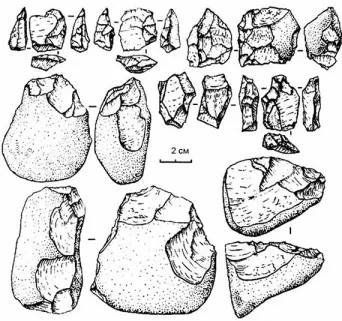
Volkov’s book “Experiment in Archeology” is a brilliantly written work where experiments in three areas are collected and examined in detail: stones, planrait of settlements and Paleoecons. I have not met in the literature more intelligibly, full and clearly stated the analysis of primitive technology for working with flint. Descriptions of experiments on splitting are just few. This is rather the results of long -term experimentation and very smart thoughts on them.
Interesting and unexpected planigraphic experiments are more widely represented - with “working sites” for flint processing: seven participants each worked on their site, and as a result, the experimenter, having removed the results of work on the plan, received a clear division into experienced craftsmen and inexperienced (“students”). The experimental waste lenses were more compact, the largest withdrawal lay at a distance (safety precautions), the workspace was streamlined, and the rejected chips were concentrated in the center. These results may be useful when analyzing primitive workplaces.
Experiments with bonfires are very good. The stimulus was some oddities of the location of bonfires in the Madlanskaya parking of Penceswan (France) - outside the conical dwelling at the entrance. To solve the mystery, Volkov examined different types of bonfires (round, legal entity, or Siberian, screen, vertical nodi, horizontal nodi), investigated their advantages and disadvantages in different conditions and through experiments established what traces remain from each type. This allowed him to offer an acceptable hypothesis by the interpretation of pence bonfires. But, given the usual foci in archaeological excavations, the applicability of Volkov’s discoveries is much wider.
With a dissonance in the book, the last chapters seem to me, where the author is trying to convince the reader of the consent of religion with science and the beneficiality of religious (and even specifically Orthodox) beliefs for the correct understanding of primitiveness. The anecdotality of such a linking of evolution with Orthodoxy is especially pronounced in the light of Volkov’s beliefs (EA, p. 20): “... if we want to set ourselves the tasks worthy of our time, then only the experiment is able to save us from the inevitable subjectivity in assessing the excavations of the material.” Suppose not only an experiment, but also he. Skeptics are entitled to ask what experiments test and prove the existence of God, the advantages of Orthodoxy over other religions, the bankruptcy of Darwinism (Volkov returns to understanding Danilevsky) and much more.
In my opinion, religions and superstitions are absolutely equivalent and cannot have any contact with science. I am inclined to give more weight to the statement of the Czechs of Malinova and Raspberry (1988, p. 11): “In the Middle Ages, the dependence of cognition on the dogm of the Bible did not leave a place for experiment and experimentation,” indeed, as we see, experiments appeared in archeology only at the end of the 18th century! Volkov mourns the XVIII century - the age of enlightenment (as well as revival, yearning for the Middle Ages). Adhere to a particular religion (or no) is a purely personal matter of a person (his subjective way to achieve mental balance), and to introduce his religious beliefs into science - well, this leads only to embarrassment.
Volkov’s book about the experiment, fortunately, reflects a hobby rare for a scientist only in a small suspension. Unless, in addition to other places of the book, the author’s special attention is felt to the facts talking about the surprise of human thinking, human abilities in some primates. Apparently, it seems to him that this confirms the idea of God's participation in this matter - an act of creation. Meanwhile, each archaeological culture arises as if suddenly, without visible preparation. And genetic mutations explain the surprise of the appearance of new abilities in humans.
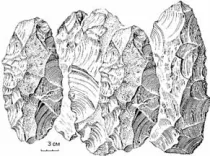
Volkov pays special attention to the Ashol Rubil, bifas. In trasology, these are long -term meat knives. Volkov gives his observations so important that it is necessary to bring them literally. So:
“1) thoroughly finishing of stone tools was carried out in the manufacture of only one type of tool, the material for them was selected extremely high -quality. These leaf-shaped bifasally processed artifacts have an unusually expressive and finished-beautiful shape, strikingly different from all other products as part of the tools of that time;
2) Only these guns in the Ashel period were monofunctional, i.e. narrowly specialized, and were not used in any other, everyday work.
3) The attitude of people to these tools was clearly unusual. But perhaps the most important for us is the functional specialization of the “Ashel Bifas” - cutting of animal carcasses.
... We can confidently say that the "Ashel bifas" possess almost all the signs that ... can be considered obligatory for the characterization of religious guns. If we assume that in order to perform the first sacrifices in the history of sacrifices, a person really needed only one tool - a sacrifice knife, then this tool could well be described above with the leaf -shaped Ashel bifasas. ” Hence, Volkov paves a logical path to the assertion that “religiosity should be attributed to the original, basic, perhaps determining human properties that sharply distinguish our ancestors from the world around them” (AE, pp. 306-307).
Volkov emphasizes the surprise of the appearance of the Ashelsky Rubil, their sharp separation from the Olduvai industry, which does not show the human mind. The main task of the science of wolves (AE, p. 308) considers "know the Creator through Creation."
The possibility of early manifestations of religiosity is not necessary to reject, because a primitive person had very few opportunities for a sound understanding of what is happening around him and in himself, and there are a lot of temptations to explain dreams and accidents with the simplest connections, alas, fantastic. It is quite possible that there is an early existence of ideas about the special importance (“holiness”?) The cutting of the carcass of murdered animals, especially large and dangerous. But in the Doneantertal era, complex concepts such as “God requiring sacrifice” were hardly available. However, this is all fortune -telling - both in favor of the hypothesis and against it, but the burden of evidence lies on a hypothesis that is extending.
This applies to all religious hypotheses, including the hypothesis of the existence of God. This deviates all the conversations that since it is impossible to either prove or refute the being of God, it is better to adhere to atheism, but agnosticism. Either there is, or not. No, sir, the burden of evidence lies on the affirming, otherwise it would have to be refuted by an infinite number of hypotheses.
What is proved that this is exactly the sacrificial knife? What experiments or facts are confirmed? Extraordinary abundance chopped in Western Europe (with extreme rarity outside Europe) speaks precisely against the cult nature of these guns. They are not so sudden: they were preceded by gross manual chopping - there are also.
Let us return to the soil of experimental archeology. In science, I prefer to trust the experiments given and soberly analyzed by Volkov, and not his quotes from the saints and fathers of the church. “Science is much weaker than we thought not so long ago,” says Volkov (AE, p. 308), motivating the need to “strengthen” science with religion. Science is much stronger than some people think today, and it continuously crowns religion. Scientists also make mistakes, but they are corrected by science, and religious dogmas cannot be replaced by other religious dogmas - the truths established by science are replaced by them.
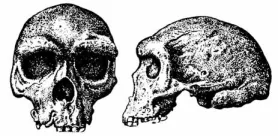
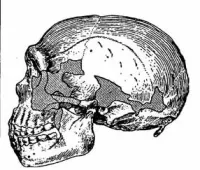
Let us now turn to the second book of P.V. Volkova - to "Archeology for the Orthodox." Her quintessence consists in attempts to tighten the facts of modern archeology to biblical texts literally, i.e. Behind each type of man, for each archaeological culture to see biblical characters. Adam and Eve were created by God on the sixth day of creation. According to Volkov, the sons of Adam Cain and Abel were Neanderthals with the Ashelian culture (Adam and Eve, apparently, also, since Volkov’s Ashel culture-the first genuinely human, Olduyskaya-even a monkey, and between them a gap), the third son of Sif and his descendant- homo sapiens .
But on the fifth day of creation, God has already created a couple of people in the image and likeness of His (more about this in the first book of Genesis). These are pre -dadamites. Their church does not recognize, the doctrine of them is considered heretical - silent about this pair and wolves. Well, there are a lot of ambiguities - it is unclear where the wives Cain and Sif got from, if God took out from Adam is only one rib, and God created only Eve from Adam’s ribs, and Adam and Eve did not have daughters. Isn’t it easier to admit that the Bible is a mixture of the historical chronicle of Judea with Hebrew myths, and in the best case, only purely metaphorically can be perceived about the beginning of mankind?
The Neanderthals can’t give the Ashel culture in any way. Volkov, undoubtedly, knows that all over the world, archaeologists on many reasons associate Neanderthals with Mousterian culture - the following in chronology (we have this step is called the average Paleolithic), and the Asholsky culture, lower Paleolitis, is associated with the Heidelberg type (there are many finds), with paleoanthropes. They are much closer to the monkey than Neanderthals, and, of course, do not approach the role of biblical characters. So Volkov, contrary to all the facts, have to connect Neanderthals with Ashel in order to contrast modern people (including Neanderthals) with monkey -like archanthropes Olduva in order to remove the intermediate link. The mind of this concept is impossible to understand. Here you can only believe. But I do not believe - and do not believe. I need evidence.
A hundred years ago, Pater V. Schmidt, a member of the Order of the Word of God, recognized evolution in a multi -volume “origin of the idea of God”. The General of the Order was shocked and assured Schmidt that after fifty years this teaching would cease to exist. Schmidt wrote to the general: “According to the current state, it seems almost reliable ... I do not think that it will be refuted in the next 50 years. I do not think and that theological reasons against evolution are true ”(Brandewie 1990: 73-74). Abbot Brail, as you know, was an evolutionist - and a great archaeologist.
Lev Klein
- Volkov P.V. Experiment in archeology. Novosibirsk, 2010
- Volkov P.V. from Adam to Noah. Archeology for the Orthodox. St. Petersburg, 2010
- Malinova R. and Malina J. Jump into the past. Moscow, thought, 1988.
- Brandewie E. when Giants Walked the Earth. Freiburg, 1990