
Translated material
555 days of Mars

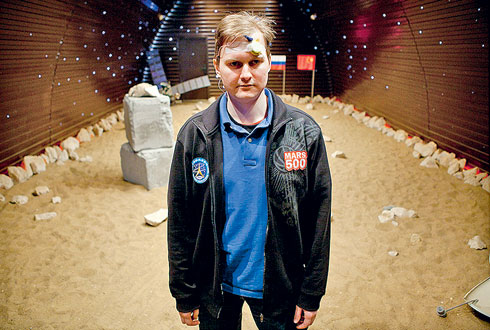
On Monday, December 5, participants in the one and a half year experiment “Mars-500” were finally able to leave the research center and go home. To understand what gave science their imprisonment, scientists have yet to be, but to find out what it was like, you can already be buried in the sand today . Around it is dark and quiet, only light bulbs over the head of the New Year's garland sparkle. The surface is dotted with uneven stones, 3 flags of conquerors stick out of the ground - a Russian, European space agency and the DPRK, and 2 large concrete bricks folded over each other rise above them. During the landing from this Martian cliff, samples of extraterrestrial soil were removed with a drill and a hammer. “You know, many people ask us: and when you were there, on an imitator, you didn’t feel stupid, sitting in this sandbox? -says one of the participants in the “Mars-500” experiment, military doctor Alexander Smoleevsky. - No. We saw Mars through the small window of the spacesuit, and it has a small level of view, and we constantly had to look under our feet so as not to stumble on an oxygen hose, and in our hands when we worked. We did not see the boundaries of the simulator. For us, Mars looked real. ” A team of 6 volunteers spent 1.5 years in isolation from the surrounding world in a cramped module on Khoroshevskoye Shosse, simulating a manned flight to the Red Planet. To this Mars from here - at least 6.5 months of flight.
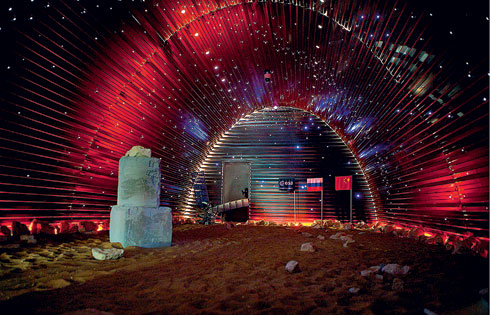
A module like a marvelous disco garage-the Mars surface imitator here the Institute of Biological Problems (IMBP) of the Russian Academy of Sciences since the late 1960s has been studying the effects of isolation on the psyche and human health. The largest, Mars-500, designed to understand whether a group of people can fly to a distant planet and not kill each other, started in June 2010 and lasted 520 days. The expedition was attended by three Russians aged 34 to 39 years, the Chinese (29), the Frenchman (32) and the Italian (28). The expedition “to Mars and Back” finished on November 4, 2011, foreign participants left the institute 2 weeks after its completion, and the Russians “returned to Earth” only on Monday, December 5, after undergoing a medical examination and a kind of quarantine. All this time they slept in the module in which the flight took place.
“On the way from one clinic to another, I ran into the connection salon and noticed that there were new modems of modems and telephones unknown to me,” Smoleevsky shared the sensations of the role of the researcher on board. “I did not feel any other changes.” Alexei Sith, the brown-winner and crew commander, adds that they most likely have changed the composition of the blood, since the air in the module was saturated with carbon dioxide, which means that calcium was washed out of the bones and blood coagulation decreased. “When we came out, the Moscow air seemed to us a clean mountain air,” says Sitev.
Representatives of the institute promise to publish the conclusions and results of the experiment in April 2012. So far, only one thing is clear: in order to get along with a group of people to get along for a long time, you need to become an almost insensitive machine.
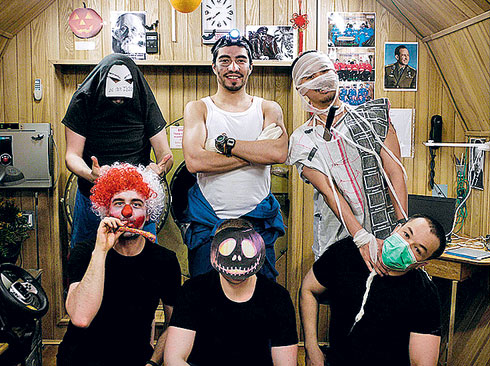
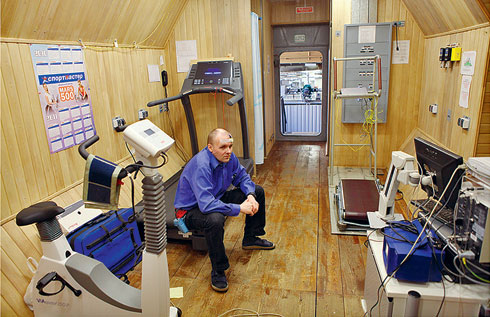
The Mars-500 crew celebrates the Halloween ship test complex “Mars-500”-these are 2 levels of buildings similar to the garages of buildings interconnected by narrow passages. The complex is located inside a large spacious building and consists of 5 modules: medical, residential, warehouse and greenhouse, planting Martian, as well as the surface of Mars with an area of 1200 sq.m. Inside, the ship does not look at all like a spaceship or station - rather, a mixture of a bathhouse with a sports hall: pine wall sheathing, ordinary furniture, book shelves, simulators. Only between the compartments are real round hatches with massive lids through which you need to climb. In the living room - a table, a TV, several chairs, a meager kitchen. Employees of the Institute of dissimilarity explain
That: this is a model, and "any model has borders." The corridor into which all 6 cabins go out, the same, than the passage in a compartment car, and in the cabins themselves only a bed and a narrow table are placed. There is a heavy smell, video cameras hang everywhere. Do not run away, in general.
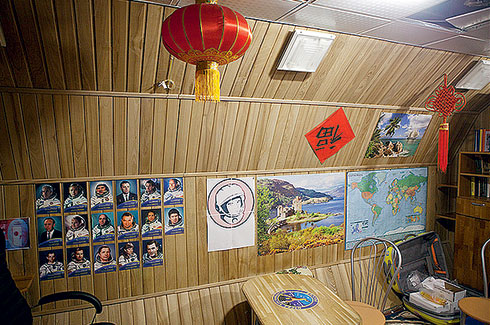
The wardroom is the ship-here the Martians rested and celebrated the holidays there the ship started on June 3, 2010. The first 11 days the ship flew around the ground, then it began to increase the orbit and on the 51st day began movement towards Mars. The distance to Mars constantly ranges from the minimum 55.76 million km to 401 million km. By February 1, 2011, when the ship reached the gravitational field of Mars, the distance was 80 million km. The flight took 193 days.
The crew had several ways to communicate with the outside world. The leaders of the experiment sent short radiograms with instructions and new tasks. The commander Alexei Sitev every evening sent radio -class about the state of the team and the operations, he corresponded with a psychiatrist about the condition of the crew. In the vicinity of the Earth, you could use a telephone connection. Several times a month the crew was allowed to send news to the relatives: they wrote an electronic message, attached pictures and sent it to the command post, from where the institute specialist received it, processed it and sent a letter to the addressee from another computer. And so in the opposite direction. The main type of communication was video calls: the testers recorded a video, sent to the headquarters, recorded the answer there and handed it back. As they deepen into space, the messages reached more and more slowly. In the vicinity of Mars, the delay was 40 minutes: 20 minutes - one way, 20 - in the other, plus time to record an answer.
There was a hard schedule on board and only 2-3 hours of free time per day. Rise at 7-8 in the morning. Medical control - several times measurements of pressure and temperature, weighing. Then a blood and urine test. Breakfast. Experiments. Dinner. Rest 1.5 hours. Experiments that were interrupted for sports training until 6 pm. Since physical activity has sharply reduced in a closed space, it was necessary to regularly engage in so that the muscles would not atrophy. Free time. Dinner. Preparation for experiments of the next day: folding equipment, premises for a warehouse and installing new equipment, preparation of consumables. As one of the constant experiments, researchers were grown in the greenhouse machine in the greenhouse, modeling weightlessness, an edible salad. Evening Medcontrol. Reading, watching a film, sleep.
Astronauts could take only 10 kg of personal belongings with them - 3 times less than luggage on the plane. It was allowed to take several discs with films, a disc with photographs, personal videos and electronic books, several paper books and albums. It was impossible to take products, clothes, cosmetics in bottles and spray can.
There was no plate on the ship, so the products were warmed in the microwave. During the flight to Mars, they sat on a German diet - they ate frozen German products. During the landing, they ate canned food, as in the ISS. On the way back, Russian and Korean products ate - powder yogurts, butter and cottage cheese in vacuum packages, into which it was necessary to fill water and shake for a long time, bakuchini - bars of fruits and berries, canned meat and rice, a drink from silk and cinnamon, cookies, porridge in pressed packaging. The stomachs, as the tests showed, have been withstood such a diet.
 |
The selection and rules Biologist Andrei Bozhko in 1967 participated in the first experiment of IMBP on isolation: he spent a year in a 24 sq.m. module with an engineer and a doctor. There were so few places that when two were sitting at the table, the third could not pass by without hitting them. Water consumption was limited, and the team secretly from the leadership of drank water from the toilet tank. In the fourth week, one of the crew members had a nervous breakdown, in the second month the struggle for leadership began, which led to the fact that for some time the testers communicated only with notes, conflicts arose for any insignificant occasion. For example, due to how you need to cook dumplings correctly. Psychologists reported: “The periods of hostility to each other sometimes reached“ blind hatred ”and“ physical disgust ”.
There were no conflicts between the members of the Mars-500, according to their statements. Alexander Smoleevsky claims that the reason is in the correct selection of the team. Of the 1000 people, psychologists selected 11 applicants, and then, after a series of checks and tests, five were cut off. There were 4 criteria - absolute health, psychological and stress resistance, profession of a doctor, biologist or engineer, as well as knowledge of English. The team members met six months before the start and all this time got used to each other. According to Smoleevsky, the main thing, why the team has maintained normal relations is an understanding that you need to control yourself. “This was possible due to strong motivation and self -discipline,” the researcher says. Smoleevsky was helped by the idea that he had given a lot to participate in the experiment: he refused the apartment and military pension, who had been laid out to him from the length of service, because for the sake of the experiment he quit the army earlier than he had to, and therefore lost the benefits.
On the “Mars-500” ship, as well as at the “Zvezda” Bozhko, the rules were automatically lined up, which was based on a simple thought: with all its might we need to get along with each other. And this means observing silence: in the residential module poor sound insulation. Listen to music and watch movies on a computer in headphones. After yourself, wash the dishes immediately and remove it from the table. You take things - put in place. If you want to take someone else's - ask permission. Respect someone else's space. Without a special need, do not go to other people's cabins. One way to calm down on board was a computer Strike computer shooter - it allowed to relieve tension and splash aggression. French and Italian played on the prefix in Guitar Hero
* * This game is similar to karaoke, but you can’t eat, but you play the guitar. . Between themselves, the “Martian six” spoke English in English, although the Europeans and the Chinese, all 1.5 years of the experiment, studied Russian: black and white photocopies of the pages of the Russian language textbook were hung on the walls of the cabins.
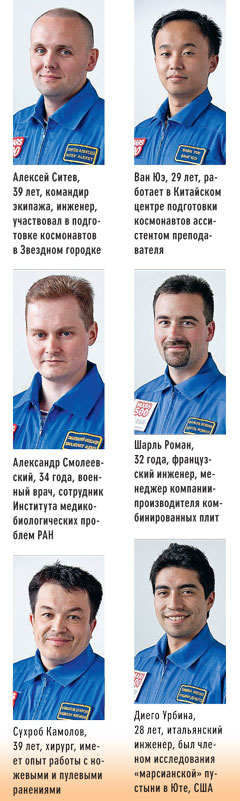
“The Russian part is the former military, so it was not difficult for us to follow the rules,” says Smoleevsky. He used to work at the Military Institute of Medicine, Sitev graduated from the Higher Naval Engineering School. Dzerzhinsky, and the surgeon Sukhrob Kamolov graduated from the Military Medical Academy. Kirova and worked as a doctor on the border of Tajikistan with Afghanistan. Van Yue - from Beijing, works at the Chinese Cosmonaut training center, and is engaged in adaptation problems. Van Yue took the unit (“puls-linguistic”) with him in the experiment for experiments in the field of traditional Chinese medicine. Europeans also brought a lot of all sorts of devices: they were interested in sleep problems, “emotional and cognitive adaptation of loneliness”, changes in the human psyche in a closed space.
There, on the 244th day, they reached the orbit of Mars. After 12 days, Smoleevsky, Van Yue and Diego Urbina said goodbye to the others, moved to the take-off and landing module with an area of 50 sq.m, plucked from the side and went to the Martian surface. On Monday, February 14, 2011, at 13.00 Moscow time, the foot of a man touched Mars. For 11 days of landing, the crew went to the surface twice - February 18 and 22. Two went out - one always remained to monitor the readings of the sensors and the flatulent. Earthlings conducted experiments with a pancreas, figured out the work of lightweight spacesuits, to simulate the redistribution of blood slept upside down at an angle of 15 degrees, obtained samples of the Martian breed and found a magnetic anomaly - a magnet in the form of a dog bone. At the last return to the module, Luke hit a Chinese researcher and dislocated his shoulder, it was a training, fake injury - they worked out communication with a doctor in orbit and a team on the ground: they transmitted electrocardiograms for decoding, X -ray and sound images. On the day of the defender of the Fatherland, February 23, the crew went back to the ship. There were 247 days ahead of the road home.
At home, the experiment is completed. The costs of Roscosmos and RAS on the Mars-500 amounted to $ 15 million. The participants did not decide what to do next and what to do with a bonus of 3 million rubles to each. They do not understand whether they want to truly fly into space. They, to be honest, are generally not clear what they want. Either prolonged isolation and self -control, or something else, but they are not very similar to those who are able to experience people's emotions. Cold, incredibly calm and without shine in the eyes. As if they are still on Mars. All questions answer insinuatingly, quietly, measuredly, without exclamation intonations, and for an attempt to somehow stir them, they are not being conducted. Tired, maybe. Even to the question, as for 1.5 years they did without sex, the answers were mainly deprived of all sorts of emotions: “They didn’t think about it”, “There was a lot of work - not up to it”, “Adults - we can restrain ourselves.” The only flash of feelings occurred due to the Leonard unit.
“But this is one of our simulators,” Smoleevsky showed.
“No, no, this is not a simulator,” Sidev corrected him calmly.
“This is a simulator,” Smoleevsky answered excessively calmly.
- This is a platform for physical training. We stood on her, jumped and measured the height of the jump, ”Sidev commented coldly.
“Plus, we performed a static load on it to maintain balance with additional load,” Smoleevsky said slowly. Sidev averted his eyes to the side.
Why do we need Mars Doctor of Physical and Mathematical Sciences, head of the Laboratory of the Institute of Space Research of the Russian Academy of Sciences Leonid Xanfomalithi, the famous specialist in planets, in his book “Parade of Planet” says that Mars, which was stuck somewhere in the middle of the evolutionary path of the Earth. Rusty red, burning cold soil, atmosphere, 95% consisting of carbon dioxide, dried valleys of ancient rivers, the average temperature minus 63 degrees Celsius. There are rosures, platinum metals, silver, gold and uranium. Therefore, humanity is developing plans for the colonization of the Red Planet. Last year, the research center named after Aimsa, one of the main NASA laboratories, began to design a “centenary spacecraft”, which will have to forever send the first group of people to Mars in 2025 so that they began to master the planet.
But the story of the domestic “phobos-group”, which was lost in space, who could not even take the desired course, the history of “Mars-500” researchers who voluntarily locked themselves on Khoroshevskoye Shosse, suggests that today, despite technical development, Mars remains too far.
“People just don’t need to go there,” said Leonid Xanfomalithi, The New Times. - There is a place for robots and devices. People are a place on Earth. "