
Translated material
"Chibis" goes to take off!

On November 2, 2011, the Progress M-13M cargo ship arrived at the International Space Station, on board of which the Chibis micro-tick is located among other goods. It is planned that after the performance of all official functions, the progress ship at the end of January 2012 is ploted from the ISS and switches to a higher orbit, about 480 km with an inclination of 53 degrees. Then the Chibis will be pushed out of the transport and launch container and begin an independent flight, and the “progress” will make a maneuver in order to burn without a trace in the upper layers of the atmosphere.
The Cibis satellite was created by the employees of the Institute of Cosmic Research of the Russian Academy of Sciences in cooperation with other Russian and foreign institutions, and its main task is to explore the characteristics of the earthly gamma flash (TGF-Terrestrial Gamma Flash) associated with thundercloud. Gamma radiation from earthly thunderstorms was recently opened on satellites, looking for sources of gamma radiation in space, but suddenly discovered them on Earth. Outbreaks of gamma radiation on Earth have a duration of 0.2-3.5 milliseconds with energies up to 20 MeV. Scientists want to understand the details with this phenomenon, and Chibis here acts as an experimental installation for the research of the physical mechanisms of electrical discharges in the atmosphere in the widest range of energy- from radio to gamma radiation.
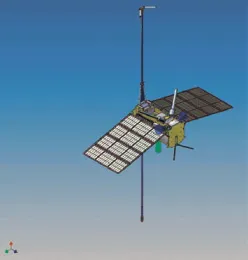
On November 21-23, in Tarusa, on the basis of the special design bureau of Iki RAS, where the device was developed and created, a working seminar was held, where they discussed preparations for work with micro-stones. The seminar examined in detail the theoretical and practical aspects of the experiments on Chibis, and academicians L.M. took part in it Green and A.V. Gurevich, leading scientists responsible for the instruments on the satellite, and young employees of Iki, for whom experiments on Chibisa will be the first steps in space research. Like any spacecraft, Chibis needs large -scale ground support - a flight control center is required (it will be in the SCD of the RAS), a data acceptance and processing system, an interactive data access and analysis system. The coordination of all work with the satellite will be carried out by the main group of operational management (GOGU), which was created in iki and combines the efforts of all experimenters on Chibis.
In addition to the scientific tasks, “Chibis” will perform educational. The first step in this direction-telemetry about the condition of the satellite-will be transmitted to the radio amateur VHF-band 435 MHz, so that its signals will be able to freely accept schoolchildren and students and use for educational purposes. In addition, the scientific database will have an open format in the form of graphs representing measurements for individual devices.
Before the release of Chibis, it remains to wait for a free flight for a long time - we wish the success of his mission!
Alexander Zaitsev
The site of the microsatter "Chibis" http://chibis.cosmos.ru .