
Translated material
It is for schoolchildren
On November 16 , a seminar organized by the Skolkovo Open University and the Skolkovo information technology cluster was held at the Center for International Trade. The topic was quite relevant for Russia: “IT in education. Education in it ”[1].
Despite the fact that the theme of the seminar implied education as a whole, most of the speakers devoted their speeches to school education. The question of postgraduate education was actually hung in the air. And this is explainable. It is difficult to fix those mistakes of training and education that are laid at the very early age. The younger the students, the more fundamental education should be. No wonder in market economies the quality education of children is significantly more expensive than a qualitative education of adults.
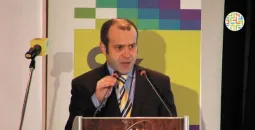
A striking example of the importance of early education was the presentation of Anatoly Kushnirenko, head. Department of the Research Institute of System Research of the Russian Academy of Sciences, which, on the basis of experience in teaching programming his granddaughter, showed that in order to master the concepts of programming, the age of transition from pre-operational thinking to a particular operating room, i.e. Starting from the age of 6. Graduates of elementary school with early interests in the natural science region will be able to go through a systematic course of sequential programming in the 5th grade and consciously approach the choice of further educational trajectory.
The most interesting at this seminar was a clash of two approaches in education regarding IT-disciplines (and essentially any vocational education). This is due to a certain contradiction between the IT industry and representatives of the pedagogical direction.
Anna Zharkova, deputy. ABBYY General Director for the Development of State and Public Programs, said that it is important to teach invariant concepts and skills. It is necessary to teach to understand the system, not specific tools, applications, etc. Informatics should form algorithmic thinking. We need to study user skills and programming. We must strive for knowledge with prolonged relevance. All items must be saturated with the methods of using a computer that are relevant specifically for this area.
Director of the Center for Information Technologies and Educational Equipment of the Department of Education, Moskva, Elena Igorevna Bulin-Sokolova, reported that in accordance with the developed standards of the new generation, competencies come to the fore (i.e. the ability to apply knowledge), the formation of universal educational actions, the revision and reduction of the volume of subject knowledge, an increase in the priority of meta-subject knowledge (ways of searching, collecting, processing, analysis, analysis, analysis, analysis, analysis, analysis, analysis, analysis, analysis, analysis organizations, transmission and interpretation of information).
Everything seems to be important. Both professionals and teachers are right. But the approach dictated by education workers does not suit professionals - as a result, there is a shortage of highly qualified personnel. Those who copy the competency -based approach from the West often do not inform us of its shortcomings, which are as follows: the approach is focused on real, rather than future competencies; It is more suitable for selection, and not for development and often suffers from the quality of choosing a significant measuring strategy.
And the way out here, in my opinion, is in the following. It is necessary to diversify the approaches to the formation of schoolchildren, and not work only for dictation of the Federal State Educational Standard. Moreover, the standards are obsolete without having time to go out. It is necessary to exist more autonomous from the mona of educational organizations in the work of which professionals participate.
Nevertheless, the discussion, which took place at the seminar in the IT-claster of the Skolkovo Foundation, seemed useful to me. The interaction of the scientific and professional community with teachers is always desirable, since usually at seminars and conferences related to education, mainly specialists working in the field of education are represented. It would be possible to advise the IT-Claster also to discuss IT topics in scientific research (issues of open science, electronic publications, copyright, Creative Commons, etc.) and, in particular, the influence of IT on humanities.
In conclusion, I would like to note that, despite the criticism of the Skolkovo project existing in scientific circles, it makes no sense to refuse to participate in the projects and events of the fund. Among the latest positive points, one can note the message of the vice president of the Stanislav Naumov Foundation about the idea to achieve the right to conduct research in the laboratories of the Academy of Sciences before laboratory complexes are built in Skolkovo. At the same time, equipment for these studies will be imported using the benefits laid for the Skolkovo residents [2]. Another interesting project of Skolkovo is the competition of the concept of the school of the future Skolkovo, in which the academic team is involved in the head of the vice president of the Russian Academy of Sciences Kozlov [3]. Of course, errors in the implementation of the project probably exist. And in Soviet times, there were many errors in managing large projects, but the talent of individual performers more than overlapped all costs.
Valery Platonov,
Executive Director
ANOO "Higher University
Science and technology "
At institutes of the Russian Academy of Sciences
1. Http://openu.ru/event/seminar-n2-it-v-obrazovanii-obrazovanie-v-it .
3. Www.i-gorod.com/newslist/konkurs_konceptcij_po_sozdaniyu_shkoly_ skolkovo/