
Translated material
All the same, we won’t leave to drink!
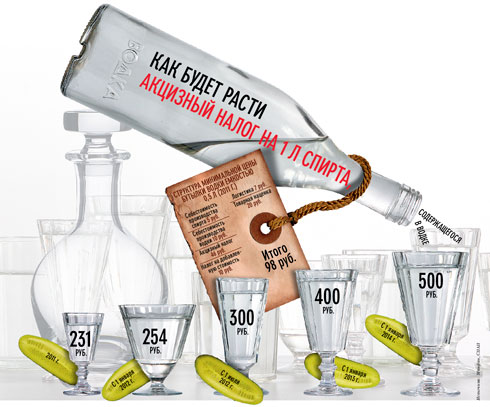
All the same, we won’t leave to drink! The coming New Year will be remembered by the Russians by the fact that the post -holiday hangover will cost them more than the holiday itself. From January 1, 2012, a phased increase in excise taxes from alcohol manufacturers will begin. Vodka will rise most of all. What will this lead to - found the New Times
Dasha, an unnecessary saleswoman in the wine and vodka department of an inexpensive grocery store in Chertanov, the conversation about prices willingly: “I will put new ones from the New Year, and nothing will change more. As they bought, they will buy it. ” She does not see the grounds for falling sales - and not only because she works on a salary and does not receive any surcharges from revenue: “I don’t know, excise taxes are not excise taxes, but vodka was valued before. But those who regularly go here for her, they will rather save on other products, and they will take a “white one”. I know this audience well ... "
| | | --- | |  | | | Higher and higher
Excise tax is a decisive factor that determines the price of vodka. The minimum cost of a half-liter bottle of "Belenka" today is 98 rubles. Of these, the cost is only 15 rubles, while excise taxes are 46 rubles, almost half of the price. Starting next year, according to the Law * *, the Federal Law “On Amendments to the Secondary of the Tax Code of the Russian Federation and Certain Legislative Acts of the Russian Federation” was signed by the President of the Russian Federation on November 29, 2011. Excise taxes on strong alcohol products will begin to increase almost exponentially. From January 1, 2012-by 10%, from July 1-another 20%, and by January 1, 2014-already 2.5 times. If today an excise tax on 1 liter of alcohol contained in vodka is 231 rubles, then after 2 years it will amount to 500 rubles.
Accordingly, the prices for vodka on the shelves will take off quite a lot. According to Dmitry Dobrov, the chairman of the board of the Union of Alcoholic Products, the average price of a half -liter will come next year to 200 rubles (today - about 140 rubles). And in 2014, when the excise rate reaches the climax, the same 200 rubles will be the minimum price of the bottle (of which 100 rubles will have to be on excise tax), and the average will be in the region of 400 rubles.
In the explanatory note to the law introducing new excise taxes, 2 reasons why the government goes to this step: the authorities hope to replenish the treasury and take care of the health of the nation, reducing the number of people who want to drink strong alcohol. Will the declared goals be achieved? Experts disagree.
As a result of the growth of excise taxes, the consumption of vodka in the next 3 years will decline by 7.7% per year and by the beginning of 2015 on average per capita will decrease from the current 11.9 liters to 8 liters per year - analysts of the Renaissance Capital company in a special study on the alcohol market of Russia recently published. They note that all over the past years, the turnover of vodka in the country has already fallen, but not so fast: according to Rosstat, in 2006-2009-by 3-4% per year, in 2010-about 6%.
Moonshine or beer?
The Russians will drink less vodka, Vadim Drobiz, the director of the analytical agency of the digitry (the Center for Research of Federal and Regional Alcohol Markets), agrees, but in general, alcohol consumption will not decrease: redistribution will occur inside the alcohol market - between strong and weak drinks, as well as between legal and illegal products.
Analysts of the Renaissance Capital admit that the increase in retail prices for vodka will most likely lead to the temporary growth of the shadow market, but to insignificant. Now, according to them, the “gray” vodka market is 35–40% of the total. By 2014, subject to tightening control by regulatory authorities, it should not exceed 45%. As for the choice of those who, for reasons of high cost, will refuse the next 3 years of vodka, they, according to the Renaissance of Capital, mainly switch to beer and wine.
“Any alcoholic drink has its own“ target audience ”,” Valery Loginov, a member of the Council of the Union of Vinocence and Winemakes of Russia, does not agree. - Say, the youth today is less committed to drinking strong alcohol, prefers beer, low alcohol cocktails, wine. Vodka is usually used by those who are older. But there are other priorities - social, even professional. For example, for military vodka - their "courageous" drink. And these traditional consumers of vodka are unlikely to stop the expected rise in prices. ” "
The average price of a half -liter next year will approach 200 rubles. And in 2014, when the excise rate reaches the climax, it will be around 400 rubles
"
Vadim Drobiz has much less optimistic forecasts on this score: he believes that moonshine will take the place of legal vodka. According to him, the production of strong alcoholic beverages will increase over 3 years from the current 150 million to 220 million decalits. At the same time, the volumes of production of vodka (including illegal) will be reduced to 85–90 million decalits, the remaining 130–135 million decalpers will come to moonshine: “You will see, it will even come to the point that the Russians will begin to create“ puffs of moonshine lovers ”.
At the same time, the state will still take its own, adds a fragment, referring to the growth of revenues to the budget. According to his calculations, in 2011, the excise tax will be collected with 80 million decalis of vodka, which will ensure the receipt of 70–74 billion rubles to the treasury. And in 2014, the legal market of vodka will amount to 60–65 million decalits, but a sharply increased excise tax will lead to the collection of about 125 billion rubles * * according to the Ministry of Finance, excise taxes on alcohol brought 82 billion rubles to the budget, and in 2014 they should amount to about 315 billion rubles. .
Left left
The path to improving the health of the nation is not an increase in excise taxes at all, but their freezing, Dmitry Dobrov believes. He claims that the number of cases of death from people's poisoning by alcoholic beverages compared to 2005 has almost doubled-due to the fact that the backy of vodka became less in circulation. “In recent years, the legalization of the alcoholic market has been quite active: if a couple of years ago the“ left ”vodka was over 50% of the turn, now about 35%,” the expert says. - But this legalization can negate such a significant increase in excise rates. People who are accustomed to drink vodka, but who have lost the opportunity to buy it, will switch to a “stick”. At first, a reduction in the share of the “left” vodka in the total circulation from the current 35% should be reduced to at least 10-15%, and only then raise excise taxes, Dobrov believes.
Nevertheless, the majority of experts surveyed by The New Times believe that the government made the right decision, sharply increasing excise taxes on vodka. “Russia was and remains a country where strong alcohol is one of the most inexpensive in the world,” says Valery Loginov. “One hundred percent rise in price, stretched for 3 years, will still not make vodka in Russia with expensive goods, it will still remain relatively cheap compared to foreign analogues.”
An increase in excise taxes in any case, the coalition coalition “for control of alcohol” Daria Khalturina is sure: “Everywhere in Eastern Europe, such a measure immediately led to a decrease in mortality from alcohol consumption. For example, in Ukraine in 2009, excise taxes were raised 1.5 times, and the mortality curve immediately went down abruptly - for the first time in the entire post -Soviet history of this country, before it only grew. ”
The Russian government will inevitably have to increase taxes after the elections, the head of the Department of Strategic Analysis of the FBK Igor Nikolaev is sure: the burden of budget expenditures taken over by the state is too large. “It is better to raise taxes on bad habits, increasing excise taxes on alcohol and tobacco than to increase fiscal pressure on the business or to the salaries of citizens,” the expert believes.