
Translated material
Daily magazine: European
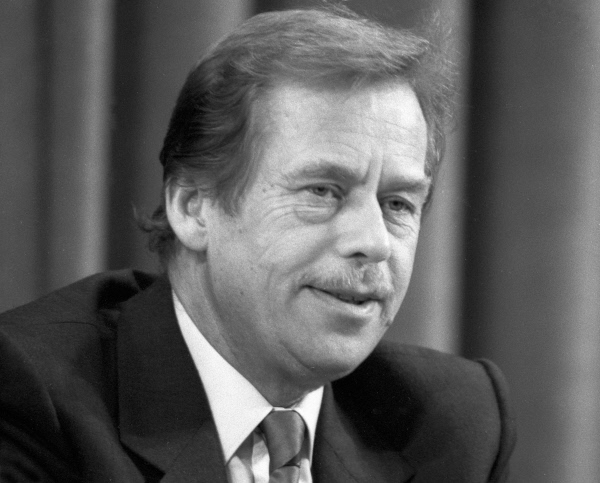 Vaclav Gavel was a European - even when his country was behind the "iron curtain." Many politicians of the former Czechoslovakia have made a difficult and controversial path from the sincere following communist orthodox to the commitment of democratic values. The key figures of the Prague Spring were just such people - Dubchek, Blueberry, SMRkovsky, Kriegel, Mlynarzh.
For Gavel, “Europe” and rejection of the Soviet system, like its flip side, was hereditary and organic. His family was “inscribed” in the European elite, and he was brought up in this spirit - despite the fact that in Czechoslovakia, belonging to the former establishment entailed large and minor troubles: the inability to study in a gymnasium, to get a prestigious humanitarian education. In conditions of lack of freedom, he grew up a free person independent of the political system that existed in his country. However, in Eastern Europe this applied not only to immigrants from the old elite - for example, Adam Mikhnik grew up in a family with left -wing traditions.
Vaclav Gavel was a man of generation of Lech Valensa and Yozhef Antall, leaders of the Polish and Hungarian “velvet revolutions”. But it was more difficult for him than them. In Poland, there were an influential Catholic Church and a powerful labor movement (its symbol and became Valens), with which the authorities were forced to reckon even during the period of martial law and the defeat of the organizational structure of "solidarity". In Hungary, after the ferocity of the first years of the Kadar's rule (when Nadia and his associates executed), the liberal “goulash-socialism” came, in which dissidents could work in scientific institutes and museums, engaged in intelligent labor.
In Czechoslovakia, after the defeat of the “Prague Spring”, the authorities rely on the burning of dissent to morally crush the not consonants with the regime. Participants in Spring, who did not repent in their sins, were deprived of the opportunity to work in the specialty even in the smallest posts. They remained only vacancies of janitors and laborers, regardless of the education and knowledge of languages. Gavel was one of the few who was more fortunate - he was a famous playwright, whose plays were in demand outside the country and brought him fees. Then the authorities began to “dig” from the other side, accusing him of parasitism - and Gavel had to set up an auxiliary worker at a brewing plant so as not to repeat the fate of Brodsky, but within the framework of an even more rigid system.
The struggle in such conditions seemed hopeless, especially since society was conformist. The economy grew, in the Soviet market Czech goods were appreciated. In these conditions, participating in the dissident movement was doubly more difficult - and Gavel decided to do so. He became one of the leaders of the small community of Czech human rights activists and naturally headed the country after the “velvet revolution”, which destroyed the totalitarian regime.
The leaders of the revolution cannot cause unanimous approval. Firstly, they initially represent only one part of it-the other, offended, at first silently, and then aggressively rejects them. Secondly, since many supporters associate excessive expectations with them-it is worth electing a good honest leader how the dairy rivers will flow, and the shores will become sour. When it turns out that their chosen ones are not capable of creating a miracle, disappointment comes. Thirdly, recent associates become political competitors-and this also violates its original idyll. All this was characteristic of the Czech Republic under Gavel and his comrade-in-arms-member of Vaclav Clause.
But Gavel at the president’s post was able to achieve the results that entered his name in the history of the country. Under him, the Czech Republic and Slovakia were able to divorce in a civilized way-unlike the republics of the ex-jugoslavia, the collapse of which was accompanied by a bloody war. Now both countries are members of the United Europe, maintaining normal friendly relations with each other. The role in this last Czechoslovak president, which was not characterized by “mini-imperial” complexes, is great. Fast European integration of the Czech Republic can also be recorded in the Act of Gavel. Currently, the country is a member of the EU and NATO, and non -alignment to the euro zone in the current situation can be considered more a plus than a minus. The country was carried out in the country, the Communist Party was recognized as a criminal organization, but its heiress (not refused ideological identity) continues to exist and is represented by the Ministry of Education faction in parliament. Thus, the Czech society under Gavele advocated sanctions against specific persons and the moral condemnation of the “nationalist” party - but not for the ban on the communist idea.
Gavel became the president in time - in the ordinary political situation, such leaders are rarely in demand - and left the state life just as timely. Leaving the Prague city, he did not form his own party and turn into one of many political figures, whose fate depends on electoral vicissitudes. He became one of the moral leaders of Europe - this was possible not only thanks to his dissident past, but also thanks to the experience of the presidency, during which he consistently adhered to democratic values. The word of Havel meant more than the point of view of many current politicians - for example, his position became decisive in the case of the non -administration of Putin of the German Prize "Quadriga".
How did Havel relate to Russia? He was a decisive opponent of the Russian state as an empire, imposing his will to other countries. Therefore, the Russian imperials, nostalgic for Soviet times, consider it Russophobe and cannot forgive him for participation in the collapse of the Warsaw Treaty. But Russophobia is a hostility not to geopolitical plans, ambitions and illusions, but to the Russian people - but Gavel never suffered. A few days ago, he said in an interview with Novaya Gazeta that “the most threat to Russia would be the indifference and apathy of people. Against. They must tirelessly achieve recognition and observance of their rights and freedoms. ” If Russophobia, be the Russians to become citizens, and not submitted, then what is Russophilia?
Author - First Vice President of the Center for Political Technology