
Translated material
Georgia brought Russia to court
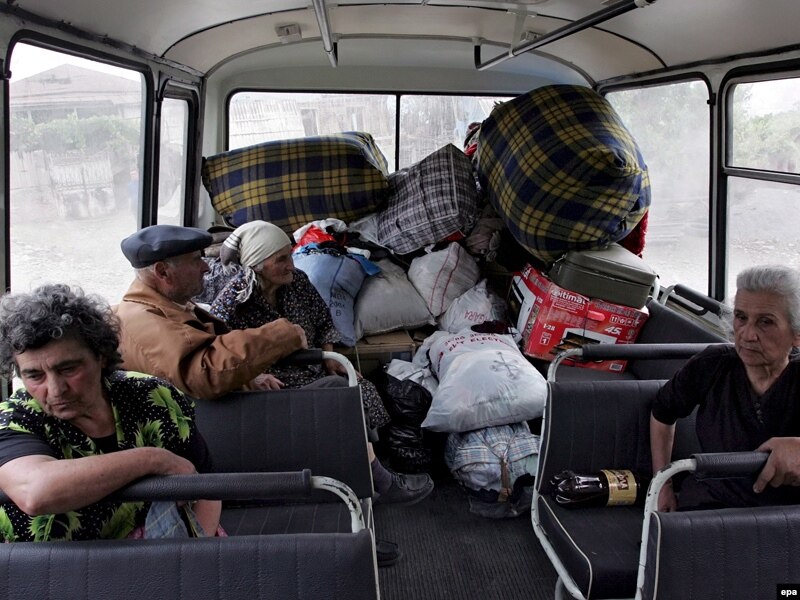
When the consideration of the case begins, it is not yet known. However, in Tbilisi they hope to decide in their favor and intend to demand compensation from Russia for moral and material damage caused to Georgian citizens.
The confrontation between Russia and Georgia in European courts began before the end of the military phase of the conflict. On August 11, 2008, that is, the day before the cessation of hostilities on the basis of the so -called "Sarczya - Medvedev agreement", the Ministry of Justice of Georgia appealed to the Strasbourg Court of Human Rights. Finally, this complaint was framed in February 2009, it contains eight points. Georgia accuses Russia of violating several provisions of the Convention on the Protection of Human Rights during or after the end of military operations around South Ossetia. Including - in inhuman treatment of civilians, torture of civilians, the destruction of their property, restriction of freedom, etc.
Georgia is ready to provide the court with evidence in the form of eyewitnesses of eyewitnesses, as well as evidence of representatives of international human rights organizations. Basically, we are talking about the destruction of the Georgian villages of South Ossetia after the completion of hostilities, about the murders and torture of civilians of these villages. The Georgian side does not deny that almost all crimes were committed not by Russian troops, but by Ossetian armed groups. But since South Ossetia at that time was already fully controlled by Russian troops, Tbilisi has liable for Moscow, referring to the provisions of international law that the country whose armed forces occupy the territory is responsible for the actions of armed formations controlled or loyal to it.
The Ministry of Justice of Georgia, the Radio Liberty correspondent, reported that within three months the Russian side tried in every possible way to convince the Strasbourg court not to accept the Georgian complaint for consideration, referring to procedural violations allegedly committed by the applicant. However, the European Court of Human Rights will still begin consideration of the case, starting with the interrogation of witnesses.
In Georgia, it is believed that the court’s decision itself to make a complaint for consideration is a great success. Deputy Minister of Justice Tinatin Burdjaliani (who oversees the Ministry of International Academy) told reporters that the Strasbourg court has the right to apply the widest range of sanctions to Russia. Including, to oblige to compensate for material and moral damage to Georgian citizens who have lost loved ones or property as a result of the actions of armed groups who burned their homes and committed murders in the Georgian villages of South Ossetia from August 12 to 18, 2008.
One of the authors of the current Constitution of Georgia Vakhtang Khmaladze emphasized in an interview with RS:
- A positive solution to the issue will be very important both from a material point of view (Russia will be obliged to pay compensation) and from the political one: this will be a rather serious blow to the reputation of Russia ...
Famous human rights activist, member of the pardon commission on President Saakashvili Elena Tevodoradze does not agree with the main argument of the Russian side that the Russian army cannot and should not be responsible for the actions of the semi -official armed forces of South Ossetia:
- At the moment when the Russian troops were already stepping towards Gori, I was there and saw how Georgians, Ossetians fled, are the inhabitants of those villages that are compared to the ground today. I was in that commission that received calls day and night - from people who hid in dungeons and forests, since militants of an unknown nationality (the militants have no nationality) killed them. There were only Russian troops. And if gangs were attended before their eyes - they are responsible for this, ”Elena Tevodaze is convinced.
The European Court of Human Rights is not the only instance where Georgia is trying to sue with Russia. Earlier, the International Court in the Hague considered the appeal of Georgia regarding the violation of Moscow during the events of August 2008 of the Convention on the elimination of all forms of racial discrimination. True, the Hague court rejected this appeal, urging the parties to start bilateral consultations to resolve the problem.