
Translated material
Dancing La Scala
Sleep on the winter night. The former choreographer Mariinka shows in Moscow the art of Italian dancers. The performances of the Milan ballet ends the year of Italy in Russia 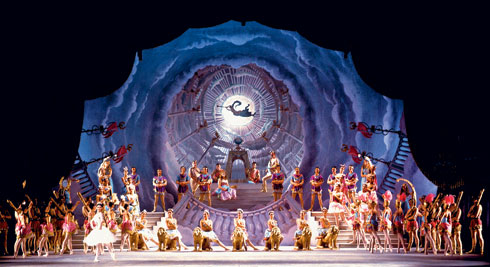
The Galop of the Telegraphists “Exenser” was first put in La Scala in 1881 by Luigi Manstti, resurrected in the repertoire of the main Italian theater in 1971, and Hugo del Ara was reconstructed. In today's posters of European theaters, you will not meet the productions of so naive and so touching in this naivety. Manzotti believed in progress, that technical inventions would certainly bring happiness to humanity - and set out his beliefs in dancing.
We are shown by the achievements of mankind: the invention of electricity, the ship, the opening of the Suez Canal. In the first scene, the light is freed from the shackles - and then the whole performance, in each scene it triumphs over obscurantism. Sometimes the ballerina simply opens his leg high in Developpe - and the gloomy type shies so as not to get a pointer in the jaw. The light inspires and comforts the inventors when it becomes completely bad, shows them the future of their creations. Thus, the crowd who invented the person who came up with the steamer, and the light shows the Light, shows the poor fellow who will walk around the seas. At the same time, the genre of the play is an extravaganza, and the theater did not spare money for the “picture”, applause periodically arises in the hall when a steam locomotive or a ship running along the bridge appears. The invention of the telegraph is the result of the discovery of electricity - and now sixteen sending people are waved with telegrams in the vigor of the gallop. Of course, it is assumed that the sending ones are boys, but the dancing to the female corps de ballet were given, and quite virtuoso ensembles on the poinets are built. The most impressive (and most ridiculous) scene is the opening of the Suez Canal, on the banks of which there are Indians with Japanese, and the embodied civilization changes four partners in the dance of the Chinese, the Englishman, the Turk and the Spaniard.
"
Manzotti believed in progress, that technical inventions would certainly bring happiness to humanity - and set out his beliefs in dancing
"
The little-headed art few musical theaters of the world can equally boast of an opera and ballet-somewhere the musicians inadvertently “strangle” the dancers, somewhere, on the contrary, the ballet people command and adjust the work schedule for themselves. Who is the main one-you can easily find out at the prices of tickets: in a large, as you know, viewing the ballet performance will cost two to three times more than the opera, in the LA Scala-exactly the opposite. Now the Italian ballet is not at all as famous as at the end of the 19th century, when Russia was conquered by Milan virtuos (Fuete in our Fatherland, as you know, was the first to perform Pierrin Lenyani). However, in the last three years the situation began to change: Maharbek Vasiev became the artilleryshop in La Scala.
With the name of the Mariinsky dancer, who in 1995, which became the head of the ballet in his native theater, the best decade of Mariinsky was connected: loud premieres, each year that appeared new names, new stars, seen by the vigilant eye of Vasiev in the ranks of the corps de ballet. His voluntary resignation was caused by a chronic misunderstanding with the “big chef” - Valeria Gergiev was much more interested in the opera. Now, it seems, everyone except himself regrets Vasiev’s departure. He is good in Milan. There, he implements his program, and one of the most high -profile European premieres of last fall was the reconstruction of Raymonda, carried out by Mariinsky soloist Sergey Vikharev. The ballet swings were very hoping that it was this ballet to tour - but apparently it was decided to show the exelfer important for Italian history, and two such huge performances would be difficult to bring for purely financial reasons.
Morning in the Milan Forest Balanchinsky “Summer Night Dream” does not promise staged miracles, the attention of the choreographer always occupied only the dance. But the dances there are excellent - both narratives (the entire first act of the Balanchin retells the Shakespearean play), and almost plot -divergen (the second act is a wedding divertissance). The score is collected from several works of Mendelsson - including, of course, the “wedding march”. The crafty PEK easily takes off over the stage, and the poor, enchanted Titania, looks toward at a shortage with a donkey head on his shoulders. The participation of “stars” is not supposed, but there may be a special move of Vasiev: he also liked to put people in Mariinka to important performances of people that no one had yet known: they became famous. And to take a look at the rare nostalgic performance of Balanchin (he went on the stage of the St. Petersburg Mikhailovsky Theater in the “Snow night” in the role of tiny elf) curious to the emergency.