
Translated material
"Young Cuba" armed with the Internet
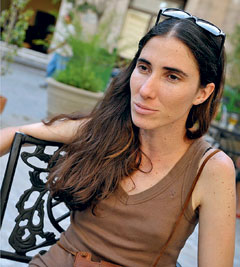 |
| Joani Sanchez, leader of the "generation y" |
Lajovencuba.wordpress.com - a young cube blog, working in the Cuban city of Matansas, published sensational data: at the end of 2011, on the island there are from 2 to 3 thousand bloggers. 36-year-old Joani Sanchez leads in the ratings. It turned out to be difficult to get out with her on Facebook, which the author tried to do: the number of people “exceeded the limit”. And on Twitter, Sanchez has more followers than the immortal commandant Fidel Castro, who started the account of the first of the Cubans: 184 thousand versus 35. How was it possible on the island where tough restrictions on the Internet are still operating, ”the daughter of the current leader of Cuba Cuba Cuban Mariel started the New Twitter. Castro Espin. And the first to ask her a question on the network was Joani Sanchez. "When will Cubans finally be able to get out of their secret corners?" - Joani asked, referring in mind the ban on the free departure of citizens who was still valid in the country. Mariela answered sharply, turning to the blogger to you: “I advise you (you) to learn to conduct such discussions at the proper level.” Literally the very next day, Twitter, the leader of the leader was attacked by critical responses. And she fell off: “Despicable parasites! You work out orders of your employers! (They, presumably, are the same as the Russian opposition - the US State Department. - The New Times) It would be time to become more creative! ”
Mariela Castro Espin is an atypical representative of the Cuban nomenclature to the question of the creative, actually. Rather, even on the contrary - it stands out sharply from its ranks. Having headed the Cuban National Center for Sexual Education for many years, Mariela recommended the National Assembly of Cuba to adopt a law recognizing same -sex marriages and permits free flooring operations with a change in the relevant metrics: the document was approved in 2008. “Defender of Cuban gays and transvestites,” Western media write about Mariel Castro. But even such a progressively thinking, it would seem, person falls into attacks of rage when someone is trying to talk about fundamental civil liberties, question the policy of the regime established in Cuba half a century ago by her uncle and father.
Mariela Castro, of course, is wrong. Cubans are the most creative people in the world. Well, in what other country would a hybrid of the American car of the middle of the last century and the old Soviet motor boat in order to flee to America? And “despicable parasites” Cubans can only be in the conditions of a centralized economy, but they bloom at large, turning into brilliant managers and talented entrepreneurs.
Yoani Sanchez, meanwhile, is a rare and therefore particularly valuable example of how the intellectual potential of a cube can open up in his homeland. Having spent several years in Switzerland with her husband, journalist Reynaldo Escobar, and the son of Theo, she returned to Havana in 2004. It was then that her ascent began. First, Joani, a philologist by education and a graduate of Gavan University, founded the social and political magazine "Consensus" together with her husband. But having not received proper recognition in the traditional printed form, the magazine by the will of its founder was transformed into an Internet page called “Generation Y”-from the first letter of the name Sanchez-Yoani and at the same time with a hint of those in whose names this letter is present.
What is this generation? “It grew in the 70-80s,” Yoani explains in one of the blogs, “in the era of total retraction, schools in the field (primary and secondary educational institutions operating in rural areas-their students joined the physical labor on the plantations of citrus fruits; schools in the field were especially widespread in the 70s and 80s-The News-The New Times), Soviet -made toys, state paternalism, illegal mass flight from the country, double morality and a crash of hopes. ” But with the beginning of the new millennium, Sanchez notes, “Generation Y” received at least one hundred percent opportunity for self -expression - a global network.
"
Cubans are the most creative people in the world ... they make them a centralized economy “despicable parasites”
"
The drive belt of its first blog, which appeared in 2007, Joani Sanchez devoted to the problems of city transport of Cuba. The second is the discrimination of Cubans in the tourist centers of the country intended for foreigners, including the world -famous resort of Varadero. A month later, Joani's caustic comments were dispersed throughout Cuba about the ban on leaving the country, terrifying unsanitary conditions, lack of elementary drugs in Cuban hospitals ...
A few weeks after the start on the network, Joani Sanchez began to receive hundreds, and then thousands of responses. Her blogs began to be discussed at bus stops, in kitchens and in university campuses. Foreign journalists began to ask for an interview with her. According to the Spanish newspaper El Pais, "The Blog of Joani Sanchez set in motion the island."
Its popularity began to grow like a snowball. In 2008, Joani received the prestigious Spanish Prize of Ortega for achievements in the field of digital journalism. In the same year, the American magazine Time includes it in a hundred most influential people in the world. In 2009, Joani takes an interview with US President Barack Obama, and Generation Y, according to the results of the Time magazine and CNN, is included in the list of 25 best blogs of the world. For three years-from 2008 to 2011-Joani Sanchez receives about 15 prestigious international awards. It seems that for happiness she lacks only the Nobel Prize of the World.
Secret forces? Such a degree of intellectual influence on Cuban society, like “generation y”, have neither power, nor scattered and rather small groups of opposition. This, perhaps, is the phenomenon of Joani. At the same time, the blogger herself does not consider himself either a “fighter with a regime” or a “cyberdissional”. Her destiny, as she herself says, is enlightenment. And this is true. Joani not only leads his own page on the Internet. She still founded in Havana a kind of “Bloggers Academy”, which taught the lessons of ethics, rights, Cuban culture, photographs, techniques for using such tools of Internet journalism as blogpost and Twitter.
But the educational activity of Sanchez causes a fierce reaction of the regime. Two years ago, the agents of the Cuban secret police stole Joani when she was heading for a meeting of the discussion club, and brutally beaten. Soon after, her husband was also beaten.
If only it was about the machinations of the guard! Joani is also attacking some European adherents of the “conspiracy theories”, convinced that the influential forces interested in destabilizing the situation in Cuba are behind the Cuban blogger. Here is what, for example, Salim Lamrani writes, a French author examining cubes-American relations: “The site“ Generation Y ”is simultaneously translated into 18 foreign languages. Neither the US State Department nor the CIA has such a linguistic resource. Joani Sanchez simply could not be able to brand the vices of the system on the Internet alone. The powerful interests of third -party strength are what is hidden behind the smoke curtain of “generation y”. And in Domingo Amochestegi, in the past, an employee of the Cuban state security, now the political analyst of the information ballot of Cubanews published in the United States, there is even some data testifying to the connection of Sanchez with a foreign “backstage”. “Joani’s server is located in Germany and belongs to Cronos AG REGENSBURG. She, in turn, is associated with a domain registered by GODADDY, which fulfills the Pentagon’s orders for the jurisdiction of cyberov, ”says Amuchestegs.
But Sanchez still has more defenders. Among them is Ernesto Ernandez Boosto, a Kubinsky emigrant writer living in Barcelona. “Joani has become the leader of civilian peaceful resistance in Cuba,” the writer notes in a conversation with The New Times. - The authorities accuse her of the fact that she is an "mercenary of Obama." But this is nonsense! All authoritarian regimes in the world use this kind of accusations: they say, our enemies are someone's paid agents. Sticking such a shortcut is always more convenient than starting a serious dialogue with society. ”
The main argument against the accusations of “venality” leads to one of the blogs by Joani. “If Cuban intelligence, considered one of the best in the world, would have at least some evidence of my connection with“ subversive centers ”, she would not slow down to demonstrate this on television in the prime time,” the blogger notes. As for the technical side of the case, the work of “generation y”, according to her, is ensured by “several young Internet geniuses from among Cuban citizens”.
"
A card for using a computer for an hour costs $ 7–8 - this is a third of the average monthly earnings of a Cuban
"
“Invented ...” In Cuba, it is officially prohibited by the use of the Internet by private individuals. The Internet is, firstly, with Cuban hotels, but there is a card to use a computer for an hour $ 7–8-this is a third of the average monthly earnings of the Cuban. Secondly, the Internet is allowed to use foreigners working on the island. Finally, the network is available to members of some creative unions, for example, the Cuban Writers Union. Unlicensed cards can be purchased in the black market, but their quality is doubtful.
It is difficult to imagine how in such conditions ordinary Cubans enter the network. However, it is just as difficult to understand as the ordinary Cuban family survives, receiving one chicken per week on the card and half a kilo of rice. In Cuba they say: "We invent ..."
According to El Pais, two years ago there were no more than 50 bloggers on the island. Now there are already from 2 to 3 thousand, and they, as the newspaper writes, "use any opportunity to communicate with like -minded people around the world." Having lived for more than half a century with a gag in the mouth, the Cuban nation no longer wants and cannot be silent.
The authorities, of course, do not remain in debt. So, the Granma newspaper, the body of the Central Committee of the Communist Party of Cuba, in the advanced article published a month ago, menacingly warned: bloggers “can be counted for subversive elements and even terrorists”, which provide for prisoners of 5 to 30 years. This year, the Cuban authorities conducted a demonstration trial of American engineer Alan Gross: he was sentenced to 15 years in prison only because he supplied the Cuban Jewish community with satellite phones and computer equipment.
At the same time, both YouTube and other Internet hostings can easily find interviews with Yoani Sanchez and with many other Cuban bloggers who openly talk about the confrontation between the regime, that "the current power of eighty-year-olds has long experienced itself." In recent years, this authorities graciously allowed the Cubans to purchase electric pots, DVDs, cars, cell phones and even change the floor. But she still does not allow them to be just citizens.
 |
From the last post of Joani Sanchez on the site "Generation Y":
“In the long list of words on which the veto was imposed, since childhood I remember the“ Christmas ”and“ human rights ”from childhood. I heard the first word from one old woman who also remembered Christmas Christmas trees, hung with crackers. Well, the second was used exclusively in relation to those who were involved in counter -revolutionary actions, that is, enemies. So I grew up, alien to the celebrations of the last week of the year and sacredly believing that in the Declaration of the United Nations * * , this refers to the universal declaration of human rights, adopted by the UN resolution on December 10, 1948 * embodied all world evil. This flawed dictionary led me to the fact that I took a conformist position and, full of fear, internally agreed with all conceivable and inconceivable restrictions /... /
/ .../ In December 2011, in our stores flashes and Christmas trees are decorated with toys. People jokingly welcome Santa Claus with a big belly: "Happy Christmas!" - My fellow citizens returned one of the forbidden words. Only one thing ** It was allowed to celebrate Christmas in Cuba in 1998, after three decades of the ban. .
/ .../ hypothetical snow falls on Christmas Christmas trees, but a rain of intolerance collapses on top, and a fierce hurricane immediately rises when someone on this island tries to pronounce two simple words aloud-“.../ a guy from my street still advises his peers to communicate with his neighbors:“ Do not approach them, they. These ... from ... human rights. " And at some rally in support of the authorities that pass throughout the country, someone will cry out: “Down with human rights!” And the policeman on the corner with the walkie -talkie will report to the commander: "Yes, those that are from the Human Rights Group come here."
The connection between Cuba and the rest of the world
It is carried out through the system of the intercesser and through old telephone lines laid back in the 50s of the last century. Websites of foreign media, as well as social networks such as Facebook, are not blocked by the government, but due to outdated equipment they open too slowly and are almost inaccessible to the population.
In February of this year, a fiber-optic cable was laid between Cuba and Venezuela (the project was completely funded by the Government of Hugo Chavez), but the population has not yet felt improvements in the Internet.
The Internet appeared on Cuba back in 1996
However, the country still has one of the last places in the world by the number of users by personal computers: according to independent sources, approximately 2.2% of the population officially uses the Internet in Cuba. There are several reasons for this.
The first, which is mainly referred to by the Cuban authorities: due to the preserved economic embargo from the United States, the cable between the island and the state of Florida has not yet been laid, which makes the functioning of computers very expensive.
The second: the weak development of the Internet is associated with the depressing state of the Cuban economy, the lack of state financing and the hostile attitude of the government to the activities of foreign telecommunication companies.
Finally, the third and, according to independent experts, the main thing: the authorities deliberately inhibit the development of the Internet out of fear of losing control of society, which will lead to a repetition of the Arab Spring Cuba.