
Translated material
The uprising of the bottom
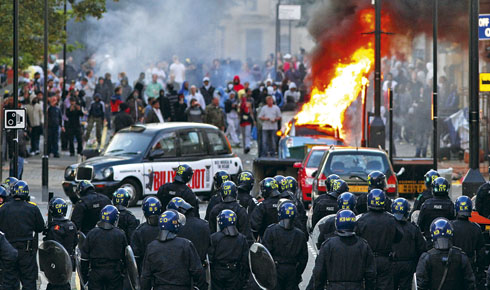
On the streets in Hakni, police officers met cars set by young pogromers
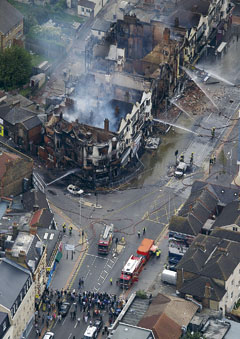
The uprising of the bottom. I have not seen such Britain since the Second World War: raging fires in many areas of London, Bristol, Birmingham, Liverpool, Manchester. Charmed skeletons of buildings, looted shops, workshops, cafes, hairdressers. Streets covered with a layer of broken glass and debris. The results of the events of August 2011: 5 dead, 16 crippled from among the participants of the riots, £ 200 million damage, several dozen of burned houses. More than 4 thousand arrested, of which more than 2 thousand will remain behind bars on the court sentence for a long time. And the trials are still ongoing
Statistics, of course, are sad, but in the modern world not too impressive. In hot spots, every day many times more people die, and the damage caused by wars, revolutions and natural disasters is measured by billions. Another thing is the moral damage suffered by Britain and the British. It cannot be measured in pounds. And if someone had invented such a recount, then we would talk about astronomical numbers.
Another country?
After the August events, the British suddenly found that they live in some other, unfamiliar country. Where is the famous restraint, tolerance, deep respect for the law? What remained of faith in social harmony, which allowed Britain for so many centuries to avoid revolutions and great shocks?
In this new, unfamiliar country, it may now be required to use water bodies and plastic bullets to tame the riots, and the police are ready to use them. But for many decades she fundamentally refused such cruel means (with the exception of Olster, but there was a civil war). Moreover, 90% of the British surveyed by sociologists now agree to give the police such a right - before the August pogroms of supporters of tough measures, there was an absolute minority.
In New Britain, people buy baseballs and all kinds of sticks in unprecedented quantities in order to be able to protect themselves if the police are again powerless to stop the pogrom, as happened in the first days of riots.
And most importantly - the British were convinced that in their country a large and very passionate layer of youth was formed, completely alienated from the rest of society and not experiencing pythet to the liberal, humanistic values of the United Kingdom.
Society did not want to think about what was happening in the heads of people who did not know what work and salary are, and whose parents never worked, and grandparents basically sat on benefits. This is the third generation - mostly teenagers from decayed families deprived of all authorities. Fathers are replaced by youth gangs, such in London alone, according to Scotland Yard, there are 257! And they turn into hell life in their quarters and around.
A series of discoveries
 |
And then what the British did not yet know: it turns out that a rather large number of normal ones, seemingly integrated into society, could not withstand the primitive temptation of a broken window. When it was possible, as it seemed to them, unhindered and with impunity to enter the store, crushed by someone else and take a brand new computer, mobile phone or something fashionable from clothes, they did not fail to use it.
Another unpleasant discovery that the British can no longer hide either from the world or from themselves is a catastrophic situation in state secondary schools in the country. It turns out that many representatives of the young generation completely lack even a semblance of the ability to empathize, sympathy of someone else's pain, respect for anyone or anything. One of the most terrible and in its own way of the symbolic moments of Augustus is the tragic death of 68-year-old Richard Bowz, who was trying to extinguish the fire-lit fire. They did not like it - and they began to kill him. In front of the powerless police officers, powerlessly observing what was happening.
However, one must be fair: most of all during the pogroms, the police were physically injured in which bricks, sticks, and pieces of reinforcement flew. 186 people were injured, some are so difficult that they had to hospitalize them. It is the police who personifies the state for the “lost generation”, it is the main object of hatred and protest. “This time we controlled the police, not them. We taught them to manners ... They ran away from us, not us from them. This time they were criminals, and we established the law and order, ”said one of the young Londoners in an interview with the Gardian newspaper, who actively participated in the riots.
The roll to the right
Another consequence of August events is the strengthening of right -winging organizations, such as the British National Party (BNP) and the English defense league. In the second half of the year, both noted the 15 percent growth of their ranks *** according to the police, the number of active members of the BNP-12 thousand people, the defense league-3 thousand .. British ultra successfully exploit the exacerbation of interracial relations, to the greatest extent-between Muslims and blacks. The former in the tragic days of August mainly defended their property and dwellings, the latter, as it turned out, were leading in number among pogroms. According to the British Ministry of Justice, more than 40% of those who appeared before the court were black, while in the country's population they account for a little more than 2%. However, in some cities, for example in Salford, 94% of the pogroms were white, despite the fact that their share in the region’s population below is 88%. In a word, the racial background, although present in what was happening, was not as pronounced as the age -related one - the vast majority of “Heroes of August” for less than 20 years.
And also a curious note in the fields: only 14% of those who appeared to the courts are immigrants. Everyone else was born in the UK.
Lessons for the future *
What have since come up with the authorities, in addition to the new system of police patrol, the concentration of forces in problem areas and permission to take more stringent measures, use rubber bullets and waterflies? Prime Minister David Cameron offered an interesting program of dense custody of 120 thousand of the most problematic families using the tactics of the whip and the gingerbread. According to some reports, it is these families that is the main source of crime and petty hooliganism, which has recently become one of the most serious diseases of large cities. Each of these families should now have its own “guardian”, which will not only conduct soul -saving conversations and observe the life of the family from close range, but also attract social services and education departments, and if you can’t do without it and the police. It is clear: it will pass for many years before the program can give real fruits. "
The racial background, although present in what was happening, was not as pronounced as age -old - the vast majority of the Heroes of Augustus less than 20 years
“As for the convicted pogroms, the courts sentenced them unprecedented hard sentences, an average of 25% more harsh than usual. 200 thousand British signed a petition requiring the pogromers and their family of subsidized housing and other benefits. This thought was initially supported by many politicians and representatives of the government: with what it is with which the taxpayer of those who do not respect those who do not respect The law destroys the country? But then they refused the idea: it turned out that it is extremely difficult to realize it in a rule of law, and from a practical point of view, it only exacerbates the problem of social alienation.
As passions cool down, a thirst for purely police measures subsides in society. By common thought, they also abandoned the idea of establishing state control over the Internet. The former liberal instincts wake up. To the honor of Britain - in this regard, it has not changed.
Burned symbol 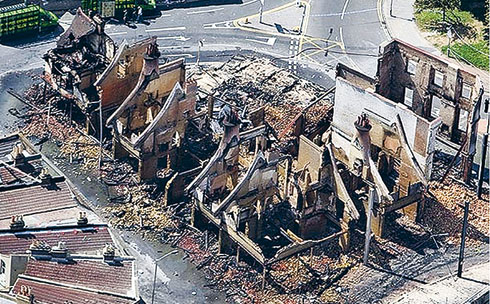
The Reeves furniture store in the London district of Kreudon, which was once considered a decent middle class abode, was founded in 1867, survived five generations of owners, two large wars, Nazi bombing and great depression, the Daily Mail newspaper recalls. During this time, the store managed to become a real symbol of the district, like a tram stop named in his honor. Giganta supermarkets that sank many other small firms could not ditch the Reeves-the townspeople loved it as part of the tradition and continued to make purchases here. The August 2011 events did not manage to survive. The pogromers threw it with bottles of incendiary mixture, Reeves burned to the ground. "What kind of people could do this?" -the current owner of the store 80-year-old Maurice Reeves, who was hastily arriving at the police stupid in Kroydon, asked sadly: he found out about the fire when he turned on the TV. This, Mr. Reeves, was made by people who do not give a damn about everything: on the "Reeves", and on tradition, and on someone else's property, and most likely, on someone else's life ...
BlackBerry riot 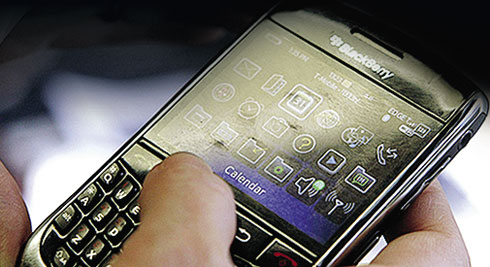
“Shops are gonna get Smashed Up So Come Get Some (Free Stuff !!!) F *** The Feds We Will Send Them Back with Our Riot!” “Shops will be broken, come and get off (free !!!), ... federals, we will take them our rebellion.” It was from this historical message, distributed through the Blackberry Messenger system, riots began in the north of London. The unseemly role of the server in the concealment of the rebellion was officially confirmed by the acting The deputy head of the Scotland Yard Steve Kavannes.
BlackBerry smartphones, with which looters coordinated their actions, use, according to some estimates, 37% of British adolescents. This service is fast and cheap - ordinary SMS cost 10 pence (approximately 5 rubles). One message can be sent to all contacts in the phone book, however, in contrast, for example, from Facebook or Twitter, it is impossible to trace who sent the message to you. The service is good because the signal is encoded, since the system was specially designed by the Canadian company Research In Motion for businessmen. By the way, RIM representatives, despite the actions of the looters, said that they did not intend to turn off the users of the service of quick messages. At the same time, they admitted that after the first wave of riots, the company promised the authorities that, perhaps, the police would help the police to track the sent messages. And then she paid for this: hackers brought down her blog on the Internet and threatened to transfer the addresses and data of RIM employees to participants in the riots. However, the looters did not even much try to encrypt their messages. In one of them, a call was called to take hammers and add cars, vans and even carts to take the loot. And later, with the help of all the same smartphones on the Internet, photos with prey were posted. For example, in one picture, someone’s bedroom is clearly visible, and in it ... 40 boxes with iPad.