
Translated material
The sky is in diamonds
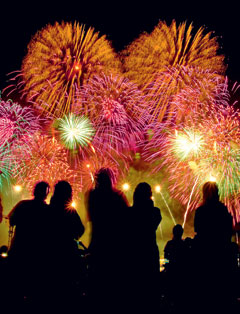 |
| Fireworks have long been to this day - a satellite of the celebration |
Light! Residents of large cities are increasingly celebrating the New Year on the streets and squares. So it happened from the meeting of Millennium. The Russians, however,, unlike Europeans, are selected from the houses already under the hops, cheerful and well -fed after the wires of the old year. Leaving on the table the traditional Olivier and Shprat, they are impatiently in a hurry to their beloved and fashionable fun - the launch of the fireworks. However, as The New Times found out, and this new trend is actually an old New Year's tradition
At the end of the holiday, exactly at midnight, a grandiose firework was supposed to begin. The young princess never in her life saw either the salute or the exploding firecrackers, so the court engineer was ordered to accompany their Majesty at the wedding (how much could happen!): “Fireworks? - asked the Prince of the Prince. “What is it?” “It looks like morning Aurora,” the king hurried to say, who loved to get into other people's conversations. “But the fireworks are much better than stars, because you always know where it should flash. The sky becomes almost as beautiful as my play on the flute. You definitely need to look at it. ”
Oscar Wilde. "An extraordinary story that happened to the cartridge for the fireworks"
The guns gave 168 volleys, and a grandiose fiery picture unfolded in the sky: Hercules, tearing the mouth of a lion. The missiles soared into the sky every now and then. The spectacle was not only stunning, but also very expensive. The fiery Hercules cost about the same as 3 thousand cows. So on May 30, 1690, the first in Russia, the pyrotechnic show was celebrated his eighteen years by Tsar-reformer Peter I. And ten years later, the following words appeared in the tsarist decree on the reform of the outdated Russian calendar: “The New Year is considered differently, this is the day to consider the New Year everywhere from January 1. And as a sign of that good undertaking and fun, to congratulate each other on the New Year, wishing in the affairs of well -being and in the family of prosperity. In honor of the holiday, to make jewelry from fir trees ... ”And further:“ ... to fix the shooting of small cannons and rifles, let the missiles how many will happen and light the lights. ” Six days were supposed to celebrate and have fun.
Everyone was stunned by a scale, but most of all the "madness" of fireworks was remembered. So, in the era of Peter I, fireworks were given the significance of state importance and "this case was raised to an unprecedented height." Then the domestic “Feueerver traditions” began to emerge ...
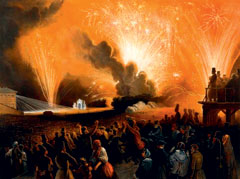 |
| The lights bloomed the sky and on the night of the coronation of Emperor Alexander II and Empress Maria Alexandrovna on September 7, 1856 |
They took off to the emergence of fireworks by the Taoist sages. The monks found a recipe for the manufacture of gunpowder from wood coal, nitrate and sulfur. The experimental way - due to a change in the dosage of the components - they learned to regulate the time and strength of combustion. The ancient Chinese masters used bamboo stalks as a charge body, filled it with a combustible mixture, threw it into a fire or set fire to a special wick. Already with the Song dynasty (960–1279 AD), fireworks could be bought right from street merchants and light them, for example, for the new year to repel evil spirits. In 1110, the eighth emperor of this dynasty Huissun rolled a grand pyrotechnic show during a military parade. True, this art lover (he was an artist, a calligraph, a musician, and a master of tea ceremony) was so casually related to state affairs, which eventually lost his northern possessions and was captured. In 1240, the Arabs spent a recipe for gunpowder in the Middle Kingdom, and at the same time learned how such beautiful fiery “Chinese flowers” are created.
 |
For the sake of fun, but in Europe both gunpowder and fireworks brought, as is commonly believed, Venetian Marco Polo. It is interesting that, according to some researchers, he really has never been to China. But, despite the now fashionable trend to overthrow the idols, it must be admitted that Europe actually got acquainted with fireworks shortly after Polo informed the Venetian recall and members of the Council about his journey to the east. Although it is possible that the so -called “Greek fire” invented by the Byzantines was also used for European fireworks (its exact recipe has not yet been disclosed), which was used primarily in military affairs. Unlike gunpowder, raw materials for him were probably half -fluid, reminiscent of napalm mixtures of the twentieth century.
The new entertainment quickly gained unprecedented popularity, and by the middle of the 15th century, almost all European countries could boast of their fiery shows, which were most often arranged at the noble nobles. Pyrotechnics reached unprecedented development in Germany, from where the word “fireworks”-“production of fire” went, and in Italy, where even their pyrotechnic schools appeared in the cities-states. Fireworks were arranged on the occasion of religious holidays, arrival in the city of representatives of monarchy families, higher clergy, arrival of ambassadors or conclusion of peace.
In Russia, the systematic device of Fiery Potsh began in the end of the XIV century. Under Ivan the Terrible, the position of “powder manager” appeared in the Streletsky Regiment, in whose responsibilities the manufacture and launches of fireworks were charged with the duties in addition to military affairs. In the last years of the reign of Alexei Mikhailovich, Feireverki have been a purely entertaining sight, which can be seen from their names - “fiery fun” and “fiery fun”. So in fairness it is worth noting that Peter Alekseevich, who turned the entertainment into a powerful means of political propaganda, only used the already accumulated domestic experience and brought to it what Europe was rich at that time. So, during the stay of the Great Embassy in 1697 in Koenigsberg, Peter hired a “gunshot artist” by Jagan Bus and sent him to Moscow, where the creation of fireworks was in charge of a special Bombardi company of the Preobrazhensky regiment, in which the tsar himself served. In Amsterdam, he took to the service of George Wilhelm de Genin, for whom Russia became the second homeland. He turned out to be a talented engineer of fireworks. In 1712, the artillery lieutenant colonel Genin arranged on the Neva a New Year's fireworks in front of the palace of Prince Menshikov. There is a known case when, during the celebration of the Nistadt world with Sweden on October 22, 1721 in St. Petersburg, Peter was forced to take care of the structure of the fireworks, as the manager got drunk and could not manage them ...
 |
Flowers and chariots The procedure for preparing and conducting fireworks in Russia of the 18th century was very painstaking and complex. First, the official order of the Academy of Sciences was received to draw up a program. This duty was performed by venerable scientists, for example, Mikhailo Vasilievich Lomonosov himself. The program was compiled taking into account knowledge in the field of heraldry, mythology, history, chemistry. Then she was sent to the office of artillery and fortification, where instructions were given to the manufacture of pyrotechnic products necessary for the fireworks. And only then they built the Feuierver Theater - a platform that housed all the figures, racks, decorations, etc. Sometimes the troops of local garrisons, which produced a cannon salute, took part in such performances. In places where there was a danger of fire, the watchmen and firefighters were on duty. In 1809, under the leadership of Count Arakcheev, the “Regulations on Fireworks” was developed, which systematized and under control of the state production of fireworks and the conduct of fireworks. Both in the required quantity anyone could order in a military laboratory.
Similar festivities were becoming more and more diverse every year. At the beginning of the 19th century, substances were found with chemists that allow you to change the color of the fiery torch when burning a combustible mixture, which became a new era in the development of pyrotechnics. Special effects were constantly complicated and improved. The complex, diverse fiery drawings of all colors, moving figures and trees growing in the air, rushing through the air of the chariot, began to appear. And now, more than 300 years after the first firework show in Rus', little has changed. As before, according to the organizer’s plan, you can create fiery palaces, waterfalls, battle scenes and paintings on biblical themes. True, thanks to modern fireworks, fireworks today can be synchronized with your favorite music and laser drawings in the sky. Hundreds of companies are offered their services for conducting exclusive fireworks and organizing whole "fiery" festivals in our time.
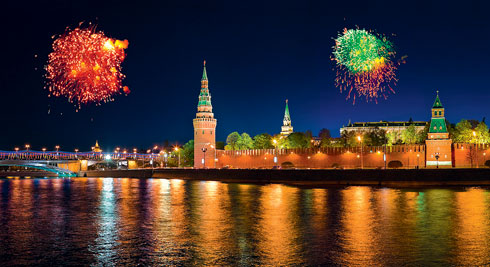
Salute, unlike the fireworks with its variety of fire drawings, is solemn shooting with idle charges from artillery guns and/or small arms. Salute as an integral part of military parades, solemn meetings of high -ranking foreign guests during an official visit still suffer from a monotony of pyrotechnic effects. The fantasy of fireworks manufacturers are endlessly funny shells in the manufacture of fireworks to this day, sparkling, sparkling, sulfur, nitrate-gray compounds with the addition of staining salts are used. Thanks to them, the spectacular effect has improved significantly, and production increased rapidly.
According to one of the classifications, fireworks are divided into “riding” figures (various types of missiles and jokes) that are launched up; “Middle” (the so -called “Roman candles” and “drills”), which, so to speak, shoot from the ground; and “lower” (fountains, force, slags, Mars). In addition, there are fireworks burning on the water - the so -called “oakers” and “quakari”.
Many of modern fireworks are divided into professional and household. Households are easy to use and do not require special preparation. But with professional things, everything is much more complicated: not only knowledge, but also special permitting documents are needed here. Some of them can be used at all in the presence of qualified employees of the Ministry of Emergencies. So, for example, when launching chandeliers (this shell, translated from the German “cheerful ball”, takes off to a height of 100-300 m and explodes there) from a professional mortar without the Shoigu department. The household mortar does not require the admission of the Ministry of Emergencies, but the strict adherence to the safety rules in this case is the right way not to burn yourself and do not burn something nearby. After all, I don’t want the magical holiday of the New Year's fireworks to be remembered by something except the rampant fun and the multi-colored fire illuminated by the spray.
 |
Do not forget about safety measures! When buying a fireworks, make sure that the packaging is not damaged, the instruction is compiled in the country's language in which the product is sold, the seller has certificates of conformity and conclusion of sanitary and epidemiological examination, and the shelf life has not expired.
When transporting, do not shake, do not turn over and do not drop the product. Store in dry, warm rooms (up to 30 ° C).
When starting, pay attention to the radius of the safe zone specified in the instructions. As a rule, it is at least 100 m. It is necessary to launch the fireworks on a flat site, free from houses, trees and power lines. Strengthen the shell on the ground with sand, snow or bricks. Start a wick with an outstretched hand without leaning over the product, and move to a safe distance. If the wick burned down, but the fireworks did not work, wait 15 minutes, and then lower it into the water.