
Translated material
Mont Blanc over the Alps
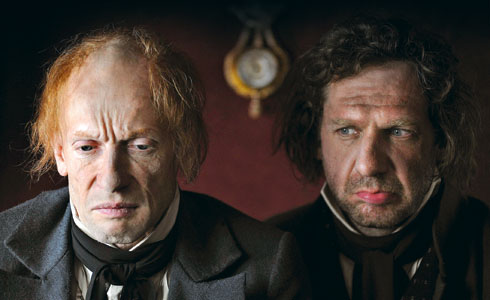
Mont Blanc over the Alps. The cinematic year was successful for Russian cinema. The largest and most unconditional achievement of our directorial school is the “Golden Leo” of the film “Faust” by Alexander Sokurov at the 68th film festival in Venice. Another festival favorite Andrei Zvyagintsev received the main prize of the Cannes program “Special Gazing” for the acute -social picture “Elena”. A strong resonance in society was caused by Andrei Smirnov’s historical filmmaker “Once upon a time there was one woman” about the peasant uprising of 1921 in the Tambov province
“Faust”, with all the complexity of the composition and aesthetics, was adequately, respectfully and enthusiastically perceive the press, and criticism, and the public of the Venetian festival. Against the backdrop of a completely representative program, interesting films and large names, the film towered like a Montblania over the Alps. Sokurov’s victory is perceived even by those who are not among his fans.
Missing soul
The shocking beginning of the film is as if painted from the works of the artist Jacob de Gane, where they gut the corpses, fry the humanity and suck blood out of people. Similar to this happens in the "creative laboratory" of Faust even before the devil of his own person is. The motive for disgraces is the thirst for knowledge, the desire to declassify the divine riddle of life, an insatiable craving for experiment - whether in science, art or politics. The daring of the rational atheistic spirit, the deification of individual will and the authorities lead to the most radical concept of the superman, to manipulation of huge masses, to the triumph of a new barbarism. In the classic version of the Enlightenment, these motives are personified by Dr. Faust, in the modernist German - Dr. Faustus Thomas Mann, in the modernist Russian - Lenin, the hero of the Sokurovsky “Taurus”.
The first sensation from the film is the stench of European civilization, not yet equipped with the discoveries of hygiene technologies. But this is the stench of the human body, deprived of the soul: after all, Faust and its assistants during the autopsy are not able to detect the desired substance - the soul, instead of it - intestines, organs of respiratory, sexual and digestive, nothing more. And the body without a soul exudes not the most pleasant aroma.
Following the soul, Faust inspects another most important concept of human culture: the word that was supposedly at the beginning. Sokurov “Faust” is not a film adaptation, but “reading between the lines”, and reading German in his native Goethe. The script of Yuri Arabov includes an array of witty, honed dialogues pouring from the screen like a mountain waterfall, causing laughter and fear, sometimes a shudder. Arabov is also attributed to the introduction of Gogol characters in the structure of the plot - Chichikov and the servant who rushed to Paris in Paris, put Fausta with Mephistopheles to themselves, and then throw it on the side of the road: this, you see, the fate of the Western ideas in Russia.
The element of real evil
Mephistopheles in the picture, strictly speaking, is not: this antisanitarian type is simply called a trap, it is deprived of any infernality, not the hellish flame, but the stench, as it suffers from gastrointestinal disorders-in such a mundane appearance is depicted by Anton Adasinsky, an actor with magnificent plastics, which prompts to recall the ticans of the dumb cinema.
Sokurov is amazing, with genuine inspiration, shoots the finale of the film, which is played out in the metaphorical hell, among Icelandic volcanic rocks and geysers. This is a clear roll call with the cinema of German expressionism and the aesthetics of Arnold Funk mountain films, which were so loved by the Nazis.
As for the most famous conspiracy, fastened with blood, Faust easily does without the opera envoys of Hell, being more and more immersed in the element of real evil. Despising the terms of the transaction, he throws the mountain boulders of a miserable Mephistopheles, suitable except for the role of the architect. And already independently, not in need of temptations or reflection, it runs “further, further, further” along the path that is clearly visible in the landscape of the 21st century, where there are no more illusions and there are no evil gods - there are only its real performers.