
Translated material
Russia-Ssha of breakthroughs is not expected
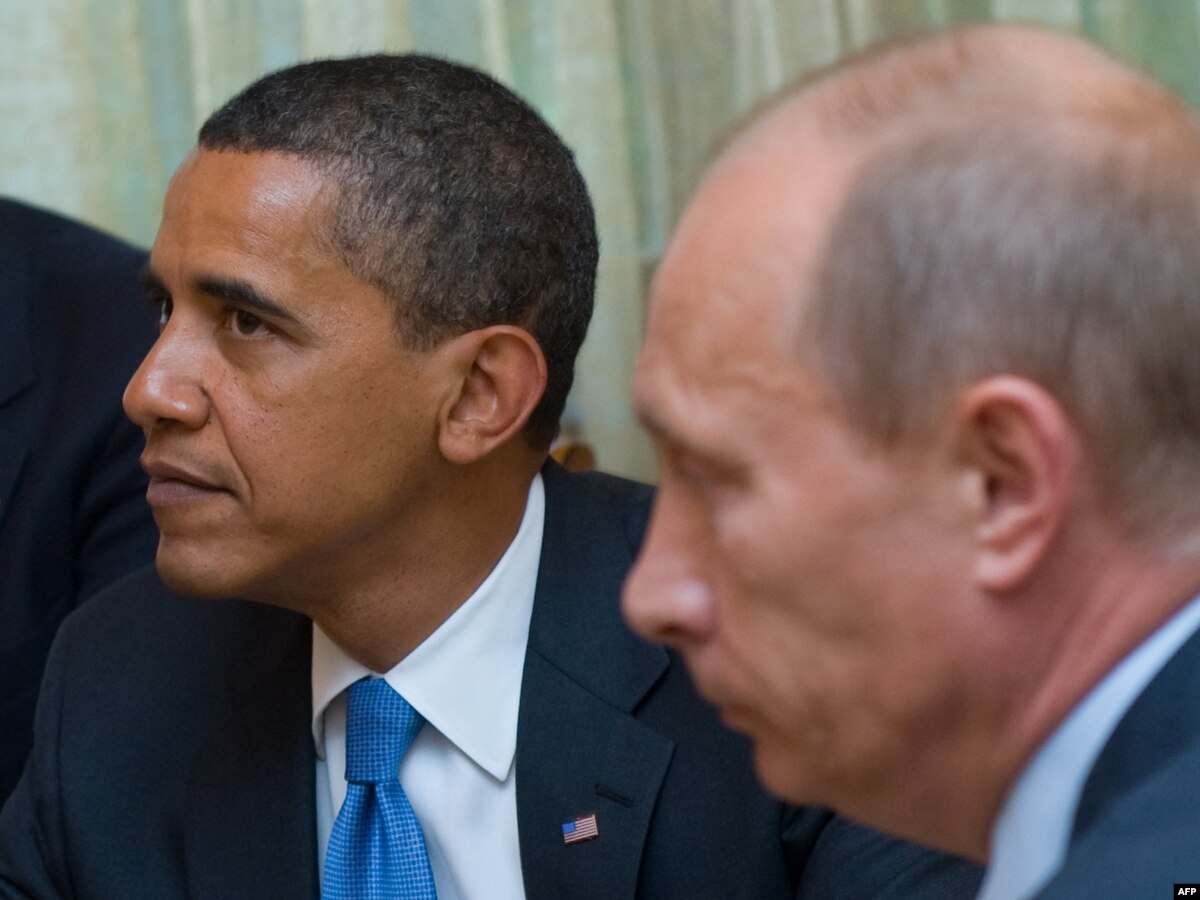
Throughout 2011, the Russian leadership seemed to forget about the reboot in relations with the United States : President Dmitry Medvedev from time to time threatened Washington with the release of Moscow from the Treaty of Strategic offensive Arms, and Prime Minister Vladimir Putin directly said that it was US Secretary of State Hillary Clinton, who, in his opinion, is the main interested person in street performances of critics Russian authorities. At the end of the year, however, Medvedev remembered his good feelings for Barack Obama and, congratulating him on the upcoming New Year, turned to the US President and gratitude:
- In the past year, noticeable successes have been achieved in a number of areas of bilateral dialogue, including the beginning of the practical implementation of the new agreement on STARTS and the completion of a long -term marathon to join Russia to the World Trade Organization. Once again, I would like to express gratitude to you for support on the problems of the WTO and for your sincere attitude to achieve the cancellation of the amendment of the Jackson-Vannik.
However, it is already clear that Dmitry Medvedev will determine most of the Russian policy against the United States that came in 2012. What factors will influence the interaction of Moscow and Washington in the next 12 months? Director of the Moscow Center of Carnegie Dmitry Train is sure that the influence of the two presidential election campaigns will be key in this sense:
-Obviously, during the election campaign, the plots associated with Russia will take some place. And the promotion of these plots will not like the leaders of the Russian Federation. Most likely, this will be regarded as an intervention or an attempt to intervene in Russian internal affairs. As for the change of power in Russia, it will probably not happen, and the power will be in the hands of Vladimir Putin in a year. The question is how much power, will this power be limited, will it still be as monolithic and monopolistic as it has been over the past few years, or will there be any changes here? I will foresee the changes. In general, in 2012, the Russian government will be in an unstable position. This, for its part, will also affect bilateral relations.
If you distract from such important but transient processes as election campaigns, then, according to Dmitry Train, two long -term problems, which the United States and Russia will need to find a common language - this is economics and security. If the expert talks about the possibilities in the economy with some optimism, then in the field of security, according to Dmitry Train, breakthroughs are not expected:
- There are two large blocks. One is associated with safety problems, the other with the prospects of economic cooperation. Russia's entry into the WTO, which will be officially formalized in 2012, of course, will play a long-term positive role in the development of Russian-American relations. In the future, Russia would be very profitable to give itself attractive for American capital, investment, American technologies. And there are opportunities here, but the implementation of these capabilities depends on the efforts or lack of efforts from the Russian side. Here are the traditional topics of the investment climate and so on. As for another bloc, military-political, then, frankly, I do not foresee any movement here. The United States will create a missile defense system in Europe and, probably, at the NATO meeting at the top in Chicago in May 2012, European missile defense within NATO will be formalized, its architecture will be determined. It is clear that by this time Russia and the United States, Russia and NATO will not be able to agree on some kind of joint project in the field of missile defense, ”says Dmitry Train.
Many observers, summing up the results of the cooperation of Moscow and Washington to the board of President Medvedev, come to the conclusion that the conclusion of a new START agreement is an indisputable achievement. However, the chairman of the Presidium of the Council for Foreign and Defense Policy, political analyst Sergei Karaganov , on the contrary, considers this not at all:
-In 2012, Russian-American relations will most likely be in a state of stagnation with a tendency to deterioration. But I do not expect large failures. With the exception of one. Initially, a flawed principle was laid in the Russian-American reboot, it was addressed to the solutions of unimportant problems of the past. First of all, this concerned the agreement on strategic offensive weapons. This thing was good, but in principle, she did not lead anywhere further, she simply normalized the relationship. A new agenda directed to the future was not proposed. Therefore, inevitably, trodden on an old, even positive patch, they began to crawl back. Moreover, new stimuli appeared.
According to Sergei Karaganov, crises developing in various regions of the world will often pushing Moscow and Washington foreheads. This can affect not only the foreign policy rhetoric of Russia and the United States, but also on the real actions that will be taken by the heads of the two states:
- There will be disagreements in Syria, in this kind of conflict. A major event that can play both a negative and a positive role, can become seemingly likely to me now - I give such a forecast for the first time in the last many years - the war in Iran . We do not know what influence it will have on the situation in the world, on the situation in the region, and, including Russian-American relations. I do not exclude not only that, for example, Russia will naturally condemn the blows to Iran, but perhaps in the end this may lead to the fact that Russia, the United States and other countries will be forced to look for joint solutions for the ball of problems that this war will untie. Since it is quite obvious that it will most likely become a "box of Pandora", which will release a completely unknown number of problems, dangers to the whole world, - said Sergey Karaganov.
Giving their assessments, experts, reasoning mainly in the categories of Real Politician, attach not too much importance to such a sphere of contacts of Russia and the USA as the development of democracy and human rights. Meanwhile, one of the main reasons why light frosts occurred in the relations of the Kremlin and the White House is the consistent demand of many members of the US Congress to punish Russian officials for the death of Sergei Magnitsky, as well as the assessment of the past State Duma elections given by Hillary Clinton. The Russian government believes that all these steps are aimed at achieving Washington purely material tactical goals, and 2012 may well show how true this opinion is.