
Translated material
Standard & Poor's reduced the ratings of nine eurozone countries. Financial world in a panic
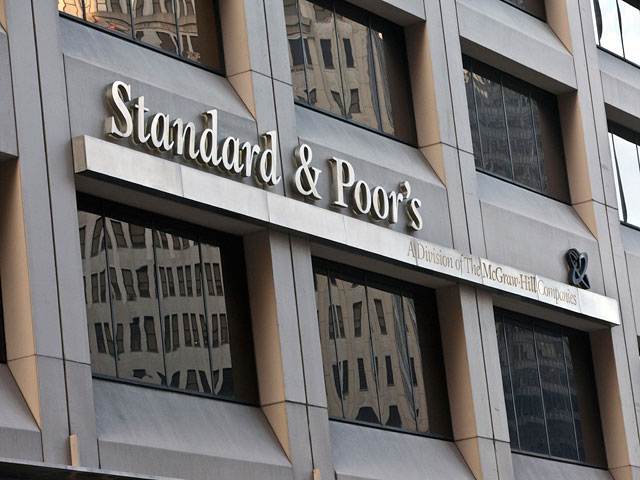
The financial world is in a fever: the world's leading media reported on Friday evening that the Standard & Poor's International Rating Agency can reduce the sovereign ratings of the eurozone countries on this day.
In particular, this was reported by Reuters and the influential publication of Wall Street Journal with reference to sources in the diplomatic circles of the European Union.
On the night of Saturday at Moscow time , RIA Novosti published an official release of the agency. It follows that sovereign credit ratings are lowered for nine of 17 countries of the eurozone, including France, Italy, Spain and Portugal.
At once, the ratings of Italy, Spain, Portugal and Cyprus were reduced to two levels, and on one - France, Austria, Malta, Slovakia and Slovenia.
In total, the agency carried out rating actions against 16 countries of the eurozone. In particular, Germany, Finland, Luxembourg and the Netherlands retained the highest credit rating "AAA". At the same time, the FRG rating is awarded a “stable” forecast, while the ratings of the remaining three countries from AAA can still lower: their forecast is “negative”.
Meanwhile, the second largest EU economy - France - lost the highest credit rating. Her rating was reduced by one step - to "AA+" - with a "negative" forecast. Thus, the agency does not exclude its further decrease.
In the evening, the French Minister of Economics, Finance and Industry Francois Baruen confirmed that his country is deprived of the highest credit rating of AAA, ITAR-TASS reports. The S&P agency lowered it by one step. According to Baruen, the government was notified in advance. “This is not good news, but not a catastrophe,” the minister emphasized.
Recall that the agency in early December last year placed on a review with the possibility of lowering the ratings of 15 of 17 countries of the eurozone. In particular, the list contains all the countries of the eurozone with the highest credit rating "AAA" - Germany, France, the Netherlands, Austria, Finland and Luxembourg.
The countries whose ratings do not expect a decrease, only Greece includes, the rating of which was reduced by the agency to the “garbage” back in July last year, and Cyprus, whose long -term lending rating was confirmed at the level of “ATV” with “negative” forecast.
Explaining their actions, S&P noted that the EU authorities are taking insufficient measures to resolve the debt crisis in the eurozone.
Euro, stock markets and oil prices are reduced
News from the European Union was rapidly reflected in various auction, despite the fact that the agency announced its decision, waiting for the end of trading in New York, where exchanges were closed with the last before the weekend, the world media had quite accurate and certain data. As a result, they managed to sow some panic.
A strong drop in the exchange rate of the Euro - 1.08% relative to the dollar completed the current trade week of the European Union financial market. By 02:00 in Moscow, 1,2675 dollars were given in the EU for one euro in the EU. Thus, the European currency fell into the area of many -month minimums - autumn of 2010.
American stock indices on Friday closed in the "red" zone. This happened not only because of European news, but also against the backdrop of the weak reporting of the JP Morgan Chase bank. The Dow Jones index decreased by 0.39% and amounted to 12422.06 points. The S&P 500 wide market index fell by 0.49% - to the mark of 1289.09 points. The high -tech NASDAQ lost 0.51%, reaching 2710.67 points.
Oil prices in world markets on Friday also decreased - here the European Union’s intentions were additionally influenced to postpone sanctions against Iran.
The price of February futures on the North Sea oil mixture of the Brent Crude Crude Oil brand on the ISE London Exchange (Intercontinental Exchange Futures), according to the results of the auction, dropped by $ 0.82 - to 110.44 dollars per barrel. On the New York Exchange Nyme Exchange, the cost of February futures for American light oil of the Light Sweet Crude Oil brand sank to $ 98.70 per barrel.
The Russian stock market, which rose after Europe on the news on the next successful placement of Italy's government bonds, turned down in the evening and went into the “minus” on indexes after the United States. True, he did not have time to sink very much: the auction closed.
According to the results of the auction, the MICEX index sank to 1463.43 points (-0.08%), the RTS index-up to 1445.16 points (-0.9%), the prices of most “chips” on the MIVB-RTS exchange decreased within 1.9%.
During the week, the MMEVB index increased by 1.6%, the RTS index added 1.5%, and since the beginning of the year, indicators increased by 4.4% and 4.6%, respectively.