
Translated material
Notes independent
Ten years ago, a book was published in the series “Archive of the Russian Avangard”: A. Sofronov. Notes independent. Diaries. Letters. Memories. (M., "RA", 2001). For some reason, she came across to me only now, although the circulation is two thousand copies.
The artist Antonina Sofronova (1892 - 1966) was a quiet person and, moreover, unbending. In two respects, she was undoubtedly lucky: she died “in her bed”, and besides, with her death - not from hunger, like Filonov, not from the Spanishness or Tif, like many of her other peers. The main thing is that Sofronova managed to live her life - difficult, but still her own.
Usually Antonin Sofronov is mentioned in connection with the art association "13". This is true to the extent that Sofronova’s work is considered mainly in the context of her friendly connections-in particular with Tatyana Mavrina and Nikolai Kuzmin.
Sofronova received art education in the studio "Bunovytz" I. Mashkova and Smolod managed to exhibit with the "Bubnoy Valet". In addition, Sofronova purposefully tried herself in constructivism - however, having traveled a certain path, she abandoned the vanguard. In general, Sofronova studied all her life-to a large extent with the unique artist Mikhail Ksenofontov-cha Sokolov (1888-1947), who regularly visited her attic in B. Afanasyevsky Lane in the 30s and spoke about her works.
Sofronova’s life is a rare example of how a person who is decisively alien to any pose or bohemian, prefers to refuse to himself at the household level in order to preserve his freedom as an artist. At the same time - openness to the world, attention to a few genuine friends and their needs, love of music and poetry.
As a matter of fact, Antonina Fedorovna Sofronova does not have an essay with the title of “Notes of the Independent”, although her records could be called that. To understand the design of this book, another important thing: although Sofronova kept diaries, most of the records were made exclusively “for myself”, so without decryption they are often simply incomprehensible. At the same time, periods occurred, for example, 1918 - 1920, when Sofronova recorded in detail her thoughts on the tasks of art and the artist’s work process.
Publishers, including now the late daughter of A.F. - The artist Irina Evstafieva, found a successful content solution. A huge set of materials is published as “Notes of the Independent”, including the texts of Sofro-Nova itself on equal terms (diary notes, poems, letters, report), as well as the texts of other authors-and not only Sofronova correspondents, but also articles and notes about her and her surroundings, letters of her friends and contemporaries. These texts are also self -concerned as a story about an era, or rather about a few eras, which fell on the life of Antonina Fedorovna.
Antonina Sofronova was born in 1892 in the village of Drobskovo Oryol province. Her father, Fedor Vasilievich Sofronov, was not only a doctor and a famous zemstvo figure, but also a passionate fan of the theater. Amateur performances that he staged in Droskov with the participation of four daughters were very successful. In the house they constantly bought books and wrote out many magazines.
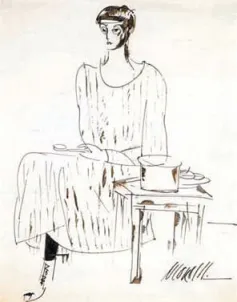
Antonina Sofronova received education at a commercial school in Kyiv, from where in 1910 she left for Moscow to enter the school of painting and sculpture. Without passing the competition, Sofronova entered the private art school of the famous artist and teacher F.I. Rerberg. After the school of Rerberg Sofronov, four years (1913-1917) studied at the studio of I. Mashkova.
There, Sofronova met the young artist Harry Blue-Menfeld, who stood out so much as his giftedness that he began to act as a mentor, not a student. They were married in Moscow in 1915. The book published Blumenfeld's letters to Sofronova, revealing the drama of this “attempts of luck” in impossible times.
Despite tuberculosis, in wartime Blumenfeld was called up for actual service. It is difficult to imagine how, in conditions of essentially catastrophic Sofronov, she decided to visit her husband in Saratov, where he served. Instead of a meeting, she got to an infectious hospital with scarlet fever, and Harry in another hospital with pneumonia, so they did not see each other in Saratov.
Sofronova was sick for a long time, but recovered. For Blumenfeld, the transferred pneumonia turned out to be fatal, especially since during this disease (apparently in the clinic where he was lying) he was used to morphine. Despite active treatment in Finland and in Crimea (Sofronova came to him in Sudak), his tragic path began, as evidenced by his diary entries and letters in the book.
By the summer of 1917, Sofronova went to give birth to her parents in an eagle, where the family moved from Droskovo back in 1908. In August 1917, she had a daughter Irina. Harry visited them in Orel in the summer of 1918, but, as Irina would write many years later, this only contributed to his alienation from the large Sophronov family. Blumenfeld left the eagle, and later took his appointment to Penza, where he successfully but not long taught in free art workshops. He was gone in 1920.
It should be noted that in Sofronov’s diary records included in the book, he writes almost nothing about his daily life, and about the events concerning her relatives or friends, as well as about many of his impressions, according to the name of Tusi. Lida ” or “ Cinema advertising. Dolls and cats. " Open emotion and detailed phrases arise when the author for some reason has a clear task- to fix something. Sometimes these are direct impressions of the contemplation of nature or works of art, sometimes worldviews important conclusions. So there are relatively detailed diary entries mainly for 1918-1920, in general, as Irina Evstafieva recalls, her mother complained to her that she could neither write nor say “about the cherished”.
Maybe for Sofronova the creation of the text - unlike the drawing process - was a kind of inorganic occupation? But Sofronova also wrote poetry and, one must think, treated them seriously: otherwise she would not rewrite them and keep them in the archive. (It is characteristic that even the daughter found out about this, already analyzing the archive ...)
Thus, the case is not in verbal material - Sofronova perfectly owned the word and, as can be seen from the book, could write in any style adequate circumstances. So, during the war, Sofronova from evacuation in detail and with humor wrote letters to her son -in -law S. Evstafyev - as was done in most families separated by the war. The published excerpts from the diary records of Sofronova are remarkable with the depth of thought and aphorism of the expression.
For example, a record from the 1920 diary “we have abstract intelligence are always able to get along with primitive forms of life. A great misfortune for a person living in Russia is to love a “form”. ” Such and similar brief records and laconic letters would have to be limited if the authors of the publication under discussion intended to publish only texts written by her personally. Instead, the reader got the opportunity to reconstruct the life of Sofronova, her friends and family (father, sisters, husband, and later - the family of her daughter), as well as the situation in the artistic environment - in texts written by other persons, and her daughter, first of all.
The large arrays presented correspondence (military and post -war) Sofronova with her older friend and in many ways as a teacher, wonderful artist M.K. Sokolov. Sokolov wrote a lot of Sofronova from exile and sent her his “pictures” - the work of a miniature format, performed by what she had to and what he had to, passionately waiting for her assessments. Sofronova spoke about his work - and, as always, lapidarously informed her news.
But what about Sofronova's work?
In 1962, a 70-year-old artist finally received a small personal exhibition-without an post and without a catalog. But she did a lot: oil, watercolors, drawing, font design of magazines. Her last lifetime free exposition is 1931, the “third” (in fact - the second) and the last exhibition of the group “13”.
Reviews for this very high-quality, but not at all a “revolutionary” exhibition today and read something awkward. It was just very good painting and beautiful drawings. Yes, they did not fit the heading of "proletarian" art. About him at Sofronova, we find wonderful lines written back in 1919:
“What is the“ proletarian art ”? If you settle all the “proletarians” on the uninhabited island, it is possible that in several centuries they will create their own special art, but probably it will be called not the proletarian, but the name of the island to which they were moved. ”
As a rule, Sofronova did not accept the exhibition committees. In the 30s, when even the famous Academia published illustrated books, Sofronova’s illustrations were consistently rejected. As a result, when they stopped taking even its applied schedule - covers for magazines, etc., Sofronova decisively divided earnings and art and later earned retouching in various publishers, and painted for herself.
The world of Sofronova in the 1990s opened for an interested viewer at remarkable exhibitions of the Moscow Gallery "Ark". Among the numerous works in different techniques, it is closest to me of its Moscow landscapes - only there was the charm of crooked arbat -lane lakes.
Rebekah Frumkin
* * *
From the editorial office
On December 28, 2011, our permanent author Rebekahka Markovna Frumkina had a birthday. Congratulations on the anniversary, wish you health and joy. We hope that more than once we will be able to read her articles about the beautiful in the paintings - and the surrounding world.