
Translated material
About natural terrorists and mayonnaise
We continue to publish a series of articles of the flavorist, the head of the development of Sergei Belkov’s food additives about popular myths about food and food.
Suppose, purely hypothetically, that we need to arrange a sabotage, for example, spray a toxic substance or arrange an explosion on the territory of a closed enterprise. How to do this if it is impossible to technically carry an instrument of crime into the territory? Does the automated security system clearly controls the presence of prohibited substances?
In cinema and literature, this problem is very often solved simply and logical. To achieve the required result, harmless substances are used, each of which is separately safe, but when mixing which a toxic gas is formed or an explosion occurs. The advantages of this approach are obvious: the risk of detecting and the threat of life of the Contractor as a result of careless circulation is minimal, and the already advanced chemical reaction, unlike the timer, is almost impossible to stop.
All that the potential attacker needs is to ensure a mixture of the necessary substances in the right place at the right time.
Natural terrorists
The idea of such a device is not new, and it was invented not by writers and filmmakers. And not a man at all. The authorship belongs to evolution.
Of course, the case does not often come to the explosions, but in the production of chemical weapons there are no equal to nature.
The use of chemicals to repel or destroy pests, competitors and enemies is widespread in living nature. If among the representatives of the animal world with impressive physical means of protection and attacks, you will not often meet pure “chemists”, such as SKUNS or toxic frogs, then among plants the use of various kinds of fungicides, antibiotics, insecticides, herbicides and simply poisons are more likely an exception.
In conditions of natural selection, a physically defenseless plant remains to defend yourself with the help of chemistry. Everyone does it in their own way.
It is important to understand that any substance, the biochemical path of the synthesis of which is fixed by evolution, serves to survive the plant. This survival is far from always in the desire to make the fruits edible to other organisms. Usually everything is exactly the opposite: the plant tries to provide itself with protection, making itself and its seeds minimally edible and most protected.
Cranberries pump up its berries with benzoic acid to such an extent that they become an unsuitable environment for the habitat of microorganisms. Substances that make up the basis of the aroma of apples, pears, bananas, oranges, almost all fruits, perhaps, have a pleasant smell for us, but they perform a completely different function for the plant. They are poisonous for many insects or have strong antimicrobial activity. Caffeine, the one that we like in coffee, from the position of an insect is a strong poison, in fact, an insecticide.
The chemical weapon of the plant can equally be directed to other plants. A drop of nicotine does not just kill the horse. Nicotine contained in the soil on which tobacco grows significantly slows down the growth of other plants.
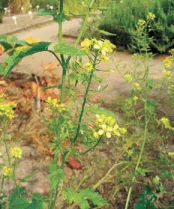
Just as our theoretical attacker, all methods of chemical protection have an important drawback. The meaning is not so much in poisoning all enemies - it is important to survive yourself at the same time. If the substance is toxic, then it will be toxic for the plant itself, therefore, together with the synthesis of the harmful connection, you have to come up with a protection scheme. If the creation of such protection becomes possible once, then it will pass quite a bit by evolutionary standards of time, and natural selection will make its own adjustments to the biochemistry of species, against which the struggle was initially fought. The evolutionary race never stops at the molecular level: if a new poison appears somewhere, a new antidote will certainly appear, which means that there will be a new poison, etc.
The optimal output for any natural terrorist is to create a substance that will kill everyone and against which there is no antidote. To do this, you do not need to synthesize and store this poison, it is dangerous and not necessary. It is enough to develop a method that allows you to quickly start the synthesis of the chemical in case of danger.
Potter essential oil
Someone may have already heard about the substance of allilizotiocyanate (AITC), also known as "Allilogormal oil". Sometimes it is simply called “mustard oil”, although more often the last term refers to ordinary fatty oil. The name, of course, is not by chance. In the essential oil of mustard of this substance may be contained from 80 to 95%.
If you at least once in your life ate mustard, or horseradish, or a basabi, or at least once you put mustard plasters, then you know that you owe all the unforgettable sensations, it is he who has such a bright irritating ability. It is him, and not mustard as such, we eat, despite toxicity and harmfulness.
Aitz is a lacrimator and toxic for many, if not all, living organisms. It not only reliably kills most microorganisms (sometimes used as a preservative), it is toxic for animals and plants. Ideal chemical weapons. If not for one “but”. For the mustard itself, it is as dangerous as for other representatives of the living world.
A reasonable question arises - but how then did the plant learn to produce and use toxin, but not suffer from it? The answer is simple: mustard is not just a terrorist, she is a smart terrorist who does not store the finished poison, risking accidentally poisoning or getting into the police, but keeps his individual components.
Strictly speaking, the essential oil of mustard does not contain Aitz at all. In the chemical composition of neither mustard nor horseradish there is no such component. Instead, there is a glucosinolate Sinigrin and the Furzinaz enzyme, which are stored separately from each other, safe and harmless. Safe exactly until the moment they are mixed, during which the enzyme (the reaction proceeds in the aquatic environment) “cuts down” glucose from Si-nigrin, giving an iso-tyocyanate or nitrile.
This mechanism provides protection not only by mustard, but also a number of plants. An animal or insect that decides to suddenly evaluate the taste and nutritional properties of mustard damages the tissue, which leads to the mixing of two harmless substances and the formation of toxic isothyocyanate. The pest, if surviving, loses its desire to harm for a long time, and the plant remains essentially unharmed.
Interestingly, the same mechanism is a way of “stripping” the territory from unwanted competitors (other plants) and microorganisms. Mustard is a one -year -old plant, in the stems and leaves that have served their stems and leaves, it interacts with myzinase, distinguishing the AITC scheme, “sterilizing” the soil and clearing the place for new seedlings.
As already mentioned, isothyocyanates are very poisonous. There is no protection against them. The only possible way is to prevent their formation. Some insects, like real chemists, have learned to launch the transformation of glucosinolates along the path of formation of less poisonous nitriles. Others went on. The famous pest, the caterpillar of the cabbage moth, learned to neutralize the initial glucosinolate. A special caterpillar enzyme quickly cuts off a sulfogroup from it with the formation of oxim. This is the same as destroying one of the two components necessary to create poison - as a result, the synthesis of isothyocyanate becomes impossible. This means for caterpillar not only a large amount of safe food, but also the complete absence of competitors on it.
What does mayonnaise have to do with it?
The same mechanism for the formation of Aitz is the basis of the taste of many familiar products.
Now it should be clear why mustard powder itself does not smell, but begins to exude the desired smell only after adding water, and not immediately. Why do molescents burn only after they were wet? There is no Aitz in mustard powder, it is necessary for its formation of synigrin, myrosinase, water and time. Everything happens in the same way as in living nature, soaking the powder leads to a chemical transformation of glucosinolate.
The presence of only mustard powder and water does not give a stable result. Depending on the batch of mustard, on the storage conditions of mustard powder and the content of Sinigri-on in it, from the conditions of its hydrolysis and even from the temperature of the water used, the amount of Aitz may vary significantly. It leads all this to one thing - the quality of the quality of any product obtained from mustard powder, the amount of active substance will be different each time. So, the quality of the resulting product will differ.
Aitz can be obtained by a chemical method using solvents, reagents, catalysts, and conduct a rectification of the resulting product. It may seem strange, but the purity of the substance obtained in this way is much higher than the resulting in the “natural” way. The point is not only in the degree of purification and not that we can save time and money. The quality of the “chemical” mustard, or, in another way, “flavor, identical to natural”, is much more stable.
Classical technology for the production of mayonnaise really implies the use of mustard powder. Modern manufacturers in most cases move away from this technology, replacing it with a flavor, identical to natural. For many consumers, this causes indignation, a feeling of deception, a natural replacement, present with a “chemical” surrogate.
Firstly, this is not so. The identical to natural is not a deception and not a substitution, quite the opposite: “chemical”, more correctly-“synthetic” Aitz (namely, it is the only component of this flavor), exactly the same as the hydrolysis of Si-Nigrin. Secondly, the use of a flavor allows not only not to suffer with soaking mustard powder, but also to effortlessly get stable quality. Still want to buy the same product in the same packaging?
Of course, when replacing mustard powder with a flavor, we lose a certain amount of proteins, fats, carbohydrates and trace elements that are contained in this powder. Is this a tragedy? A kilogram of mayonnaise includes from 2 to 7 grams of mustard powder, how much is it? Do you have confidence that it is precisely “mustard” proteins and trace elements that are so irreplaceable and necessary? How, interestingly, do people survive who do not eat mustard or mayonnaise at all?
In addition, mustard has never been and cannot be a food product precisely because of its toxicity. Mustard, horseradish, bassabi are the most ordinary food flavors, the active substance of which is dangerous isothyocyanate. They are not intended for eating, only to give it an uncharacteristic, absolutely unnatural taste. That is why the replacement of the powder with an identical natural flavor is not just justified, but logical. Nothing but the replacement of a non -lanologically and unstable flavor in the quality of the flavor with the same, but more convenient and high -quality, does not occur.
Perhaps someone does not like that the replacement of mustard powder with a flavor reduces and accelerates the process. But progress always implies cheaper and acceleration in terms of a unit of quality. It is not surprising that new technologies and new materials come to the food industry. The progress would be strange if the production became more costly and slow each time, and the product is more unstable and non -technologically.
Deviation from traditional recipe and technology? Certainly. The question is that, in relation to mayonnaise, it is a traditional recipe and technology. Moreover, the so -called “classical recipe” of mayonnaise in every sense is a rough imitation and fake of the original product, which was not included in at all.
The preparation used the materials of the book "Comprehensive Natural Products II" ISBN: 978-0-08-045382-8.