
Translated material
Silent stubborn
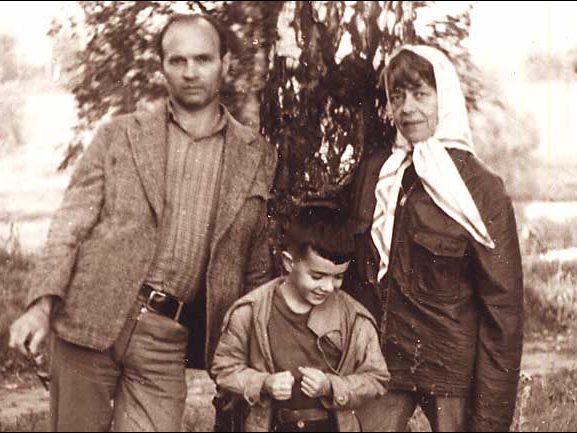
January 23, 1938 Anatoly Tikhonovich Marchenko, writer and dissident was born. In Russia and abroad, Marchenko is known primarily as the author of the book “My Testiments” , which was first talked about the post -plastic political camps. This book really turned out to be the main thing in his life; Another important achievement was the untimely and martyrdom. Anatoly Marchenko died on a hospital bed on December 8, 1986 after a 117-day hunger strike, which he kept in Chistopol prison, demanding to release all Soviet political prisoners. He spent more than half of his conscious life in captivity. Marchenko was not a gloomy fanatic of a political struggle, "poured from head to toe from clean steel," loved life and wanted to live. He had a wonderful wife - Larisa Iosifovna Bogoraz - and son; Having skipped his whole life in working hostels, camp huts and removable corners, he dreamed of his own house. Before the happy outcome, it remained a stone's throw - a little more, and the Camp Odyssey Marchenko would be completed, he would have gained the desired domestic rest, could write the conceived books, see the world. But the happy end did not happen.
Marchenko also did not gain posthumous glory. Remember him relatively few. Meanwhile, in the normal course of things, the author of “my testimonies” was supposed to enter the pantheon of national heroes, they would tell schoolchildren about him and filmed films. Even in the democratic environment, Marchenko is much less known than Sakharov, Solzhenitsyn, Bukovsky, participants in the 1968 demonstration of seven. He was not a charismatic leader, theoretician, a great epic writer and tribune, a man of spectacular deeds and brilliant ideas. Everything written by him fits in one small book. Marchenko was a man completely not loud and not demonstrative. “Quiet” - of those deeply and innate intelligent people who prefer to listen, and not speak, and take a smaller place. In general, in the idols, say, “revolutionary youth” Marchenko is not suitable in any way, one of the “throatans and leaders” is required here. But when we are talking about human rights movement as a moral movement, Marchenko is recalled one of the first.
The main motive of all his actions was the rejection of any injustice and falsehood, a rare sense of self -esteem, in which there was nothing ideological and head. Marchenko’s life is an amazing evidence of the autonomy of the human spirit; He clearly showed how little the vital choice of a person from the social environment, education or commitment to one or another doctrines depends. Watching Soviet life, reading and thinking, the worker Marchenko became a consistent opponent of communism even when some highly educated intellectuals cherished the myth of socialism with a human face, but his conflict with the Soviet regime was at the basis of his moral, and not political, and began long before Marchenko was able to give him any theoretical rationale.
Anatoly Marchenko was born in the town of Barabinsk, the Novosibirsk region. Father is a driver, mother is a cleaning lady, both illiterate. Their son-writer subsequently called himself "a provincial out of the backwood." “I grew up among the children of the railway workers. Our parents were not called steamers or wagons, for all workers of the railway there was one name: fuel oil. In the winter and summer, fuel oils were literally dripping from their clothes, so they were impregnated with them” (hereinafter, when we do not specifically negotiate, the last book of Marchenko “Live Like everyone”).
Heavy work, meager life, from entertainment - drinking, dancing and a scope with stabbing - Anatoly’s life path was predetermined in advance, like millions of guys from Russian wilderness. Marchenko naturally accepted the characteristic opinions of his environment: “The people of intelligent professions were united with the authorities: with the“ superiors ” - and the bosses for what to love? These are the owners who strive to take more from you, and give less. The teacher, the doctor, the engineer, and even more so the judge, the prosecutor, the writer - are in their service. Moreover, the authorities and the intelligentsia (and their children) in the province are acquainted between the province between yourself, and not with ordinary masters. "
The hard workers hated the “owners” with their propaganda trepid, but did not think about changing their fate, taking away the soul in conversations: “By booze, everyone could not be put to lay out“ his own ”man everything that is in their souls, to boast of courage and fundamentality, to swift their native power; The next day, sober, he will again become an obedient bracket, because of cowardice and indifference, he will support and approve any vile action, and will recharge it, he himself will participate with great enthusiasm. Neither your own thoughts, nor responsibility. ”
The picture is unpleasant, and is drawn by a person in his board - not a foreigner, not an intellectual, not a foreigner, not a "religious man." The voice is not from above and not from the side, but from the inside. “And grinding and swearing at our order, our authorities - I was tired and disgusted to listen. Always, everyone has the same thing, and the same words are the same, and the recipe from all troubles is alone: to outweigh them, whores; Shoot, cut, trans .. Peres ... what do they want in return? In general, they themselves do not know. If you think about it, so the same as they have: the owner above themselves and over the country, the lord of his belly and the defendant for everything. ”
In these phrases there is a key formula for Russian social and political life, explaining the most important circumstances of our history from Ivanov to Putin. Marchenko did not write analysts, he recorded what he himself was witness, but at the same time with exhaustive accuracy, he summed up his experience of observations in the thickness of folk life, the proletarian and camp environment.
The environment constantly pulled and sentenced: "Live like everyone else."
The parents of Anatoly, working and positive people, shared the general principle of "do not lean out." They could only offer their naughty son the quintessence of collective experience, rammed into lapidar folklore forms: “I know that I would hear from them:“ Do you need more than anyone? ”,“ You will not get justice, “you will mumble yourself, but no one will say thank you.” “They still sold Russia, there is no more truth, one work for two cups. The “Truth”, “Trud” - the names of the newspaper) Their son of folk wisdom; as it was, remained non -impedal, ruined his life ... "These lines are written by a man who has already sat in political camps who have met the dissenters who read Russian classics, Herzen and Marx.
But all this was ahead. After graduating from an eight -year -old, the son of Mazetnik became a drilling master, moved from place to place, worked a lot, went to dances, did not read books. He lived like everyone else. At twenty years, he was imprisoned for "participating in the riots" - a fight with exiled Chechens in a working hostel. In fact, he did not participate in the fight and was so outraged by an unjust sentence that he escaped (a few days later the camp came to the camp on his release with the removal of criminal record), wandered without documents, interrupting the border, was captured by border guards (40 meters left before Iran), sentenced to “betrayal of his homeland” and sent to his homeland and sent to his homeland. Mordovian political camps.
They write that Marchenko forced an unlawful sentence to rebel. Is it so? And if he really participated in a fight and sat down "for business"? The young worker was offended by the meaningless cruelty of the prison way with his everyday humiliation and oppression - it does not matter whether guilty or right. The prison suppressed and corrupted, he saw it right away and could not accept it: “I thought about myself. What the prison turned into a few months! When I first found myself in the cell, it seemed to me that I couldn’t live here and couldn’t even go to the parachm, I was mating from the mere thought that they had to eat and sleep here ... I am sleeping here and today I have been sent up and today. I eagerly eat my sprats among the blood and vomiting, and it seems to me that there is nothing tastier than this spit.
In Mordovia, the political officer Anatoly Marchenko began. Trying to figure out the roots of Soviet evil, he read a lot, noted, talked with real political - nationalists from the Baltic and Ukraine, Moscow intellectuals. Among the latter was Julius Daniel, with the campaign in support of which the human rights movement in the Soviet Union began. This acquaintance played the most important role in the fate of Marchenko - having freed himself, he went to Moscow, where he became close to the people of the circle of Daniel, without whom he could not realize his plan. “I spent six full years in political camps and prisons. But no one, nowhere, mentioned the presence of political prisoners in the Soviet Union. The world was alarmed and concerned about the position of political prisoners in South Africa and Portugal, Francoist Spain and South Vietnam, but not in the USSR. We simply did not exist. And we were ready to climb into the injustice. The wall was the despair of the doomed to oblivion. "
But in the political camps, Marchenko thought and felt not like everyone else. He would not have been himself if in this situation he did not have “my own thought and responsibility”: “I was outraged by the shameful silence of the world and domestic public in relation to the Soviet political prisoners. But I was outraged by our own behavior: we ourselves must at least declare ourselves in full voice.” To become a voice of political prisoners, to tell the whole truth about Mordovia - with this intention, Marchenko was released. To fulfill his task, he was ready for all kinds of hardships, emigration and a new term. The epic of creating "my testimonies" is stated in "live like everyone else." The book was created in difficult conditions, against the backdrop of painful attempts to get in the wild, to get a residence permit and a piece of bread, moreover, under the continuous threat of a new arrest. Other of the new intelligent acquaintances also advised not to lean out, and even assured that the authorities would certainly deal with the author physically (in the long run these people were right). Others supported and helped to overcome everyday and writing difficulties - first of all, Larisa Bogoraz, who later became his wife.
Marchenko was not to occupy hard work and courage, but there was no experience of writing. In addition, it was necessary to follow the virgin lands - nothing has been written about the post -plalin camps at all, not a single intellectual had taken up (when they read it - and the resonance of the book was huge - there were skeptics; Solzhenitsyn, say, seemed to be too independently behaved).
In the fall of 1967, with the greatest tension of the forces, Marchenko finished the book, she went to Samizdat, was published in the West. The author was not arrested immediately - the option of expulsion abroad was considered. Subsequently, the KGB really proposed Marchenko to leave, but he refused - a combination with a fictitious challenge from non -existent Israeli relatives did not suit him.
Many worthy and courageous people would have gone to such a compromise, just to break out into the free world, and not go again into a hated prison. Marchenko believed that the production of various kinds of fictions is related to the very essence of the communist regime, and tried not to participate in such games. The acute annoyance that he experienced on one of the trials is characteristic - when, in order not to complicate the work of a lawyer, he agreed to speak only within the framework of a hypocritical prosecution (violation of the passport regime), without touching the essence of the matter. Understanding that the Soviet government loves the accommodating and generations in his wards of special kind of complaisance, Marchenko consistently violated the unspoken conventions established between Soviet people and the state. In part, his non -standard life situation helped this - he left the proletarians (psychologically, all his life in the intervals between seizures earned heavy physical labor), among the intellectuals - a newcomer, such a mezema position was inconvenient - at least, but also liberated, gave freedom from intellectual collective habits and prejudices. Here is an episode of the detention on the street by “comrades in civilian clothes”: “I didn’t scream with fear and not even from an excess of emotions, but quite consciously. Somehow the company was talking about the fact that when a collision with the authorities, the intellectual behaves too intelligently. He is picked up under the arms and quietly say:“ Walk, we need to talk. ”Or: follow us. He will even ask, why, by which it will not be restrained, he will not be inconvenient, but it will be inconvenient, but it will be very convenient for the KGB.
In the annoying 1968, the loader Marchenko (there was no other work for this, a hard sick person in the Soviet Union) wrote several appeals in defense of political prisoners, and on July 22 he sent an open letter to the Soviet and Czechoslovak newspapers about a possible invasion of Czechoslovakia. On August 21, when the invasion began, he was judged "for violation of the passport regime."
Further ordeals are partially set out in "live like everyone else" and "from Tarus to Chuna." In addition to autobiographical prose, there were journalistic articles on political repressions and relations of the USSR with the West. Marchenko’s judgments on this issue are distinct and not “patriotic”. He condemns the Western elite for the policy of pacification of the Soviet regime, believing necessary continuous opposition to communism around the world, up to the provision of NATO guarantees for countries under the threat of Soviet military intervention.
Anatoly Marchenko participated in the work of the Moscow Helsinki group, was a signator and compiler of collective human rights documents, and defended the unrighteously persecuted, including Andrei Sakharov.
Marchenko’s liberation work, of course, did not remain unpunished. In total, he spent in prisons, links and camps of 18 years. The system took up him in earnest, but the "stubborn crest" - the wife called this - did not give in. Many of his literary plans were not implemented or finished - the manuscripts were selected from time to time, the house that he built was destroyed. But Anatoly Marchenko was ready to start again and again again.
His death was unexpected for relatives and friends. They understood how heavy and dangerous an unlimited hunger strike was, but they knew him as a reasonable and sober person, completely not inclined to exalted sacrifice. People who knew Marchenko well believe that in the summer of 1986 he began not blindly and not with despair, but sensitively caught the vibrations of the government course and trying to push, accelerate the course of events. It is difficult to say how much he succeeded. Five days after the death of Marchenko, the famous telephone conversation of Mikhail Gorbachev and Andrei Sakharov took place. Sakharov persistently spoke to the Secretary General of the death of a human rights activist and the need to free all political prisoners. Soon the political amnesty began.
Anatoly Marchenko was a courageous, self -thinking and literary gifted person. But among the Soviet dissidents there were more vivid writers, the thinkers are more original, many demonstrated exceptional courage. In Marchenko, he is primarily impressed by his very special human quality and his tragic and beautiful fate. The complete lack of romantic exaltation, heroic complacency, drawing. A very strict attitude towards himself - most of all he was afraid to bring and concern the people nearby, avoided favor and patronage, never manipulated by anyone, did not exploit his and alien reputation. I did not look for easy ways and benefits, in the most difficult circumstances relying primarily on myself. The best qualities of a Russian person were combined in Marchenko - the sensitivity of evil and untruth, incredible endurance for hardships, developed by centuries of peasant life in a meager and ugly country - and the best qualities of a European that we so lack: acute personal self -awareness, personal responsibility and resistance to the pressure of the collective.
Marchenko went against the Russian canon of humility, based on a deep and sincere conviction that nothing depends on us, and paid for this choice of life. The least he was a victim. Anatoly Marchenko himself chose his fate and disposed of himself at his own discretion: he lived and died free.