
Translated material
Syria: the end of the drama is not visible

Anti -government demonstration in the city of Idlib near the border with Turkey. This region of Syria is almost entirely configured against Assad
"Allah will take them anyway." The situation in Syria, where the ruling regime has already killed, according to human rights activists, 6450 people, reached a critical phase. Local Muslim Brothers refused to support Bashar al-Assad in exchange for several posts in the government and demanded his resignation after the secular opposition. Meanwhile, in the UN Security Council, despite the resistance of Russia and China, a draft resolution is being prepared to introduce a useless zone over Syria according to the Libyan script. And although Assad does not intend to concede, his repressive machine is already failing. On the vicissitudes of the endless Syrian drama - in the report from the places
43-year-old Muna Atassi (name and surname are changed for obvious reasons)-a children's doctor, which many know in Damascus. A month and a half ago, she abandoned her work, and since then she is seen in different areas of a huge city - then in the morning, in the evening, and it happens at night. Muna goes to ordinary apartments, hastily converted into hospital wards: those who were wounded in clashes with security forces are brought here.
The orderlies in civilian clothes
They try not to bring the wounded to ordinary hospitals only if you can not do without an urgent operation. In such cases, accompanying people are already asked to fill out a long form. It is worth a person to get a little after the operation, unknown orderlies “in civilian clothes” come behind him and are taken away in an unknown direction. And there were cases when doctors, under pain of arrest, instructed not to operate the seriously wounded: "Allah will take them anyway."
“The wounded relatives bring at a late night,” says Muna, “people pass the addresses of conspiratorial-gospital apartments via Facebook and Twitter. It is necessary to treat many wounded from other cities - Homs, Deraa, Zabadani: Damascus is large, it is easier to receive medical care from the authorities here. In general, everywhere in Syria people who suffered from army bullets are now being treated only by acquaintance. ”
Over the past month, in Syria, as a result of the clashes of manifestants with security forces, more than 500 people died. Two -thirds of them are in Homs, where Muna’s parents still live: “People there are used to that the military can break into any apartment and arrange a pogrom. On the street you can at any time be the target of the sniper. It’s easy to get to the city - it’s hard to survive there. ”
The rebellious Homs
Homs has long been using the reputation of the capital of Syrian humor, where the largest jokes are born over the year. Now the city is gloomy and desert. On the streets is dirt, there is not enough electricity, water, drugs and food - most stores are closed. But the townspeople, it seems, did not lose their sense of humor. “The inhabitants of Homs, do not scream loudly - Haleb is sleeping,” begs a banner written by hand at the entrance to the city. This is a subtle reproach at the address of the residents of the city far from Homs, Khaleb (Aleppo), where there are almost no demonstrations. 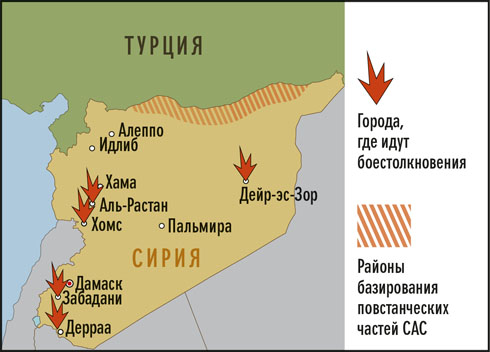
The peak of protests in Homs fell in the summer and autumn, there are many destroyed buildings in the city, traces of bullets are visible on the walls of houses. Even relatives are afraid to tell each other the truth about demonstrations and shooting ...
In the last couple of months, supporters of President Bashar al -Assad intensified in Homs - four major manifestations have already passed in his support. “This is done simply: the personnel of the military units and forces of the Ministry of Internal Affairs are dressed in civilian clothes and are taken by buses to the city center,” explains the activist of the local coordination committee of the Opposition National Council of Syria (NSS) de Jennin. -And at this time, people from the ruling party of Baas bypass the company's enterprises and issue instructions to the workers and employees: to appear then and there. Then everyone is handed over to the prepared posters and banners. Together, this audience is 20% of the population, no more. ”
“Everything is not so simple, the authorities have a resource in Homs,” the local lawyer Ramsi al-Chur does not agree. - In the city, as many as three quarters are populated mainly by the Alavites *** Alavism - a religious course, which is an eclectic mixture of elements of Shiite creed, Christianity and pre -Christian astral cults. In Syria, Alavites make up 11% of the population, these include the ruling Assad clan., Who are afraid of massacres in the event of an Assad regime. The Syrian cake, like the Libyan, consists of many unequal layers, but the West does not understand this. ”
“There are about 60% of Homs for the revolution,” says, in turn, the legal student Abdul Karim assures. “We live like in a big prison. We do not go out into the streets without particular need - you never know where you will get a bullet, ”says his fellow student Rafik Masarani. “I have just been in the Bab SBAA area, there are a lot of killed and wounded, terrible shooting,” 18-year-old opposition activist Fadi Homsi is included in the conversation.
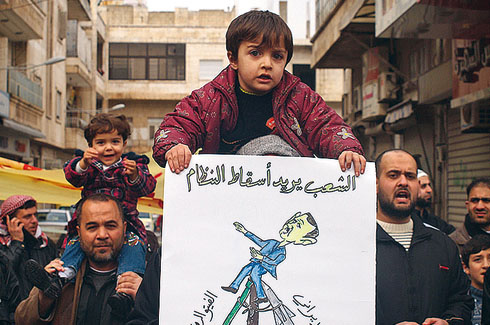 Little Manifesto in Idlib
An equally tense situation in other cities of the province: in al-Rastan, Talbisi, al-Khule, al-Qser, Palmyra, shots and artillery cannonade are heard every day. In Al-Rastan, the city center is completely destroyed. According to eyewitnesses, the army units for three days could not establish control of the city covered by protests-in the end the military used the nerve gas of the XV. Talbisi, located 7 km from Al-Rastan, is also mostly destroyed. Armored units are put forward to both cities.
The army "fermented" *
Another major focus of protest is the eastern regions of Syria, adjacent to the border with Iraq. “I have real battles in my homeland,” a 50-year-old teacher of Salekh Ahmed, a native of Deir Es-Zor, who we are talking in Damascus, shares his impressions of a telephone conversation with relatives. - The rebel people managed to capture several military warehouses on the outskirts of the city and stop the advance of government forces. (According to other sources, the weapons to the rebellious are smuggled from a neighboring Iraq.) Two army checkpoints were eliminated, there are now battles in the Gasan Abube area, near the Osman mosque, on the street Takiyat ... ”, according to Ahmed, are also in small cities: Kuria, Tinan, Shhil. The city of Abukamal (80 km from Deir Es-Zor), where a dozen tanks of government troops has already been hit by the authorities also gives the authorities. Several commanders of the army units switched to the side of the people. "
In order to deliver a deadly cargo to Syria, Russia goes to any tricks. The proof of this is the recent incident around the Chariot vessel
“Four months ago, Syria learned about Major Hussein Harmush, commander of an armored unit deployed near the border with Turkey: he refused to shoot demonstrators, and a few days later he penetrated the Turkish territory and surrendered to the local authorities. The Syrian media chopped down about the“ betrayal ”of Harmush, but did not say in a word that after his escape one by one steel began The major decided to return his closest relatives and even gave a repentant interview to Syrian television, nevertheless, the military tribunal sentenced him to execution: the verdict was carried out on the basis of the al-Mach Air Force under Damascus in the presence of Maher Assad, the younger brother of the president, who overshadows the army and the Ministry of Internal Affairs.
But the brutal fate of Harmusha did not stop fermentation in the army. The other day, an even larger military rank escaped to Turkey-Colonel-Alavit Suleiman Hassan, who held a high post in counterintelligence.
In general, the areas of the country bordering with Turkey are the most problematic for the Assad regime. It is here that parts of the so -called free army of Syria (CAS) are deployed, according to various estimates, from 20 to 30 thousand people: it is formed from former soldiers and officers (there are even several generals) of government troops. The army headquarters, led by Colonel Riyad al-Asaad, is equipped in Turkish territory. They say, having learned about this, Maher Assad gave the order to begin preparations for the war with Ankara.
The promises voiced by President Bashar Assad during his last appearance in the public on January 10 at the University of Damascus: - In February, to develop a project of a new constitution, to hold a referendum in March, and after that, universal elections; - develop and carry out reform of electoral legislation; - destroy the monopoly of the ruling party of the Arabic socialist revival (BAAS), allow the registration of new political parties and allow the secular and clerical opposition to government; - Approve the package of emergency measures to combat corruption.
"This is not a war - this is a hunt"
Anvar Malek - The New Times 
The city is actually in martial law. On the streets, tanks, in many places are still not cooled by the corpses, on the roof of any little high building-snipers. People sometimes do not leave home for weeks, they are afraid that they will shoot them like hares. This is not even a war - it is a hunt for a civilian population. At least 15 innocent people die every day. Someone on the streets, someone in prisons.
Did you manage to visit prisons in Homs?
Yes, but for some reason the prisoners were transferred to the barracks where we were not allowed. But I was in the Homs Hospital - in the morgue there are about 200 bodies of tortured people. With cut fingers and even hands, torn nails, groaned eyes. Men, women, children ... I still can’t recover from what I saw. Local residents told us how soldiers torture children in front of their parents, rape women in front of their husbands.
And why didn’t the authorities even try to hide these crimes from you?
How did not try! We could not step unaccompanied by the military, which was explained, of course, by our safety. In hotel rooms, cameras everywhere, phones are listened. They masked tanks on the streets or hid them in some yards, and half an hour after our visit were removed again. They changed the signs on the houses to show us a "calmed" area, although in fact there were simply no hostilities. But the scope of crimes is such that it is simply impossible to hide them. You can hide the tank if you know in advance that international observers will appear there. But you can’t remove the corpse from the street if the person was killed five minutes before your appearance, and no one warned snipers.
Have you been threatened?
I received numerous calls and Mails with threats and demands to shut up and stop publishing photos from Homs on the Internet. Women were sent to my room to rent them on a hidden camera and discredit me. But most importantly, the Syrian authorities, of course, simply tried to win the time, with our delegation. That is why at some point I decided that every day spent in Syria gives a new delay in the regime-it means it is time to return home and tell the truth.
The protests have not stopped since March last year. Why do you think the Syrians do not stop atrocities?
You know, I spoke with a five -year -old boy who told me that his father died first, then his mother, and then all his older brothers. And this child told me that he no longer needs his life, but he will live to avenge his family. And so many people think. They have nothing more to lose, except for life, which they also no longer value. But Bashar Assad does not seem to understand this.
The interview was taken by Sergey Khazov (Paris)