
Translated material
Marevna with Monparnas
Marevna with Monparnas. Modigliani himself wrote her portrait, Matisse spoke highly about her works, her Parisian circle was made up of Maximilian Voloshin and Pablo Picasso. But in the country of her roots about the artist Maria Vorobyeva-Stebelskaya, they knew almost nothing, and now-only in a narrow circle of experts. The New Times replenishes the gap
 |
The fairy-tale name Marevna Nineteen-year-old Maria Vorobyeva-Stubeska was invented by Maxim Gorky. The girl traveled around Italy and ended up in Capri. “No one will have such a name, proud and justify him. But you should not go to Paris, there you will steal, ”the proletarian writer of a young artist admonished. For Capri, Marevna lived as long as six stormy months, and this was the beginning of her long life in exile. Behind there were Cheboksary, where she was born, Tiflis, in which she graduated from an art school, then a year of study at the Stroganov School in Moscow. But real artistic life began only with her arrival in Paris when she settled on Montparnasas.
Girl in velvet
Maria Vorobyova-Stebelskaya for a long time was almost unknown in Russia. Only after the exhibition in the Tretyakov Gallery in 2004 and the publications of memoirs did her name be heard, and the paintings began to be successfully sold at auctions, although they did not reach the millions of dollars in which the work of her friends was evaluated. Even during her lifetime, a significant part of her work was redeemed by the artist by the Museum of Modern Art “Bird Pale” in Geneva.
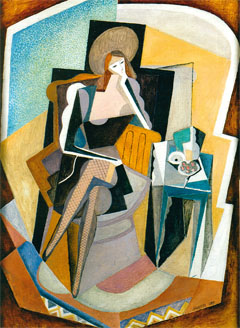 |
The last time Marevna loudly reminded herself in November 2011, when her portrait of Modigliani's work, exhibited at the Museum of Fine Arts. Pushkin at the exhibition "Paris School: 1905–1932" was accused of fake. Then a certain Russian collector said that he was trying to buy this picture for $ 3 million (auction record for Modillaan's paintings - $ 69 million), but the examination showed the presence of pigments in the paint of Modigliani. To which both the Moscow Museum and the Roman Institute of Modigliani stated that they have all the documents on the history of work, including the statement of Marevna, that she posed for Modigliani. Moreover, the picture was attributed in 1983, when Vorobyeva-Stebelskaya was still alive. The anonymous collector was most likely moving the envy and desire to denigrate the work that he did not get. On the canvas, which is now estimated at $ 9 million, a shy girl in a brown velvet jacket (according to the memoirs of the model itself) and a hat with fields is depicted. The tenderness and trepidation that is felt in this canvas is fully consistent with the love atmosphere that surrounded Harevna in her youth.
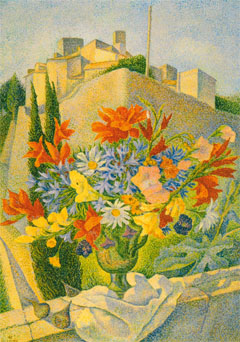
Today, Marevna firmly took her place among the artists of the Paris School. The manner of writing - the combination of cubism with pointerism - was a little like needlework, but completely coincided with her girlish blush and a delicate appearance, so worried the male environment. Despite the classic studies, Marevna was then under the influence of cubism, it was these works that Matisse then praised. She later invented her manner of writing, when she fills the space of canvas designed in the style of cubism with small points. Her landscapes and still lifes of that time are remembered by sensuality and romantic elation, which is sometimes adjacent to the carnival of images. If desired in her landscapes, one can even see the influence of Voloshin, from whom she lived in the south of France and whom she asked with addiction about the secrets of skill.
Bohemian Paris
One of the most attractive habitats of the French bohemia of the beginning of the twentieth century was the “hive”, the famous squat of Parisian artists. These were the workshops, which in 1902, the sculptor Alfred Boucher arranged on Montparnas. Mostly people from Eastern Europe, breaking through artists lived here. Among those who later became famous, Sutin, Shagal, Paskin, Tsadkin can be called ... There were everyone here - from Picasso to Hemingway and Eisenstein. Mark Shagal subsequently recalled: “Dive -up artistic bohemia lived here. In the workshops, the Russians sobbed the offended model, the Italians sang under the guitar, they argued hotly among the Jews, and I sat alone in front of a kerosene lamp. Around the paintings, canvases - in fact, are not canvases, but my tablecloths, sheets and night shirts, cut into pieces and stretched into subframes ... In the "hive" you could either die or leave the famous. "
Once in Paris, Marevna plunged into art life with her head. In the afternoon, she went to classes at the Russian Academy of Maria Vasilieva, as well as at the Academy of Zuloaga and Kolarossi, and spent even the evenings surrounded by her friends-artists, as well as writers Maximilian Voloshin and Boris Savinkov. Paris of that time is full of legends and stories that were created literally before our eyes. This could not but spell the young person. Her first friends were Chaim Sudin and Amedeo Modigliani. Modigliani smoking hash, undressed naked in front of the pale Englishwomen, showing his naked body: “Look at the magnificent model of the Renaissance,” they groaned and got drunk. 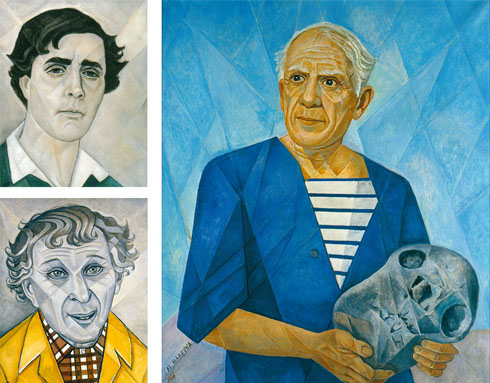
In her memoirs-in the 50s she released three books in a row-Marevna described how, after the next night orgy, one of the girls undresses naked and climbs under the icy stream of the fountain. Everyone is delighted with this picture, shout "Hurray!" And they are explained by the girl in love. “In the golden light of the rising sun, pink red, with long hair, the immortal Venus was born in the jets of water.” “Then I found out,” Marevna wrote, “that as a result of this trick, the girl grabbed pneumonia and died a few days later in the hospital.” The flip side of the bohemian life was poverty and illness. On January 24, 1920, Modigliani died from tuberculosis meningitis, his lover, distraught from grief, and at the ninth month of pregnancy went out of the window of the fourth floor. On the eve of the vernissage, Jules Paskin, who was forever doubtful in his talent, hanged himself in the workshop ...
Friends and fans
Haim Sutin became one of the closest friends of Marevna. He delighted her with his unconditional genius, crazy luster in his eyes. Sometimes he did not have a piece of bread, he knocked towards his neighbors and then lock himself in the workshop again, drawing his paintings with love and passion. Maximilian Voloshin took care of her almost like a father, there was a lot of touching and tender. “Voloshin was stunted, dense and wide ...” wrote Marevna. -His head looked like a lion, while the head of Ehrenburg reminded me of a big monkey ... When they walked down together along de la Gaet ..., someone, looking at them, said: “Hey, look at these two large monkeys!” And if there was still Diego River and I myself, then you could hear from street boys: “Hey guys! Yes, here the circus appeared! Two monkeys, a thick elephant and a girl from the "Three Musketeers"! " "
The manner of Marevna’s letter resembled a little needlework, but completely coincided with her girlish blush and a delicate appearance, so worried the male environment
“Diego River Marevna first saw in a cafe on Montparnasas. His glory as an artist was still far ahead, but for now he was known for his temperament and love for the female sex, for which Boris Savinkov gave him the nickname“ cannibal ”, hinting at the ability to“ absorb ”the female sex. Ilya Ehrenburg wrote:“ In 1917, Rivera was unexpectedly carried away from the Marevian The characters were similar to them - quick -tempered, sensitive, two years later, Marika’s daughter was born ... ”Marevna lived with Diego for six years old, until he left for Mexico and married the artist Frida Kalo. It was he and Frida Kalo who called Trotsky in Mexico and provided him with the house of their parents in the suburbs of the capital of Koyaacan. River himself was then in the USA. “He was never constant in his actions, drawn by lust and passion for women,” Marevna writes, “even from the Communist Party he left twice, returning there with repentant letters.”
Become an artist
Left alone, Marevna was in a very difficult situation. The paintings were bought infrequently. And then Marevna decided to try herself in weaving decorative belts and shawls. She collaborated with the Irfe Fashion House, created by Princess Yusupova, made sketches for the Poir Field and even showed them at exhibitions. In 1925, at the exhibition of decorative art in Paris, she put them in the Soviet pavilion. “The Russian Shali Marevna unite their savagery, primitiveness and fashion ... In the creations of Marevna there is something spring, spontaneous, free and frank that pleases ...”, in 1927, the Parisian fashion magazine L'ar Vivalt wrote. She returned to painting, and in 1936 the opener of Modigliani Leopold Zborovsky organized one of the first large exhibitions for her.
In 1948, she moved to England with her daughter. Another interest in her was caused by her memoirs, in which she described in detail the life of the Parisian bohemia. Many of her stories became cult, and her paintings, without even being masterpieces, were in the collection of the largest museums in the world. In late canvases, she returned to drawing portraits of her friends of youth, and they are perceived in many respects precisely as a tribute to love to this period of artistic history.
... When Voloshin was about to leave for Russia, he called the artist with him, to which Picasso said: “Do not go. What a whim! Here we will make you an artist ”... It turned out - not only an artist, but also a chronicle.
Marevna (Maria Bronislavovna Vorobyeva-Stebelskaya) was born in 1892 in Cheboksary. The daughter of the Polish nobleman and the Russian actress. From 1912 to 1948 she lived in Paris. The exhibition "Marevna and Monparnas" on the 100th anniversary of the artist (1992) took place in London. The author of the books of the memoirs “Life in two worlds”, “My life with the artists“ Ulya ”,“ Memories of the Nomad ”. She died in 1984 in London.