
Translated material
Politsyki of our time
Who is political here? To free the political prisoners is the requirement of thousands of December rallies in Bolotnaya Square and Sakharov Avenue remains unrequited. The authorities pretend that there are no political prizes in the country. But all over the past years, human rights activists have compiled lists of political prisoners and last week they transferred a list of 34 names to the voters league. The league is going to hand him to Putin and Medvedev. Who are they, modern Russian Politsyki, ”the political prisoners found out in Soviet times easily determined: they were considered all dissenters pursued under the articles of the Criminal Code 70 (“ Anti -Soviet agitation and propaganda aimed at undermining or overthrowing the Soviet system ”) and 190¹ (“ The spread of obviously false uprising, and defaming the Soviet social system ")
* * Convicts under article 190¹ sat with criminals. . Today, when there are no articles in the Criminal Code in which it would be clearly indicated that people are persecuted for political activities, many of those whom human rights activists are considering political and in ordinary criminal articles. True, at the end of the Soviet regime there were also cases when dissenters were planted in criminal articles. So, for example, Arseny Roginsky
* Now the head of the International Society "Memorial". In 1981, he was convicted of 4 years for falsification of documents, but everyone knew that he was actually pursued for the preparation and publication of Samizdat collections “Memory”. And in the early 90s, the Supreme Council of the Russian Federation rehabilitated it, like many others, and recognized the victim of political repression.
Click that in order to increase the article and the will that in Russia, as in the time in the USSR, there are political prisoners, human rights activists first spoke back in 2004. It is then that the General Action group

* It included the Memorial, the Moscow Helsinki group, the Committee “Civil Assistance”, “For Human Rights”, etc. With these lists, human rights activists periodically turned to Putin or Medvedev, asking them to have mercy on the innocent. The Presidential Administration automatically sent appeals to the Prosecutor General, who was memorized: there are no grounds for revising cases, everything is legal and reasonably. Neither Putin nor Medvedev never even uttered these words - a “political prisoner”, thereby demonstrating that they do not recognize this problem. But now it became possible to force them to recognize at least the very existence of the issue.
Today, the most complete list of “political” was compiled by members of the informal organization “Union of Solidarity with Political Personents”. It is they who conduct rallies and concerts, collecting donations to pay lawyers and to help the families of the persecuted. The union continues to work on the compilation of the lists of political faces, which the beginning of the "general action". “By selecting this or that candidate for inclusion in the list of political prisoners, we are guided by the criteria that we developed together with the Memorial,” the lawyer of the Union Sergei Davidis told The New Times. - First: in the case there should be serious procedural violations, falsification of accusations, selectivity of the law, inadequacy of the application of the law. Second: it should be obvious that the authorities showed political will, pursuing this person. ”
"
Neither Putin nor Medvedev never even uttered these words - a “political prisoner”, thereby demonstrating that they do not recognize this problem
"
Spies, extremists in the list of “Union of Solidarity with Political Personents” today include 34 people who are in places of imprisonment, and 37 people who are undergoing criminal prosecution without detention or are released by parole. Among them, people convicted of various articles. There are convicts under Article 282 and 282¹ of the Criminal Code of the Russian Federation (“excitement of hatred or enmity”, “Organization of the extremist community”). In a separate group, the National Bolshes can be distinguished, which receive terms for a variety of articles, from “bully” to “drug storage”, although the main reason for their persecution is, as a rule, belonging to a prohibited party. There are scientists convicted under the articles “Spying” and “Gosisman” - their candidates for the list of political faces included the Public Committee in the defense of scientists. This organization has existed for 8 years, it has been engaged in the affairs of 20 scientists, whom she considers victims of state spyomania. Some have already been freed, in relation to other cases were closed, never reaching the court. Now there are five names in the list of scientists.
* Valentin Danilov, Sergey Vizir, Igor Reshetin, Evgeny Afanasyev, Svyatoslav Bobyshev. . “We believe that their affairs are fabricated. These are artificially created trials, ”explained the New Times Academician Yuri Ryzhov, who is part of the committee. “They are accused of espionage, and this is a political article, so we consider the defendants in such cases by political prisoners.”
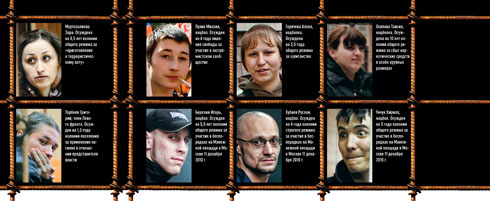
Svetlana Gannushkina, the head of the Civil Assistance Committee, included in the list of the Union of those whom the state unlawfully accused of involvement in terrorism. “We are talking about affairs directly related to the policy of the state,” she told The New Times. - For example, Chechenka Zara Murtazalieva
* In 2005, he was sentenced to 8.5 years in prison for “preparation for a terrorist attack” in the shopping center “Okhotny Ryed”. . She was chosen as a potential terrorist simply because she is a Chechen. And as soon as the investigation spun, it became obvious that it would be convicted, because the special services had to report for the open and prevented terrorist attacks. For us, it is political prisoner. We also entered the list of members of the Hizb-Ut-Tahrir organization, since they are not judged by what they did, but for belonging to an organization that the Supreme Court of the Russian Federation was recognized as terrorist. As far as I know, not a single terrorist attack is listed for Hizb-Ut-Tahrir. Their ideology is unsympathetic to me - the intention to build a World Caliphate. But this is only intentions. We consider not only our like -minded people to political prisoners, but also those whose views we do not support, but in whose affairs there is a political component. ”
The list of “Union of Solidarity” includes all the defendants in “Yukos affairs”, not only Mikhail Khodorkovsky and Platon Lebedev, but also other employees of the company convicted for different times
* "International Amnesty" recognized Khodorkovsky and Lebedev political prisoners only in May 2011.
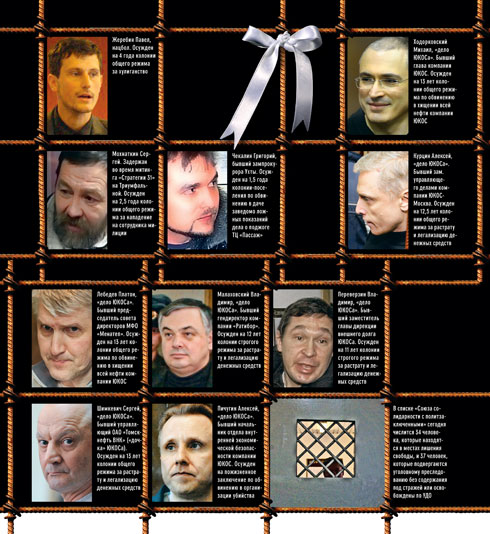
Click in order to increase the example of Gorbachev’s requirements of the December rallies to free the Politicals by the authorities habitually did not notice. But after the December speeches of the opposition, it became possible to give a list with their names personally Russian leaders. At a meeting with the editors of the media on January 18, Prime Minister Vladimir Putin said that he was ready to meet with representatives of the voter league-writers Boris Akunin and Dmitry Bykov. It was the voters League last week that the human rights activists transferred the list of “Union of Solidarity”.

Grigory Chkhartishvili
* Literary pseudonym - Boris Akunin. He told The New Times that he does not really believe in Putin's intentions. But if over time the prime minister nevertheless convinced of the need for such a meeting, then he, of course, will come to Putin. And he will certainly give him a list of political prisoners, as he considers the requirement of their release by one of the most important and fundamental decisions of the December rallies.
Can the first persons of the state solve the problem of political prisoners, not unlocked by its Prosecutor General’s Office - they say, this is its competence? At the end of 1986, Mikhail Gorbachev called Academician Andrei Sakharov, who was then in exile in Gorky, and said: he may return to Moscow. Sakharov in response asked about the release of all political prisoners. The fundamental decision on this was made to the Politburo of the Central Committee of the CPSU, and in January 1987, Gorbachev began to sign decrees on the pardon of Soviet Politicals. “The process dragged on for two years,” says historian Alexander Daniel. -In the field they demanded to write some kind of piece of paper, consent to pardon. It reached the curioses: Valery Sentorov wrote: "I agree to accept a pardon from the State Duma, even if there is a faction of the Bolsheviks in it." But those who refused to write a petition, in the end, were still released. ”
"
But the Constitution does not say that the President of the Russian Federation can have pardon only if the convict himself appeals to him with such a request
"
Dmitry Medvedev, apparently, believes that since then, domestic jurisprudence has changed a lot. Last week, meeting with the students of the journalism department, he stated that a petition from the prisoner was necessary to consider the issue of pardon of Khodorkovsky. But the Constitution does not say that the President of the Russian Federation can have pardon only if the convict himself addresses him with such a request
* Article 89, paragraph c) the Constitution of the Russian Federation: "The President of the Russian Federation Cleaning." Such a norm, however, is contained in the Regulation on the procedure for considering petitions for pardon in the Russian Federation, which was approved by Decree of the President of the Russian Federation No. 1500 of December 28, 2001.
* “Suffering is carried out by issuing the Decree of the President of the Russian Federation on pardon on the basis of the corresponding request of the convicted person or the person who has left the punishment appointed by the court and having an inconsistent criminal record.” So more important is the constitution or presidential decree? The judge of retired Constitutional Court Tamara Morshchakova told The New Times that the Human Rights Council under the President are preparing its proposals for amendments to decree No. 1500 to bring it into line with the Constitution. “There are a number of restrictions in the decree that do not allow citizens to exercise their right to ask for pardon, and the president himself to exercise their authorities to have mercy,” Morshchakova notes. - In particular, we want to include the clause that not only he, but also other citizens can turn to the president to pardon the convict with a petition. Indeed, the Constitution says that “every convict has the right to ask for pardon” and that the president “pardon”. So from the text of the Constitution does not follow that the presentation of a petition personally convicted is a prerequisite. ”