
Translated material
Hell is we
"Lear" by Konstantin Bogomolov
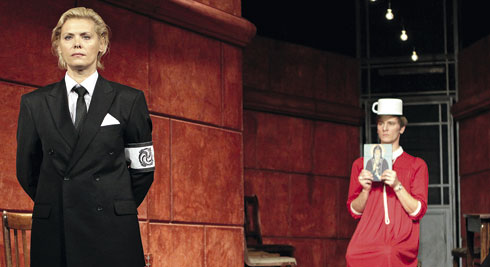
All characters underwent gender castling. Mr. Zarathustra-Tatyana Bondareva; Regan Lirovna Cornwell - Anton Moshechkov executioners and victims. The performance-scandal-“Lear” by Konstantin Bogomolov, set in the “comedian shelter”, came to Moscow from St. Petersburg. The Hall of the Theater Center on a passionate with difficulty accepted everyone who wanted to see the apocalypse with their own eyes Konstantin Bogomolov is engaged in the theater criticism dubbed the “writer directing”. In recent years, this term has firmly entered the modern history of the domestic theater (it has been mastered it for a long time in Europe), giving rise to a galaxy of such writers, representatives of the theater art house. “Lear”, whom Bogomolov put on the stage of the St. Petersburg “comedian shelter”, is a fantastic experiment in the modern Russian theater. The deep scale of the plan, the chosen expressive means, and the ambiguity of metaphors, and the almost reckless courage of stage techniques are striking.
On Granovsky Street , one who is waiting for the next version of the Shakespearean tragedy can pass a ticket: there will be no medieval England here. The place of action is the USSR and Germany, the time is from the threshold of the Great Patriotic War to the victorious May 1945. The literary foundation is from Shakespeare to the gag (from the capital letter “o” - as a surname), including the verses of Shalamov, Marshak and Tselan, texts from the Gospel and Nietzsche. Among the actors, in addition to the “advisable” Shakespearean (“Samuel Yakovlevich” Gloucester, “Semyon Mikhailovich” Kornwell, “George Maximilianovich” Albani), “European Ambassador to our country, Mr. Zarathustra” and “Doctor-Psychiatrist Lunz”. All characters underwent gender castle: women play men and vice versa (mockery of the Shakespearean “globe”). The castling was made as honestly as possible, without any stylization - the actresses are deprived of almost all the sexual characteristics: they have neither makeup nor manicure, it seems that there are not even bras. Men's costumes are the most male, baggy ugly jackets and trousers, the same faceless white shirts with thin shears lagging from thin shaars, men's boots and hair taken in bundles and tails. Men are dressed up in ridiculous Soviet dresses, stockings in elastic bands, decorated with cheap brooches and clips. On the stage there are red-brown wooden panels of the elite nomenclature house “on Granovsky”, the clanging iron elevator of the old Soviet model with an imminent access to the mine, flickering with a neon-blind lamp hanging from high ceilings (artist Larisa Lomakin). The usual atmosphere of the Stalinist empire is violated only by mountains of chips on the floor.
From the first minutes of the performance, a terrible incessant rumble comes from the stage, against which the voices of the actors gain strange barking intonations. However, sometimes they use a microphone, and then the action goes into the genre of government concerts or protocol television portions from Red Square. Members of the "Lyra" Politburo affably waved to the audience, like from the rostrum of the mausoleum. The rumor cuts bravura either Soviet or Nazi march.
 |
Cancer is other Lear himself, King Lear (Rosa Khairullina) is an infernal creature of an incomprehensible gender with an inflamed luster in his eyes and an unhealthy earthy pallor of the skin.
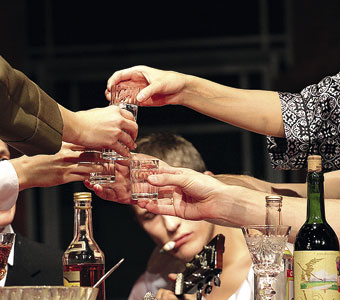
The festive lunch of the Kremlin elite - with the vinegos and olivier, unchanged for Soviet feasts, thick salted cucumbers, steamed boiled potatoes, as well as Georgian wine and “metropolitan” vodka - passes under boring health in honor of the owner of the country, irritably accepting the next confessions in love. Cordelia, as you know, violates this stream of glory, thereby causing the freneliness of the lyre. From that moment on Shakespeare, the drama begins, and Bogomolov has a genuine apocalypse.
Cancer, about the symptoms of which Lear will read in a shaggy decaying Soviet encyclopedia, spreads through the scene with red fat cancers, which will copulate on the paved chairs, click into the thighs of the close -ups and crawl into small boiled tartuses right before our eyes. Metastases are as a metaphor over which Konstantin Bogomolov himself laughs with a satanic laugh, tearing this terrible ruthless plot of decay to unhumetric depths, to black, to the abyss, to the outburst of the intestines.
Actually, so - literally guts out - lives in the play one of the heroes, the samurai species, General Cornwell (Daria Moroz). Before ripping off his stomach, the general with a corkscrew (!) Twist his eyes at the Gluster traitor, and a white muddy liquid will pour from empty eye sockets with a fountain. The lyre placed in a psychiatric hospital, along with the rest of the patients, will eagerly eat his own bowel movements from the plate, and the shone of punitive psychiatry with an impassive voice will read the list of torture used in the institution, from insulin shock to oxygen injection under the skin.
The director seems to lead us through a thin wire above and between the genres- from the grotesque of the Bulgakov varis and black comedies of the absurd to the physiological nightmare of documentary
evidence when consciousness breaks up from pieces from the inability to accommodate the scale of tragedies. And then the lines from Paul Tselan and Varlam Shalamov come to the rescue - poets who returned from the hell of concentration camps and grind their terrible experience into poetry. The poetry of torn nails, trodden gray hair, triumphant stench, canceled shame and everyday betrayals.
"
Our fireworks are more expensive for us than our dead, therefore chips fly again and again, tables are covered with red tablecloths, and rings the glasses filled with vodka ...
"
The feast of the winners with our Soviet people is not customary to walk in this direction, we drank our hell under the altar and with the persistence of the madmen we throw everything and throw new victims there, not ashamed of either the dead or the living. Konstantin Bogomolov tried to pick out the number of the beast from our genetic code, to pull out like a needle from the brain, to hear this growing rumble, to finish this “black milk of dawn” to the last drop. But our salutes are more expensive for us than our dead, so the chips fly again and again, the tables are covered with red tablecloths, the glasses filled with vodka are ringing ... The executioners and victims sitting at the same table not notice neither ripped belly, nor torn languages, nor pierced eyes. The next five-pointed order sparkling with diamonds will stick into the lapel of the jacket, and the throat will break the heart-rending: “I remember that Vaninsky inorth! ..” The feast continues.
Such a fearless and terrible performance cannot do without a team, without people of “one blood”. Konstantin Bogomolov gathered an amazing acting ensemble, in which actors from Moscow and St. Petersburg were connected, striking with courage and professional dignity, with which all circles of hell pass. They read the director on the lips and know exactly what they “die” for.
It is only a pity that Lear lived on the Moscow stage for only three days. So those who were not able to see him in the capital will have to go to St. Petersburg, to the "shelter of the comedian." The Bogomolovsky “Lear” with all its tragedy and doom confirmed the obvious - the theater is free. And the only thing that can threaten this freedom is our fear of her.