
Translated material
The order of the excursion
... Discourse ... - this is a glamor of the spirit.
Victor Pelevin. "Empire B"
We must get involved in discourse.
From radio broadcasts
Having called the glamor and discourse to the two main vampire sciences in the era of Vampire Rule, or the “Ecumenical Empire of Vampires” [1] , which, one must think, refers to the self -eating time, Victor Pelevin expressed his ironic attitude to those smart and incomprehensible terms (according to his own determination) that the current phrase is full of the current phrase, Especially in the so -called intellectual circles. Moreover, the use of such words without understanding what they mean and in what context arose, that is, as simple magic formulas, becomes fundamental for the “artistic party” [2] , which had developed in the 1990s and continues to exist today. Meanwhile, the popularity of “discourse” outside the sphere of humanitarian knowledge itself, its brilliant journalistic career, so to speak, are explained by nothing more than the novelty in the approaches of linguists and philosophers to study the problems designated by this word.
It will not be an exaggeration to say that the works of Michel Foucault played a decisive role in determining the discourse of residence in modern culture. Of course, there is a purely linguistic understanding of the problem. Discourse may indicate that speech is included in the communicative situation and, therefore, is due to the social context; This expands the idea of speech activity with its initial binding to the individual. On the other hand, in the dialogue interaction, characteristic of such a situation, the emphasis is placed precisely on interaction, that is, the dynamic aspect of communication is detected and fixed using the discourse. However, only when the “speech” [3] , having freed himself from a particular carrier, was put in a variable connection with the authorities and desire, and when the “discourse” began to be successfully applied in the analysis of a diverse historical material, this term truly took possession of the minds of contemporaries.
Speaking briefly, discourse is ways of producing knowledge that are inseparable from social practices, forms of subjectivity and power relations that permeate this knowledge from the inside. Predate attention is paid to the so -called statements (énoncé), which are radically impersonal: statements are elements of the discursive formations themselves, they cannot be attributed to either individuals or even subjects of cognition. The development of knowledge is understood not only as the deployment of certain rules and patterns of the formation of objects, but also as an intermittent process, free from the installation for increased and accumulation. Instead of establishing the genealogy of ideas, that is, their origin and continuity, a painstaking archaeological work aimed at identifying the totality of power and cognitive practices that form the subject itself, and in its concrete historical guise.
I will add that with this approach a compatible idea of the death of the author. Foucault attributes the author to the mechanisms of control over the discourse: this figure, freed from psychological and personal associations, is primarily embodied by the connectedness, designed to muffle such anxious properties of discourse as eventuality and accident. “The author is that the form of fiction depriving peace, the forms of its unity, nodes of coherence, attachment to reality” [4] . It is no coincidence that for Foucault the author is a function indicating the historical and changing nature of literature as one of the social institutions.
In the light of all that has been said, the article with the following name: “The cognac discourse of Vladimir Dubosarsky” [5] looks especially intriguing. Maybe we are talking about what was affected in the artist’s paintings and why are these same paintings only a private form of recording along with others possible? Alas. The artist notes that the heroes of the paintings created by him together with Vinogradov do not drink. They, on the contrary, are watching. Moreover, the only thing that unites cognac and art is the understanding of both as practice. “It is better to keep silent and accumulate a feeling” [6] , ”Dubosarsky advises us. Agree. But only what has Foucault?
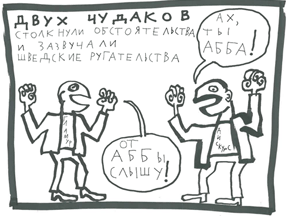
Apparently, you have to agree with a rude, but accurate content with a joke: discourse is a bazaar. In other words, the speech is in the most traditional sense of the word. Or a statement, but again without those complex meanings that humanitarian thought brought here. Well, when we are faced with a heading like “brief discourse in Swedish curses”, it becomes clear that this is the completely outsider, namely a rather flat “excursion”. In a word, excursion, discourse, what, in essence, the difference, the main thing is that on a foreign affairs, and even this glossy raid ...
PS The article is also published in the 1st issue of the magazine "Dialogue of the Arts" ("DI") for 2012. I express my sincere gratitude to Leah Adashevskaya, the editor of Di, for this initiative. - E.P. Drawings by George Litichevsky[1] Pelevin c . Empire V. M.: Eksmo, 2006. S. 272.
[2] Fry m . Discourse // Art Azbuka. Dictionary of contemporary art, ed. M. Fray ( http://azbuka.gif.ru/alfabet/d/discourse/ ).

[3] or speech practices in the broad sense of the word, and this is one of the options for the translation of the “discourse” into Russian.
[4] Foucault m . Discourse order ( http://krotov.info/lib_sec/21_f/fuk/o_43.htm ).
[5] http://www.simplewinenews.ru/degustaciya/konyachnyj-diskurs-vladimira-dubosarskogo.html
[6] Ibid.